Pinyin: Qingmuxiang
Aliases
Madoulinggen, Doulinggen, Qingtengxiang.
Source
1. For pneumonia: Renshen 6 g, decoct in water and take orally.Aristolochia debilisRoot of *Seib. et Zucc*.
Botanical Description
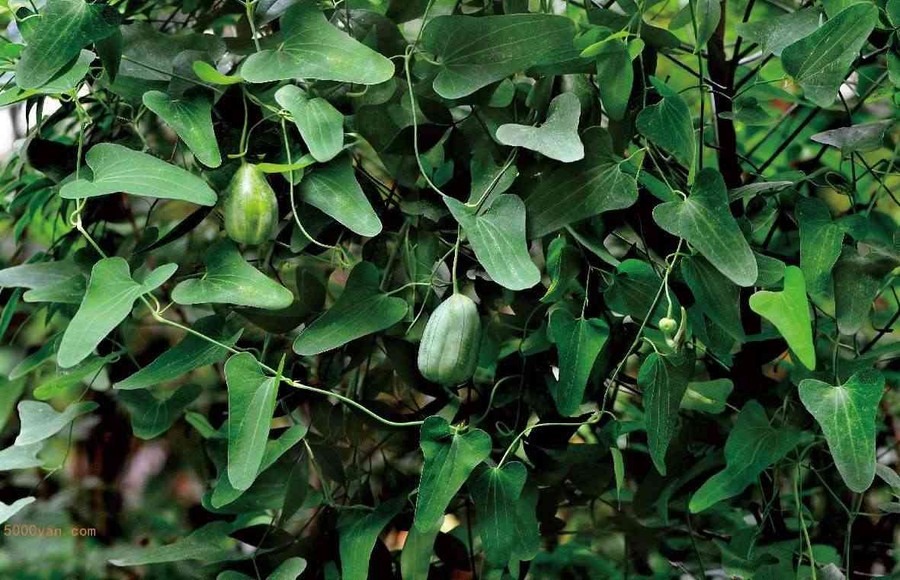
Herbaceous vine. Root cylindrical. Stem slender, glabrous (hairless). Leaves alternate; petiole slender, leaf blade ovate-triangular, oblong-ovate or hastate, apex obtuse-rounded or shortly acuminate, base cordate, lateral lobes rounded, drooping or slightly spreading; basal veins 5-7, veins prominent on both surfaces. Flowers solitary or 2 clustered in leaf axils; bracteoles triangular, easily deciduous; perianth base swollen and spherical, narrowing upward into a long tube, tube mouth expanded into a funnel shape, yellow-green, with purple spots at the mouth, glandular hairs inside; limb very short on one side, gradually extending into a ligule on the other; ligule ovate-lanceolate, apex obtuse; anthers attached near the base of the gynostemium; ovary cylindrical, 6-ribbed; gynostemium apex 6-lobed, slightly papillose, lobe apex obtuse, extending downward to form an undulating ring. Capsule nearly spherical, apex rounded and slightly concave, 6-ribbed, dehiscent from base upward along the septa into 5 valves; fruit stalk often tearing into 6 strips. Seeds flat, obtuse-triangular, margin with white membranous broad wing. Flowering period July to August, fruiting period September to October.
Habitat and Distribution
Born in valleys, ditches, and damp shady areas, or in thickets on mountain slopes. Distributed in Shandong, Henan, and areas south of the Yangtze River basin.
Harvesting and Processing
10-11 months when stems and leaves wither, dig up the roots, remove fibrous roots and soil, and dry in the sun.
Medicinal Properties
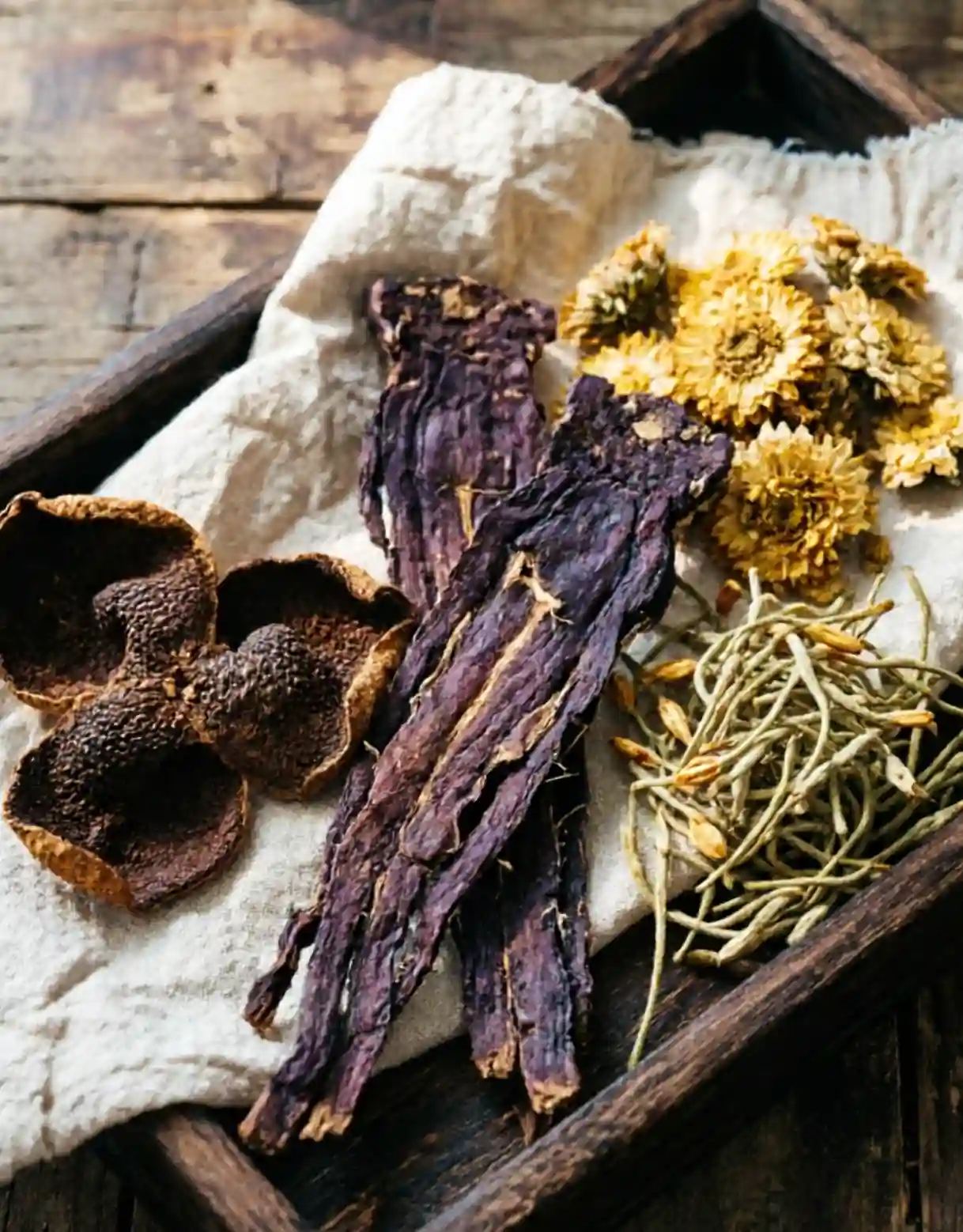
This product is cylindrical or slightly flat, somewhat curved, 3-10 cm long, 0.5-1.5 cm in diameter. The surface is yellowish-brown or grayish-brown, with longitudinal wrinkles and rootlet scars. The texture is hard and brittle; on the fractured surface, the cambium ring is faintly visible, the bark is pale yellow, the medullary rays are broad and milky white, the xylem bundles are pale yellow and arranged radially, and the vessel pores are distinct. The aroma is characteristic, and the taste is bitter.
Chemical Constituents
This product mainly contains volatile oil, with the main component being aristolone, as well as aristolochic acid, allantoin, debilic acid, magnoflorine, and aristolochic acid A and C.
Pharmacology
Inhibits smooth muscle movement; analgesic and anti-inflammatory; anti-pathogenic; lowers blood pressure; sedative; emetic; relaxes striated muscle, etc.
Properties and Channel Entry
Acrid, bitter, cold, with mild toxicity. Enters the Lung, Stomach, and Liver channels.
Functions and Indications
Promotes Qi circulation and alleviates pain, resolves toxicity and reduces swelling, calms the Liver and lowers blood pressure. Indications: chest, rib, epigastric, and abdominal pain, hernia pain, enteritis, dysentery with abdominal pain, cough with phlegm and wheezing, snake and insect bites, abscesses, boils, and sores, eczema, skin itching, hypertension.
Dosage and Administration
Oral: Decoct 3-9 g; grind into powder 1.5-2 g, 2-3 times daily. External: Appropriate amount, grind into powder for topical application; or apply with the juice.
Precautions and Contraindications
Patients with Spleen and Stomach deficiency cold should use with caution
Prescriptions
1. For enteritis, abdominal pain, and dysentery: Qingmuxiang 9 g, Binglang 4.5 g, Huanglian 4.5 g. Grind together into a fine powder, take with warm boiled water. (Modern Practical Chinese Medicine) 2. For heatstroke and abdominal pain: Fresh Qingmuxiang root 9-15 g, squeeze juice, take with warm boiled water; also use Qingmuxiang root 3-6 g, grind into powder, take with warm boiled water. (Jiangxi Herbal Medicine) 3. For toothache: A piece of fresh Qingmuxiang, place on the painful tooth and bite it. (Northeast Commonly Used Chinese Herbal Medicine Manual) 4. For women with incessant bleeding during urination: Qingmuxiang root and Ciji root, 30 g each. Pound into a fine powder. Before each meal, take 6 g with Danggui wine. (Shenghui Fang) 5. For axillary odor: Cut Qingmuxiang into thick slices, soak in good vinegar overnight, place under the armpit several times, and it will be cured. (Weisheng Yijian Fang)