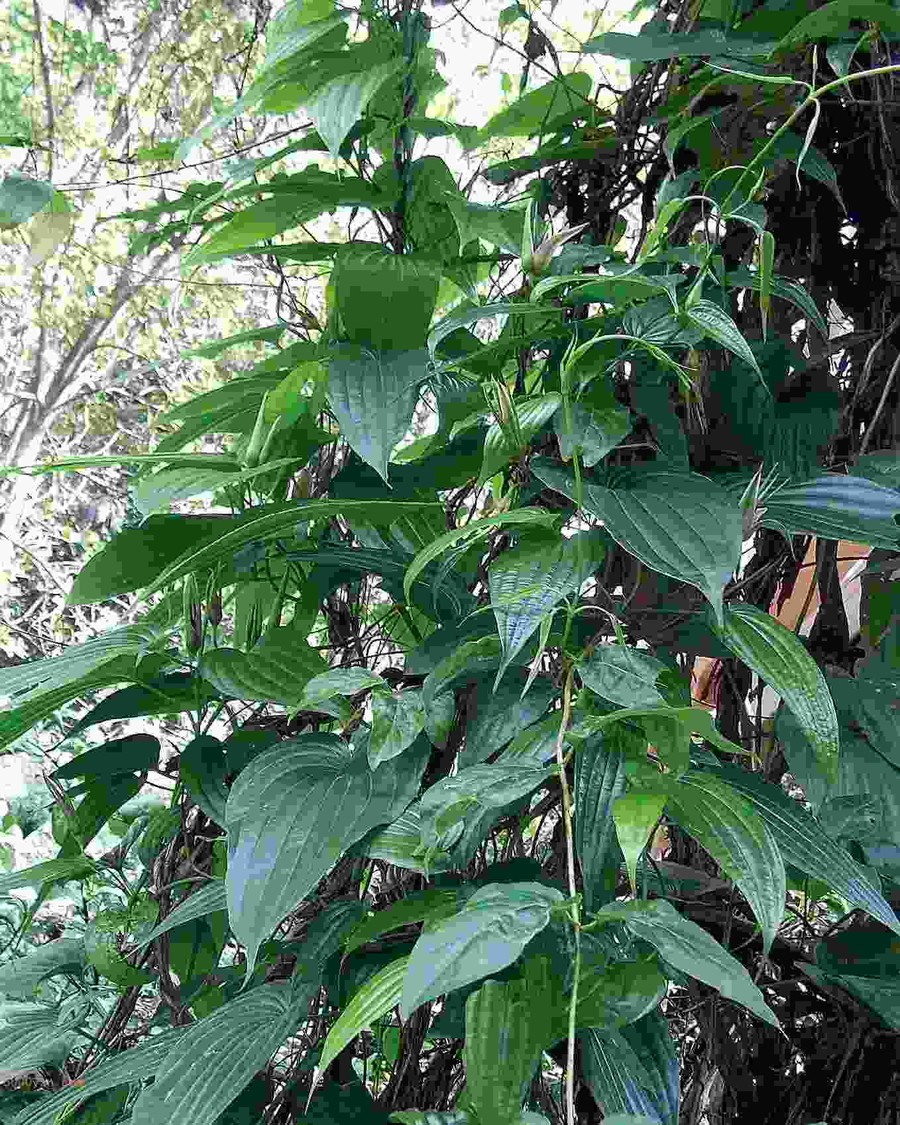
Pinyin: Baibu
Aliases
Baibu gen, Yuxiao, Ye Tianmendong
Source
Stemona root from the Stemonaceae plant Stemona tuberosa Lour.Stemona tuberosaDried root tuber of *Wikstroemia indica* (Lour.) C.A. Mey.
Botanical Description
Perennial twining herb, up to 5 m tall. Root tuber fleshy, fusiform or cylindrical; stem twining. Leaves usually opposite, petiole 3-10 cm long; leaf blade broadly ovate, base shallowly cordate, margin entire or slightly undulate; veins 7-15. Pedicel axillary, not attached to the midvein of the leaf; flowers solitary or 2-3 in a raceme, yellow-green with purple stripes; anther appendages subulate or lanceolate. Capsule obovoid and compressed. Flowering period: May-June.
Habitat and Distribution
This text is a habitat and distribution description, not a prescription or formula
Harvesting and Processing
Harvested in spring and autumn, remove fibrous roots, wash clean, blanch briefly in boiling water or steam until no white core remains, remove, and dry in the sun.
Medicinal Properties
This product is elongated spindle-shaped or elongated, 8-24 cm long, diameter 0.8-2 cm. The surface is pale yellowish-brown to grayish-brown, with shallow longitudinal wrinkles or irregular longitudinal grooves. The texture is firm; the cut surface is yellowish-white to dark brown, with a relatively large central column and a whitish pith; taste is bitter.
Chemical Constituents
This product primarily contains stemonine, protostemonine, tuberostemonine, didehydrotuberostemonine, sessilistemonine, stemonine, tuberostemospironine, stigmasterol, benzoic acid, daucosterol, sesamin, and others.
Pharmacology
Anti-pathogenic microorganisms; anti-parasitic; antitussive, expectorant, and antiasthmatic; has weak central nervous system depressant effects; toxic.
Properties and Channel Entry
Bitter, sweet, and slightly warm. Enters the Lung channel.
Functions and Indications
Moistens the Lungs, directs Qi downward, and stops cough; kills parasites and lice
Dosage and Administration
Internal: decoct 3-10 g in water for oral administration
Precautions and Contraindications
Those with weak Spleen and Stomach should use with caution.
Prescriptions
1. For sudden cough: fresh ginger juice and Baibu (Stemona root) juice combined, decoct together; take 2 ge orally (from Zhouhou Fang). 2. For cough of 30 years: Baibu 10 jin, pound to extract juice, decoct into a syrup; take 1 fangcunbi, three times daily (from Qianjin Yaofang). 3. For infantile pertussis (whooping cough): honey-fried Baibu and Xiakucao (Prunella spike) 9 g each, decoct in water and take orally (from Qingdao Zhongcaoyao Shouce). 4. For pulmonary tuberculosis cavity: honey-fried Baibu and Baiji (Bletilla rhizome) 12 g each, Huangqin (Scutellaria root) 6 g, Huangjing (Polygonatum rhizome) 15 g, decoct and take (from Anhui Zhongcaoyao). 5. For lung excess with nasal congestion and loss of smell: Baibu 60 g, Kuandonghua (Tussilago flower), Beimu (Fritillaria bulb, core removed), Baiwei (Cynanchum root) 30 g each. Grind the above four ingredients into a powder; take 3 g each time, mixed with rice water (from Shengji Zonglu, Baibu San).