Pinyin: Chonglou
Aliases
Zaoxiu, Chongtaigen, Caoheche, Dengtaiqi, Zhitouhua
Source
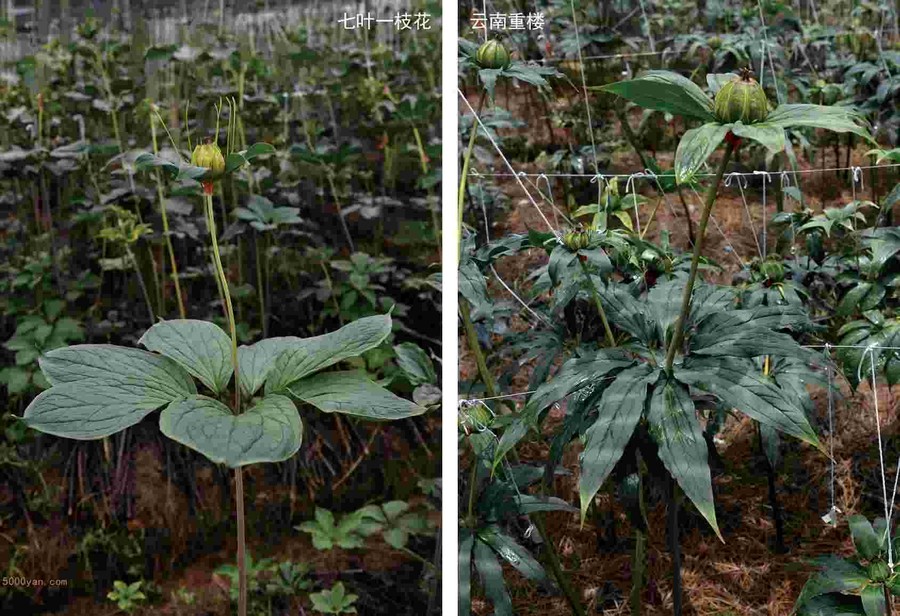
Liliaceae plant *Paris polyphylla* Smith var. *yunnanensis* (Franch.) Hand.-Mazz.Paris polyphyllaSmith var.yunnanensis(Franch.) Hand.-Mazz. or QiyeyizhihuaParis polyphyllaSmith var.chinensisDried rhizome of (Franch.) Hara.
Botanical Description
1. Yunnan Chonglou: Perennial herb, 30-100 cm tall. Rhizome thick, with distinct nodes. Stem erect, cylindrical. Leaves 6-10 in a whorl; leaf blades lanceolate, ovate-oblong to obovate. Outer perianth segments green, lanceolate or long-ovate; inner perianth segments yellow, linear and slightly lanceolate, 2-6 mm wide above the middle, 1/2 to nearly as long as the outer segments; stamens 8-10, arranged in 2-3 whorls, anthers 1-1.5 cm long, filaments shorter than anthers, connective appendage 1-2 mm long. Flowering period June-July, fruiting period September-October.
1. For pneumonia: Renshen 6 g, decoct in water and take orally. 2. Internal use: decoct 3-10 g, large dose 10-30 g.
Habitat and Distribution
Grows under forests at an altitude of 800-3200 m. Distributed in Sichuan, Guizhou, Yunnan, and southeastern Tibet.
Harvesting and Processing
Harvested in autumn, remove the fibrous roots, wash clean, and sun-dry.
Medicinal Properties
This product is nodular, flat-cylindrical, slightly curved, 5-12 cm long, 1.0-4.5 cm in diameter. The surface is yellowish-brown or grayish-brown, with the outer bark peeled off revealing white color; densely covered with layered, raised rough annular lines, with prominent nodules on one side, each nodule bearing an elliptical concave stem scar, and sparse fibrous roots or wart-like root scars on the other side. The apex has scale leaves and stem remnants. Texture is firm and solid; the cut surface is flat, white to light brown, powdery or horny. Odor: faint; Taste: slightly bitter and numbing.
Chemical Constituents
This product mainly contains Chonglou saponin I, Chonglou saponin II, Chonglou saponin VI, and Chonglou saponin VII.β- Ecdysone, Paris polyphylla saponin, and other constituents.
Pharmacology
It has antibacterial, anti-tumor, spermicidal, anti-asthmatic, hemostatic, and uterine contraction-enhancing effects; it is toxic.
Properties and Channel Entry
Bitter, slightly cold, with mild toxicity. Enters the Liver channel.
Functions and Indications
Clears Heat and resolves toxicity, reduces swelling and alleviates pain, cools the Liver and calms fright. Mainly indicated for carbuncles, swellings, sores, and toxins; swollen throat and throat obstruction; breast abscess; snake and insect bites; traumatic pain from falls and bruises; and Liver-heat-induced convulsions.
Dosage and Administration
Oral: decoct in water, 3-10 g; grind into powder, 1-3 g per dose
Precautions and Contraindications
Contraindicated in deficiency-cold patterns, Yin patterns, external ulcers, and during pregnancy.
Prescriptions
1. For acute mastitis and breast cancer: Chonglou 9 g, Shengjiang 3 g. Decoct in water, add a small amount of white wine as a guide, and take orally. Externally, apply an appropriate amount of mashed Qin Cai (celery) to the affected area. (Rural Commonly Used Herbal Manual) 2. For throat obstruction: Chonglou rhizome 0.6 g, grind into powder and swallow. (Zhejiang Folk Herbal Medicine) 3. For sore throat: Chonglou 6 g, Jiegeng and Niubangzi 9 g each. Decoct in water and take orally. (Huashan Materia Medica) 4. For sprain and bruising with swelling: Chonglou, grind with wine into a thick juice, apply to the injured area several times daily. (Rural Commonly Used Herbal Manual) 5. For chronic bronchitis: Chonglou 6 g, grind into powder. Separately, decoct Dilong 9 g and Yan Fu Mu 30 g in water, and use the decoction to take the powder. (New Compilation of Southern Zhejiang Herbal Medicine)