Pinyin: Congbai
Aliases
Congjingbai, Congbaitou.
Source
Liliaceae plant Allium fistulosumAlliumfistulosumL.'s dried bulb.
Botanical Description
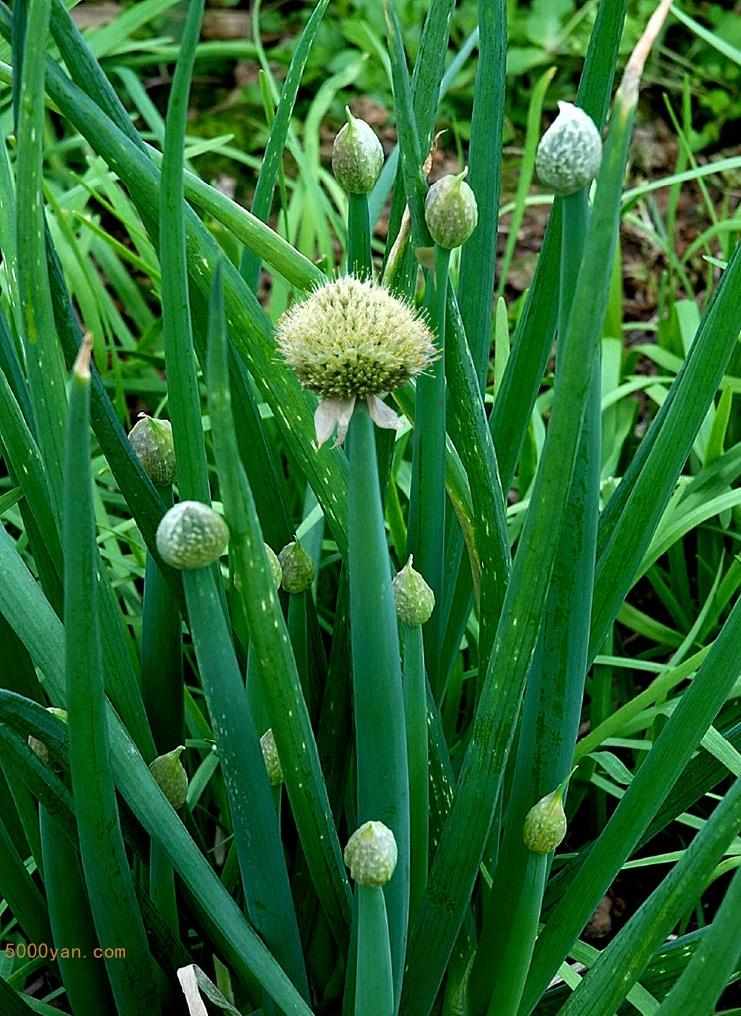
Herbaceous perennial, up to 50 cm tall. Usually clustered, the entire plant has a pungent odor, and when broken, it exudes a pungent mucus. Fibrous roots fascicled, white. Bulb cylindrical, slightly enlarged at the apex, with layered scale leaves, white, with white longitudinal striations on the surface. Leaves basal; leaf blades cylindrical, hollow, approximately 45 cm long, 1.5-2 cm in diameter, apex acute, green, with longitudinal striations; leaf sheaths light green. Scape approximately equal in length to the leaves; spathe white, 2-lobed, umbel globose. Many flowers, densely arranged; pedicels equal to or 2/3 the length of the perianth, without bracts; perianth campanulate, white, perianth segments 6, narrowly ovate, apex acuminate, with reflexed mucronate tips; filaments 1.5-2 times as long as the perianth segments, subulate, connate at base and adnate to the perianth. Capsule trigonous. Seeds black, triangular-semiorbicular. Flowering period July to September, fruiting period August to October.
Habitat and Distribution
Cultivated throughout various regions in China.
Harvesting and Processing
Harvested in summer and autumn, dug out, remove fibrous roots, leaves, and outer membrane, use fresh.
Chemical Constituents
This product primarily contains polysaccharides, fiber, carotene, vitamins, linoleic acid, and allicin, among other components.
Pharmacology
Has antibacterial, antiprotozoal, vermifuge, sedative, analgesic, diaphoretic, expectorant, and diuretic effects.
Properties and Channel Entry
Acrid, warm. Enters the Lung and Stomach channels.
Functions and Indications
Disburse the Exterior, unblock the Yang, resolve toxicity, and kill parasites
Dosage and Administration
Oral: decoct in water, 9-15 g; or decoct in wine. For congee, use 15-30 g of fresh product each time. External use: appropriate amount, pound and apply, stir-fry and apply hot, decoct and wash, or mix with honey or vinegar for application.
Precautions and Contraindications
For those with exterior deficiency and excessive sweating, use with caution.
Prescriptions
1. For breast distension and pain with blocked lactation: appropriate amount of Congbai (scallion white), pound into a paste, add a little salt, fry in a pan to form a cake, and apply to the affected area. (National Compilation of Chinese Herbal Medicine) 2. For seasonal epidemic disease with headache and fever: twenty roots of scallion white with the root attached. Cook with rice into porridge, add a little vinegar, eat while hot to induce slight sweating for relief. (Jisheng Milian) 3. For stomach pain, hyperacidity, and indigestion: 4 large scallion heads, 120 g brown sugar. Mash the scallion heads, mix with brown sugar, place on a plate and steam until cooked. Take 9 g three times daily. (Inner Mongolia Selected Materials on New Chinese Herbal Medicine Therapies) 4. For cholera with restlessness and inability to sleep peacefully: twenty stalks of scallion white, twenty jujubes. Boil in 3 sheng of water until 2 sheng remain, take in a single dose. (Zhouhou Fang) 5. For difficult urination and lower abdominal distension: 3 jin of scallion white. Finely chop, stir-fry until hot, wrap in a cloth. Divide into two portions, alternately apply hot to the area below the navel. (Benshi Fang)