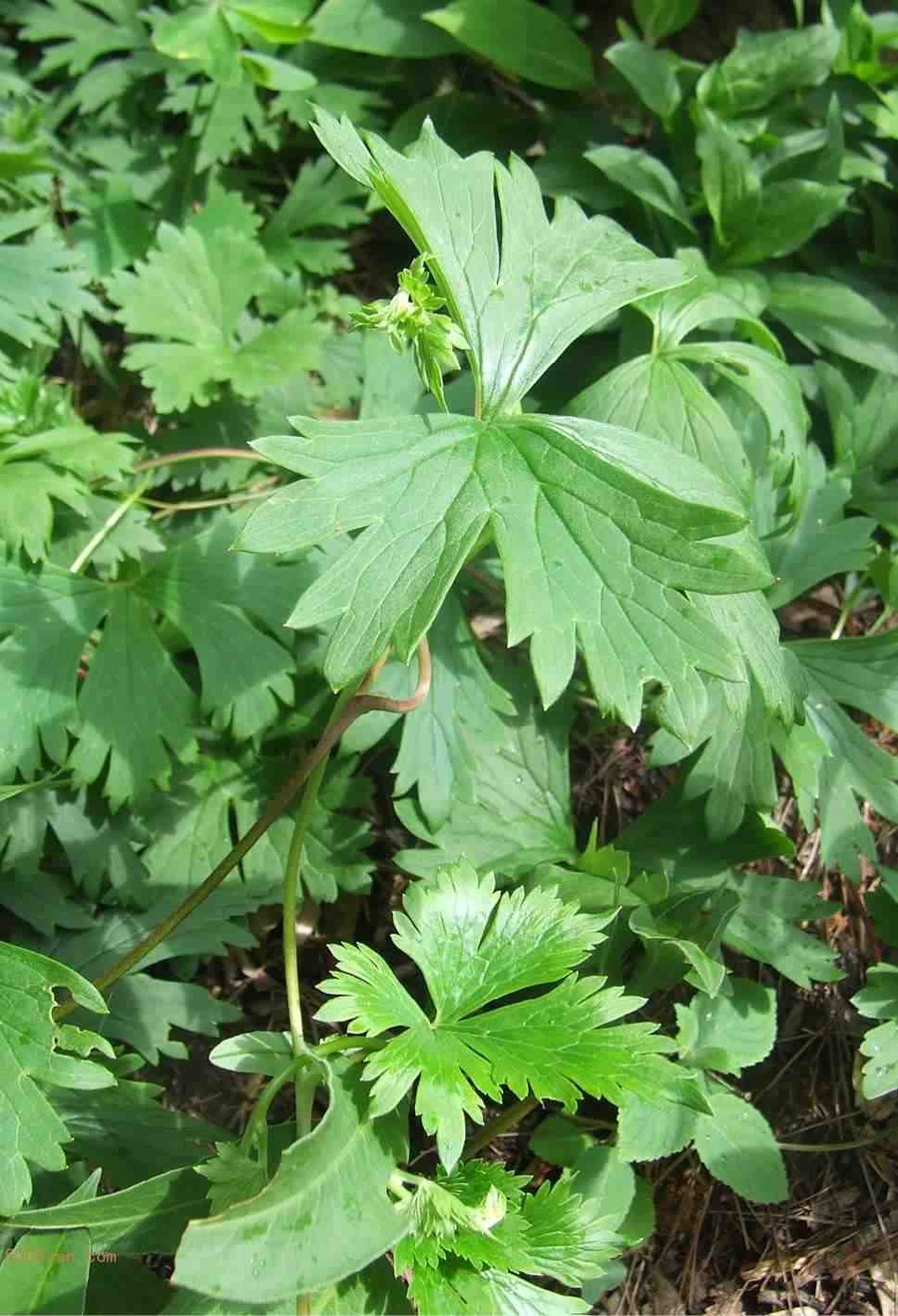
Pinyin: Chuanwu
Aliases
Chuanwutou, Wuhui, Caowu.
Source
Ranunculaceae plant AconitumAconitum carmichaeliiDried mother root of *Wikstroemia indica* (L.) C.A. Mey.
Botanical Description
Perennial herb, 60-150 cm tall. Root tuber obconical, lateral roots of cultivated plants usually thickened, outer bark dark brown; stem erect, sparsely covered with reflexed short pubescence above the middle. Leaves alternate; lower stem leaves wither at flowering, middle leaves with long petioles; petioles sparsely pubescent; leaf blade pentagonal, base shallowly cordate, 3-parted nearly to base, central segment broadly rhombic, obovate-rhombic or rhombic, apex acute or shortly acuminate, nearly pinnatifid, secondary pinnae in 2 pairs, obliquely triangular, with 1-3 teeth or sometimes entire; lateral segments unequally 2-parted, margins of each segment coarsely dentate or incised, adaxially sparsely strigose, abaxially usually only sparsely strigose along veins, leathery or papery. Raceme terminal; rachis and pedicels with reflexed appressed short pubescence; lower bracts 3-lobed, upper bracts lanceolate; bracteoles borne on lower to middle part of pedicel; flowers bisexual, zygomorphic; sepals 5, petaloid, upper sepal galeate, 2-2.5 cm high, 1.7-2.2 cm from base to beak, lower margin slightly concave, beak inconspicuous, lateral sepals blue-purple, externally short pubescent; petals 2, limb about 1.1 cm long, lip about 6 mm long, slightly emarginate, spur usually coiled, glabrous; stamens numerous, filaments with 2 small teeth or entire, glabrous or sparsely hairy; carpels 3-5, pubescent, rarely glabrous. Follicle. Seeds numerous, trigonous, both surfaces densely transversely membranous-winged. Flowering August-September, fruiting September-October.
Habitat and Distribution
It grows on mountain slopes with grassy vegetation or in shrub thickets. It is distributed in southern Liaoning, Shaanxi, Gansu, Shandong, Jiangsu, Anhui, Zhejiang, Jiangxi, Henan, Hubei, Hunan, northern Guangdong, Guangxi, Sichuan, Guizhou, and Yunnan. It is mainly cultivated in Sichuan, Shaanxi, Hubei, Hunan, Yunnan, and other regions.
Harvesting and Processing
Harvested from late June to early August, remove above-ground stems, leaves, lateral roots, fibrous roots, and sediment, then sun-dry.
Medicinal Properties
This product is irregularly conical in shape, slightly curved, often with a remnant stem at the apex, and the middle part mostly bulges to one side, measuring 2-7.5 cm in length and 1.2-2.5 cm in diameter. The surface is brownish-brown or grayish-brown, wrinkled, with small tuberous lateral roots and traces of detached branch roots. The texture is firm and solid; the cross-section is off-white or light grayish-yellow with a polygonal cambium ring pattern. Odor: faint; Taste: spicy, numbing on the tongue.
Chemical Constituents
This product primarily contains aconitine, mesaconitine, beiwutine, hypaconitine, mesaconitine, chuanwu base A, isotalatizidine, talatisamine, and others.
Pharmacology
Anti-inflammatory and analgesic effects; lowers blood sugar; anticancer; cardiotonic; local anesthesia, etc.
Properties and Channel Entry
Acrid, bitter, hot; highly toxic. Enters the Heart, Liver, Kidney, and Spleen channels.
Functions and Indications
Expels Wind and eliminates Dampness, warms the channels and alleviates pain
Dosage and Administration
Oral: decocted in water, 3-9 g; or ground into powder, 1-2 g; or made into pills or powders. For oral use, it must be processed before administration; when used in decoctions, it should be decocted first for 1-2 hours to reduce its toxicity. External use: appropriate amount, ground into powder and sprinkled, or mixed for topical application. Generally used after processing.
Precautions and Contraindications
For raw product, internal use should be used with caution; contraindicated during pregnancy; incompatible with Banxia, Gualou, Gualouzi, Gualoupi, Tianhuafen, Chuanbeimu, Zhebeimu, Pingbeimu, Yibeimu, Hubeibeimu, Bailian, and Baiji.
Prescriptions
1. For migraine and headache: Chuanwu and Tiannanxing in equal parts. Grind into powder. Mash scallion white with roots, mix with the powder, and apply to the temple area. (From Weisheng Yijian Fang) 2. For head wind: Chuanwu and Tiannanxing in equal parts, grind into fine powder. Take 1.5 g each time, with one large bowl of water, one white plum, and five slices of ginger, decoct until reduced to one-fifth, then take orally. (From Baiyi Xuan Fang) 3. For heart pain radiating to the back, and back pain radiating to the heart: Wutou 0.3 g (roasted), Chishizhi 30 g, Ganjiang 30 g, Fuzi 15 g (roasted), Shujiao 30 g. Grind the five ingredients into powder, form into pills with honey, each pill the size of a wutong seed. Take one pill before meals, three times daily. If no effect, gradually increase the dose. (From Jingui Yaolue: Wutou Chishizhi Wan) 4. For stomach cold with intestinal heat, abdominal distension, and diarrhea with dysentery: Wutou (peeled, remove the navel, use raw) 15 g, Zhizi (peeled) 0.3 g, Ganjiang (use raw) 0.3 g. Grind the three ingredients into fine powder, mix with fresh ginger juice to form pills, each pill the size of a wutong seed. Take seven pills each time, with warm wine, before meals, twice daily. (From Shengji Zonglu: Miaoying Wan) 5. For carbuncles, abscesses, and swollen toxins: Chuanwu (stir-fried) and Huangbai (stir-fried) 30 g each. Grind into powder, mix with saliva and apply to the lesion, leaving the center open. When dry, moisten with rice-washing water. (From Seng Shen Ji Fang)