Pinyin: Siyeshen
Aliases
Shanhaoluo, Tudangshen, Tongrucao.
Source
Campanulaceae plant Codonopsis lanceolata.Codonopsis lanceolataDried root of (Sieb.et Zucc.) Tratv.
Botanical Description
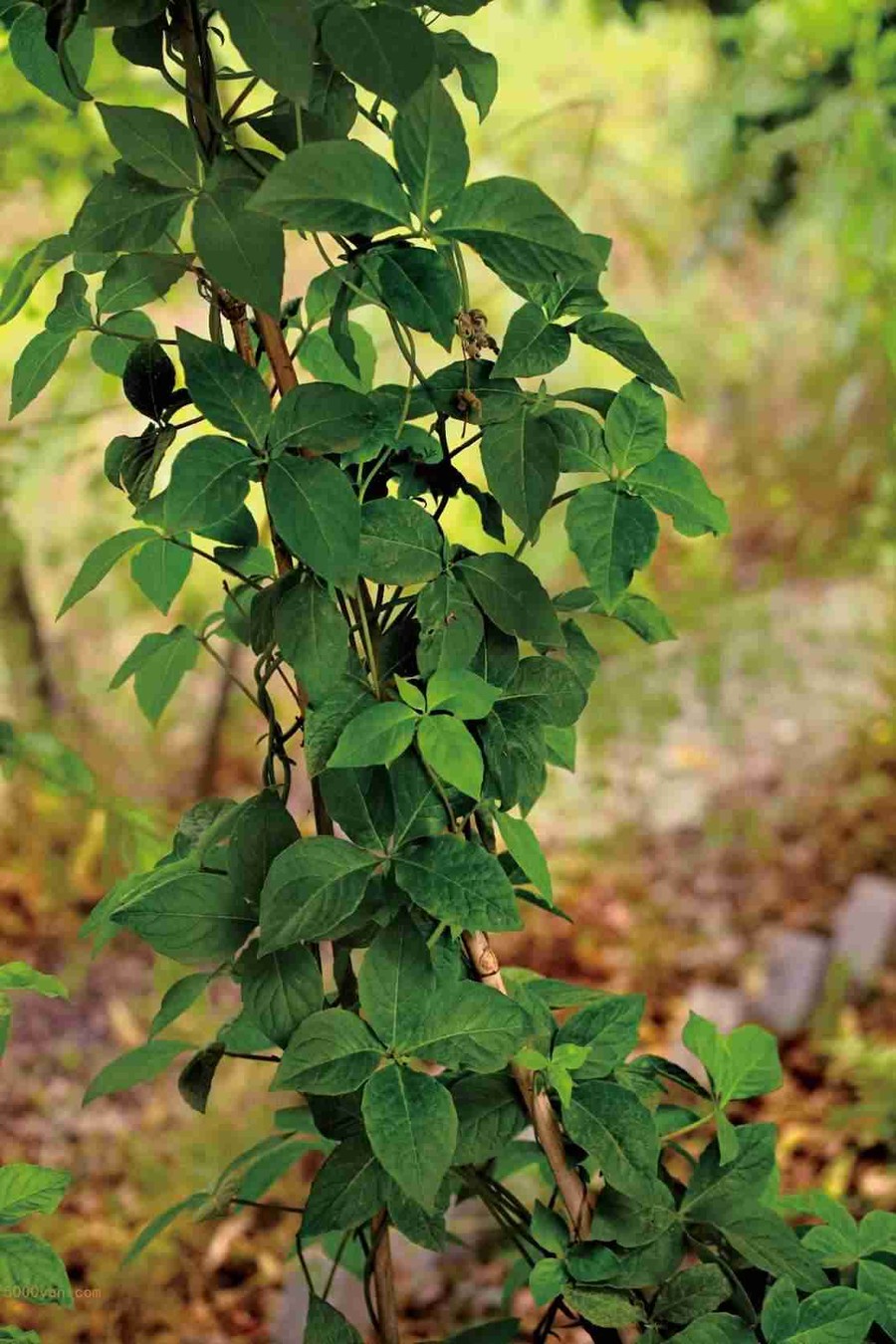
Perennial twining herb, reaching over 2 m in length. The entire plant is glabrous (hairless), rich in white latex, with a peculiar fishy odor; it has numerous short branches. The root is thick and robust, fusiform or nearly conical, with rough bark, grayish-brown to earthy yellow, and sparse annular rings near the upper part. Leaves on the main stem are alternate, lanceolate or rhomboid-narrowly ovate, small; leaves at the tips of branchlets are usually 2-4 clustered, appearing opposite or whorled, with short petioles; leaf blades are rhomboid-ovate, narrowly ovate, or elliptic, 3-10 cm long, 1.3-4.5 cm wide, usually entire or with sparse undulate teeth. Flowers are solitary or paired at the tips of branchlets, with short pedicels; calyx 5-lobed, lobes ovate-lanceolate, 1.5-2 cm long, 5-8 mm wide, green; corolla broadly campanulate, about 2 cm in diameter, 5-lobed, lobes recurved at the apex, yellowish-green, with purple-brown spots inside; stamens 5, filaments short and thick; ovary semi-inferior, stigma 3-lobed. Capsule is obconical, with persistent calyx. Seeds have membranous wings. Flowering and fruiting period: July-August.
Habitat and Distribution
Grows in damp areas of mountain ravines and among shrubs in the wild. Mainly produced in Northeast, North, East, Central South, and various regions of China.
Harvesting and Processing
Harvested and excavated from July to August, washed clean, used fresh or sliced and dried in the sun.
Medicinal Properties
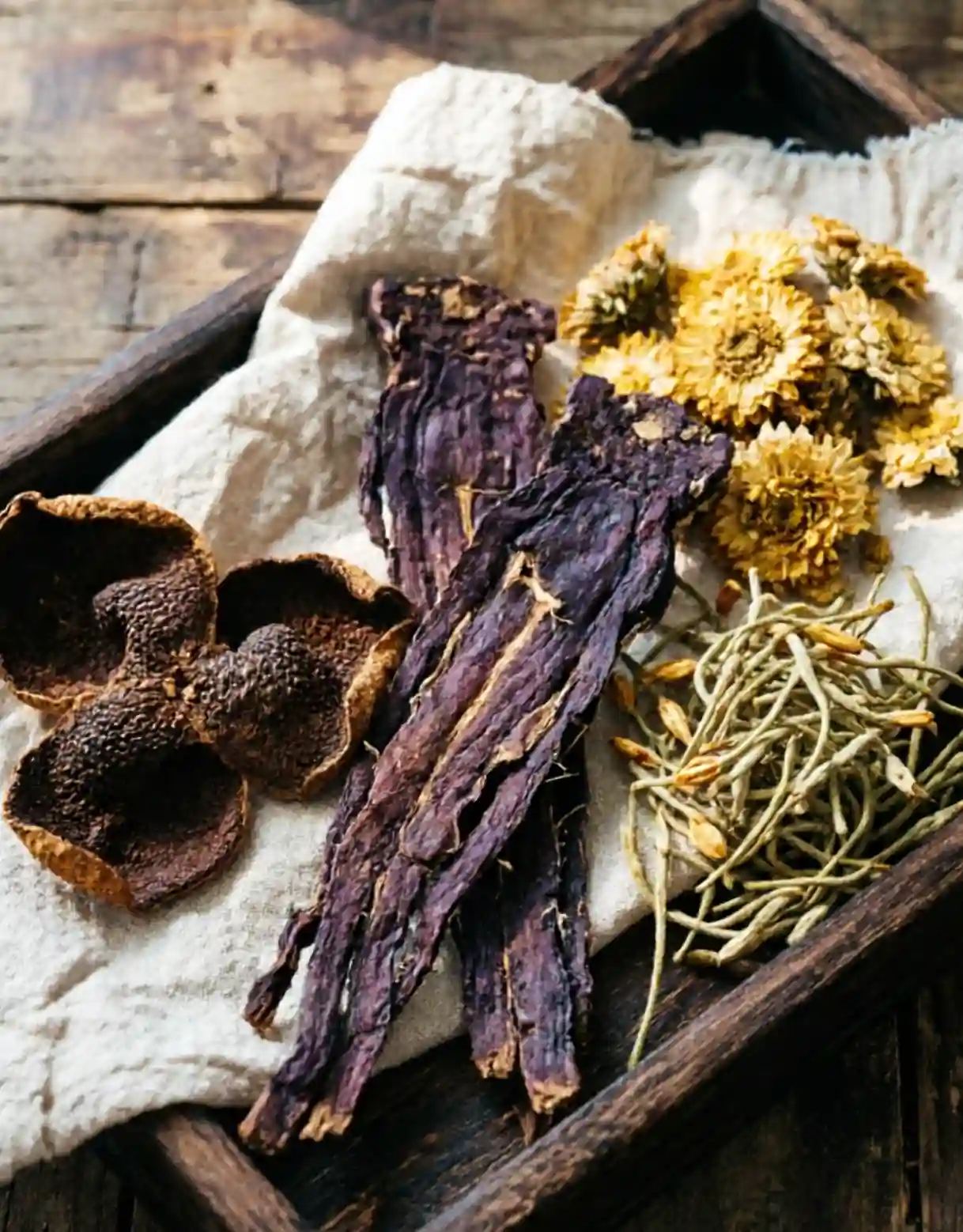
Root conical or fusiform in shape, 15-30 cm long, with a slender and long rhizome at the apex bearing relatively dense annular striations. The main root is relatively long, twisted and not straight, with a yellowish-brown surface, annular striations on the upper part, and longitudinal striations on the lower part. The texture is hard and brittle; the cross-section is slightly flat, with an obvious cambium ring and yellow xylem. The odor is distinctive; the taste is bitter and slightly pungent.
Chemical Constituents
This product mainly contains triterpenoid saponins, codonoside A, codonoside B, codonoside C, alkaloids, volatile oils, and other components.
Pharmacology
Sedation, anticonvulsant, and analgesic effects; improves impairments in memory acquisition, memory retrieval, and memory consolidation caused by drugs; anti-fatigue, can lower blood pressure and stimulate respiration; anti-tumor, antioxidant, antibacterial, antitussive, etc.
Properties and Channel Entry
Sweet, pungent, neutral. Enters the Spleen and Lung channels.
Functions and Indications
Tonifies Qi and nourishes Yin, resolves toxicity and reduces swelling, expels pus, and promotes lactation. Indications: fatigue and lack of strength, dizziness and headache, lung abscess, breast abscess, intestinal abscess; furuncles, sores, and toxic swellings, tonsillitis, scrofula, postpartum insufficient lactation, leukorrhea, and venomous snake bites.
Usage
Dosage
Oral: decoction, 15-60 g; fresh product 45-120 g. External: appropriate amount of fresh product, mashed for topical application.
Precautions and Contraindications
For external contraction at the early stage, those without sweating should use with caution; it is incompatible with Lishu (Radix et Rhizoma Veratri).
Prescriptions
1. For general weakness, dizziness, and headache: Siyeshen (Codonopsis lanceolata) 60 g. Decoct in water, use the decoction to boil 2 eggs, eat the eggs and drink the soup. (Hubei Chinese Herbal Medicine Records) 2. For Qi and Blood deficiency after illness: Siyeshen 15 g, Shudihuang (prepared Rehmannia) 15 g. Decoct and take orally. (Anhui Chinese Herbal Medicine) 3. For cough with phlegm: Siyeshen 60 g, Jiegeng (Platycodon) 9 g, Muzeicao (Equisetum hiemale) 9 g. Decoct in water and take orally. (Hunan Materia Medica) 4. For lung abscess (pulmonary abscess): Siyeshen 90 g, Dongguazi (wax gourd seed) 90 g, Yiyiren (Coix seed) 30 g, Lugen (Phragmites rhizome) 60 g, Jiegeng (Platycodon) 6 g. Decoct in water, take 3 times daily. (Jilin Chinese Herbal Medicine) 5. For acute tonsillitis, intestinal abscess, and lung abscess: Siyeshen 15 g, Pugongying (Dandelion) 15 g. Decoct and take orally. (Zhejiang Folk Herbal Medicine) 6. For various carbuncles, furuncles, swelling, and toxicity, as well as acute mastitis and scrofula: Fresh Siyeshen root 120 g. Decoct in water and take orally, take continuously for 3-7 days. (Zhejiang Common Folk Herbal Medicine) 7. To promote lactation: Siyeshen 60 g, Tongcao (Tetrapanax) 9 g, Mutong (Akebia) 9 g. Boil with meat and consume. (Hunan Materia Medica) 8. For Yin deficiency headache and leukorrhea in women: Siyeshen 45 g, lean pork 120 g. Stew together, then use the broth to decoct the herb and take. (Jiangxi Folk Herbal Medicine)