Pinyin: Duhuo
Aliases
Hu Wang Shi Zhe, Rou Du Huo, Xiang Du Huo, Shan Da Huo.
Source
Apiaceae plant *Angelica biserrata* (C. H. Shan & C. Q. Yuan) C. Q. Yuan & R. H. Shan.Angelica pubescensMaxim.f.biserrataThe dried root of Shan et Yuan.
Botanical Description
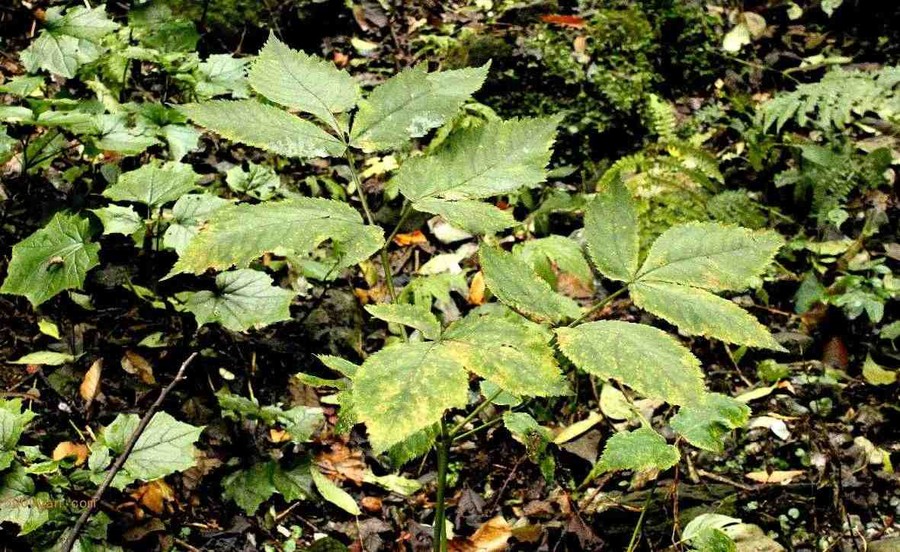
Perennial tall herb. Root subcylindrical, brown, with a distinctive aroma. Stem 1-2 m tall, up to 1.5 cm thick, hollow, often purple, glabrous or with shallow longitudinal grooves, upper part with short rough hairs. Leaves bipinnately ternate, broadly ovate; petioles of cauline leaves 30-50 cm long, base expanded into a thick, membranous, tubular, half-stem-clasping sheath, spreading, abaxially glabrous or sparsely pubescent; ultimate segments membranous, ovate to oblong-elliptic, apex acuminate, base cuneate, margin irregularly sharply serrate or biserrate, teeth with incurved short mucro, terminal segment often 3-lobed, base often decurrent along rachis into a wing, lateral segments shortly petiolulate or sessile, both surfaces along veins and margin pubescent; bracteal leaves reduced to saccate, inflated sheaths, glabrous, occasionally sparsely pubescent. Compound umbels terminal and lateral; peduncle densely short-hispid; involucre of 1 bract, long-subulate, ciliate, caducous; rays 10-25, densely short-hispid; umbellules with 17-28 (-36) flowers; involucel of 5-10 bracteoles, broadly lanceolate, shorter than pedicels, apex long-acuminate, abaxially and margin pubescent; flowers white; calyx teeth absent; petals obovate, apex emarginate; stylopodium flat-discoid. Fruit ellipsoid, lateral wings as wide as or slightly narrower than body, dorsal ribs linear, prominent, vittae (1-) 2-3 in furrows, 2-4 (-6) on commissure. Flowering August-September, fruiting September-October.
Habitat and Distribution
It grows on damp, shady slopes, under forests in grassy areas, or among sparse shrubs. It is distributed in Anhui, Zhejiang, Jiangxi, Hubei, Sichuan, and other regions. It is now cultivated in high-altitude areas of Sichuan, Hubei, Shaanxi, and other places.
Harvesting and Processing
Harvest in early spring when the seedlings just sprout or in late autumn when the stems and leaves wither. Dig up the roots, remove the fibrous roots and soil, bake until half-dry, stack for 2-3 days until soft, then bake again until completely dry.
Medicinal Properties
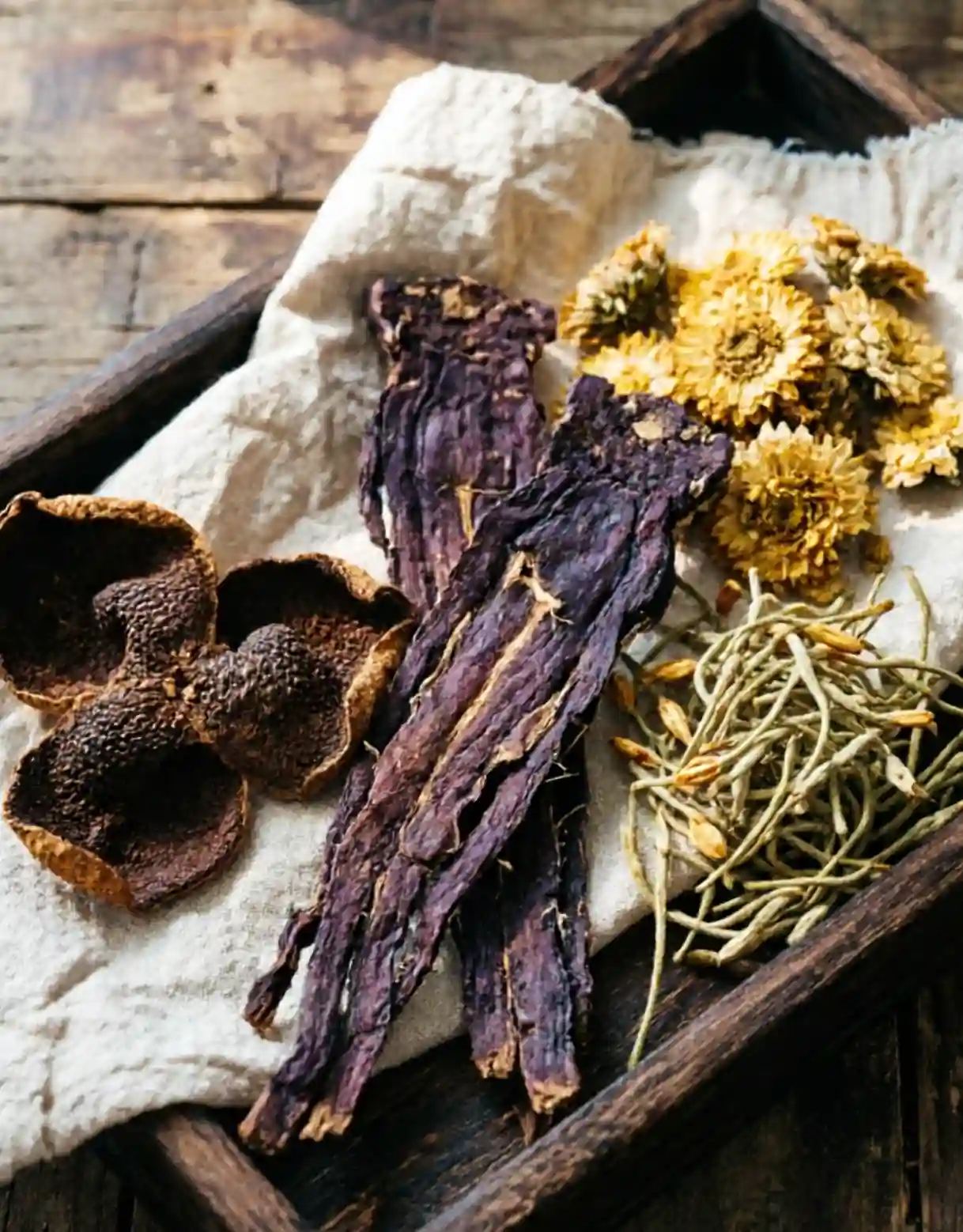
The main root and upper part of the root are thick and short, slightly cylindrical, 1.5-4 cm long, 1.5-3.5 cm in diameter, with several curved branch roots at the lower part, 12-30 cm long, 0.5-1.5 cm in diameter. The surface is rough, grayish-brown, with irregular longitudinal wrinkles and transverse fissures, numerous transverse lenticels and fine root scars; the root crown has annular striations with multiple rows of annular leaf scar marks, and a depressed stem scar in the center. The texture is hard; the fracture surface is grayish-yellowish-white, with a brown cambium ring, brown oil spots (oil ducts) in the branches, and a yellowish-brown xylem; the transverse section of the root crown has a large pith, also with oil spots. The aroma is distinctive; the taste is bitter and acrid, with a slight numbing sensation on the tongue.
Chemical Constituents
This product mainly contains osthole, dihydrooroselol, dihydrocolumbianadin, angelate, osthenol methyl ether, hirsutanol, angelol D, dihydrooroselol, isoimperatorin, and dihydrooroselol.βContains components such as D-glucosides, bergaptol, nerolidol, and thymol.
Pharmacology
It has antihypertensive and antiarrhythmic effects; can inhibit platelet aggregation and prevent thrombosis; has hypnotic, sedative, and anti-inflammatory effects; also exhibits photosensitivity, antispasmodic, antitumor, antibacterial, fat decomposition-promoting, and respiratory-stimulating effects.
Properties and Channel Entry
Bitter, pungent, and slightly warm. Enters the Kidney and Bladder channels.
Functions and Indications
Expels Wind and eliminates Dampness, unblocks impediment (Bi) and alleviates pain
Dosage and Administration
Oral: decoct in water, 3-10 g; or steep in wine; or made into pills or powder. External use: appropriate amount, decoct in water for washing.
Precautions and Contraindications
For those with Yin deficiency and blood dryness, use with caution.
Prescriptions
1. For Shaoyin Cold-depression headache: Duhuo 15 g, Fangfeng 6 g. Decoct in water and take orally. (Ben Cao Hui Yan) 2. For externally-contracted Shaoyin headache: Duhuo, Xixin, Chuanxiong, Qinjiao, Shengdihuang, Qianghuo, Fangfeng, Gancao. Decoct in water and take orally. (Zheng Yin Mai Zhi, Duhuo Xixin Tang) 3. For Shaoyin Cold-Dampness lumbago with inability to turn sides, headache, body pain, anhidrosis with stiffness, and a fine-tight pulse at left chi position: Duhuo, Cangzhu, Fangfeng, Xixin, Chuanxiong, Gancao. Decoct in water and take orally. For severe Cold, add Shengjiang and Guizhi. (Zheng Yin Mai Zhi, Duhuo Cangzhu Tang) 4. For beriberi with swelling and pain: Duhuo 15 g, Mugua and Niuxi 30 g each. Grind together into powder. Take 9 g each time on an empty stomach, mixed with plain boiled water. (Ben Cao Hui Yan) 5. For migratory arthralgia (Li Jie Feng) pain: Duhuo, Qianghuo, and Songjie in equal parts. Boil with wine. Drink one cup on an empty stomach daily. (Gang Mu, quoting Wai Tai)