Pinyin: Gaoliangjiang
Aliases
Gaoliangjiang, Manjiang, Xiaoliangjiang, Hailiangjiang
Source
Zingiberaceae plant Alpinia officinarumAlpinia officinarumDried rhizome of Hance.
Botanical Description
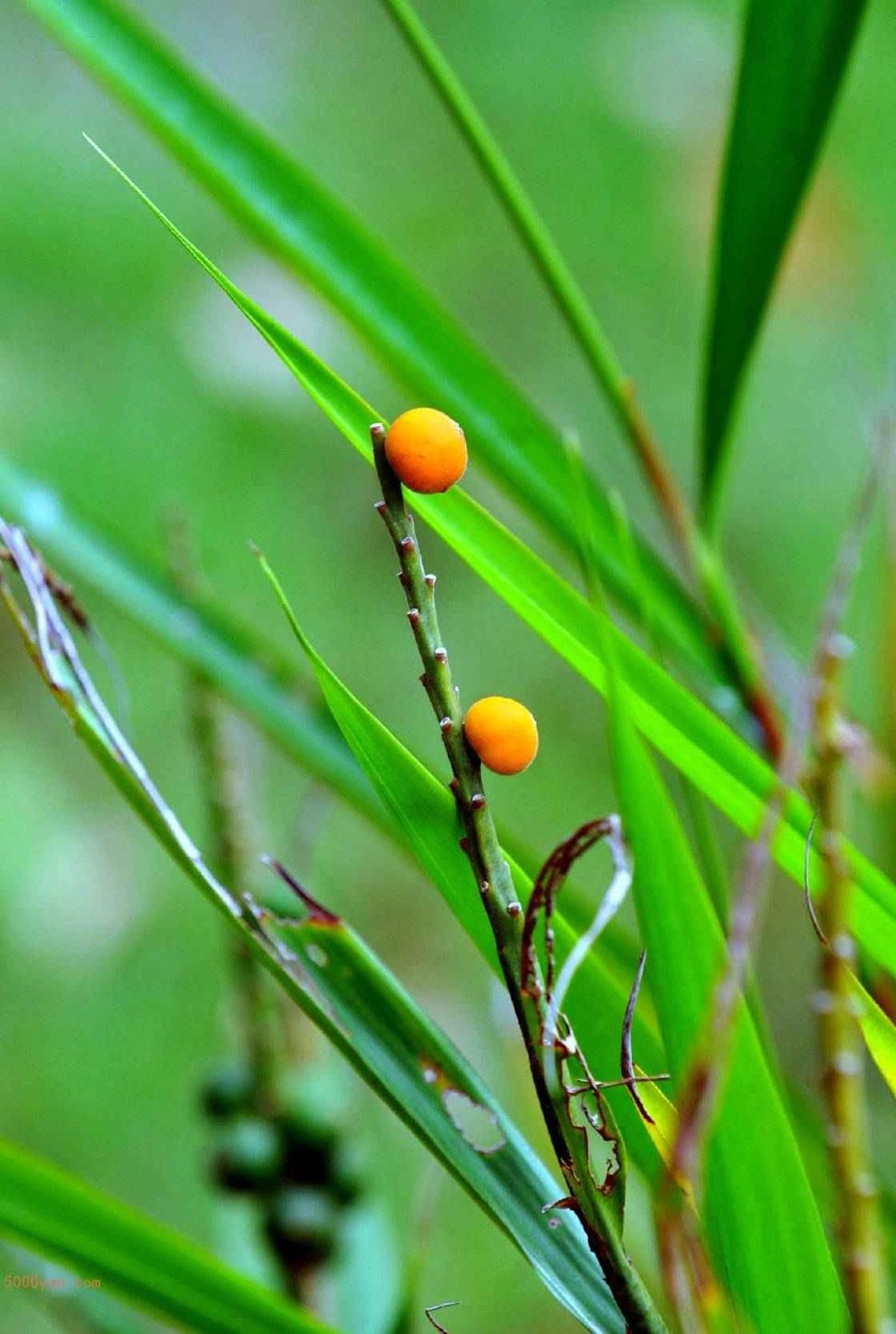
Perennial herb, 30-110 cm tall. Rhizome cylindrical, horizontal, brownish-red, 1-1.5 cm in diameter, noded, nodes with annular membranous scales and roots. Stems tufted, erect. Leaves sessile or subsessile; leaf blade linear-lanceolate, 15-30 cm long, 1.5-2.5 cm wide, apex acuminate or caudate, base attenuate, entire, glabrous on both surfaces; leaf sheath open, amplexicaul, with membranous margins; ligule membranous, 2-3 cm long, not split. Raceme terminal, erect, 6-15 cm long, rachis pubescent; calyx tubular, tube 8-14 mm long, apex irregularly 3-shallowly rounded-lobed; corolla tube funnelform, about 1 cm long, corolla lobes 3, oblong, lip ovate, white with red stripes, about 2 cm long; lateral staminodes subulate; fertile stamen 1, about 1.6 cm long, inserted above the throat of the corolla tube; ovary 3-locular, densely pubescent, style slender, with 2 connate cylindrical nectaries at the base below, stigma 2-lipped. Capsule globose, indehiscent, about 1.2 cm in diameter, pubescent, orange-red when ripe. Seeds with aril, obtusely angled, brown. Flowering April to September, fruiting August to November.
Habitat and Distribution
It grows in thickets on barren slopes or in sparse forests, or is cultivated. It is distributed in Taiwan, Hainan, Guangdong, Guangxi, Yunnan, and other regions.
Harvesting and Processing
Harvested in late summer to early autumn, remove fibrous roots and residual scales, wash clean, cut into segments, and sun-dry.
Medicinal Properties
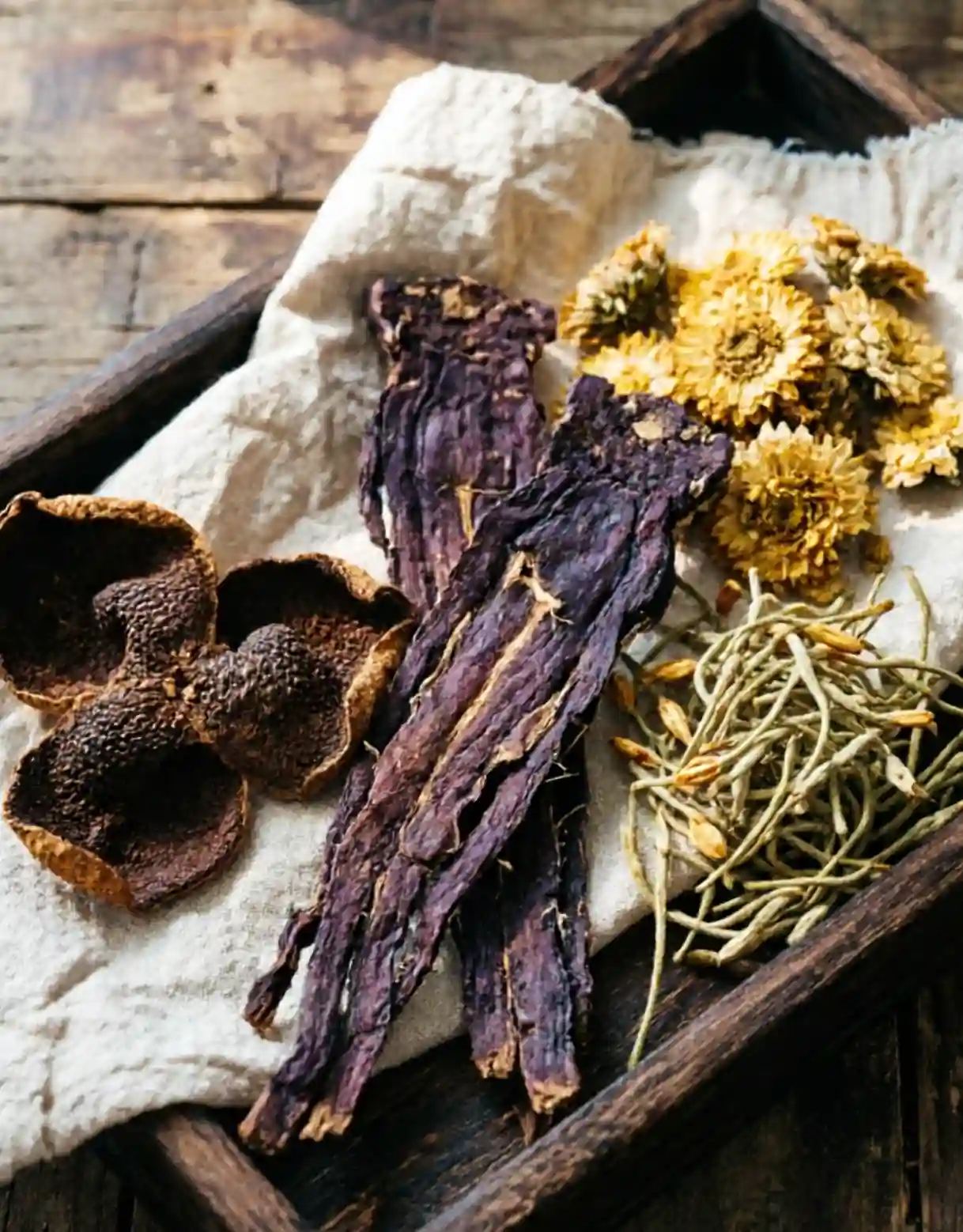
This product is cylindrical in shape, mostly curved with branches, 5-9 cm long and 1-1.5 cm in diameter. The surface is brownish-red to dark brown, with fine longitudinal wrinkles and grayish-brown undulating nodes, internodes 0.2-1 cm long, and round root scars on the lower part. The texture is tough and hard to break; the cut surface is grayish-brown or reddish-brown, fibrous, with a relatively distinct endodermal ring and scattered vascular bundle spots. Odor: aromatic; Taste: pungent.
Chemical Constituents
This product contains curcumin, dihydrocurcumin, hexahydrocurcumin, galangin, galangin-3-methyl ether, eugenol, campesterol glucoside, stigmasterol glucoside, curcumin, dihydrocurcumin, methyl cinnamate, and other components.
Pharmacology
Has antibacterial, analgesic, anti-gastric ulcer, anti-diarrheal, and choleretic effects; can delay thrombus formation and inhibit platelet aggregation; improves oxygen utilization capacity under hypoxic conditions.
Properties and Channel Entry
Acrid, hot. Enters the Spleen and Stomach channels.
Functions and Indications
Warms the Stomach, stops vomiting, disperses Cold, and alleviates pain. Used for epigastric and abdominal cold pain, stomach Cold vomiting, belching, and acid reflux.
Dosage and Administration
Oral: decoct in water, 3-6 g; or made into pills or powder.
Precautions and Contraindications
Contraindicated in patients with Yin deficiency with Heat.
Prescriptions
1. For epigastric and cardiac pain: Gaoliangjiang (Alpinia officinarum) finely chopped, lightly stir-fried, and ground into powder. Take 3 g with rice drink. (Shiquan Fang) 2. For stomach cold, undigested food, vomiting, and regurgitation: Gaoliangjiang and Chenpi (tangerine peel) in equal parts, ground into powder, mixed with honey to form pills the size of wutong seeds. Take one pill on an empty stomach with a drink. (Weisheng Yijian Fang) 3. For deficiency of both the Spleen and Stomach, with abdominal distension and hiccups: Gaoliangjiang and Muxiang (Saussurea costus) each separately ground into powder. For each dose, take 3 g of Gaoliangjiang powder and 1.5 g of Muxiang powder. Add one cup of water, decoct until reduced to 70%, allow to cool slightly, and sip slowly with the dregs. Take at any time, do not use iron utensils for decoction. (Shengji Zonglu) 4. For cholera with vomiting, diarrhea, and abdominal pain: Gaoliangjiang 150 g, roasted over fire until fragrant and scorched, then broken into pieces. Add one liter of wine, bring to a boil 3-4 times, and take in one dose. (Beiji Fang) 5. For Wind-Cold-Dampness with pain in the lower back and feet: Gaoliangjiang and Fangji (Stephania tetrandra) in equal parts, ground into powder, mixed with mashed garlic to form a cake. Apply to the painful area, spread moxa on top and moxibust, until pain turns to no pain, and no pain turns to pain. (Waike Dacheng)