Pinyin: Sanqi
Aliases
Tianqi, Dian Sanqi, Tian Sanqi, Jin Buhuan.
Source
Wujia ke zhiwu SanqiPanaxnotoginsengDried root and rhizome of (Burk.) F.H. Chen.
Botanical Description
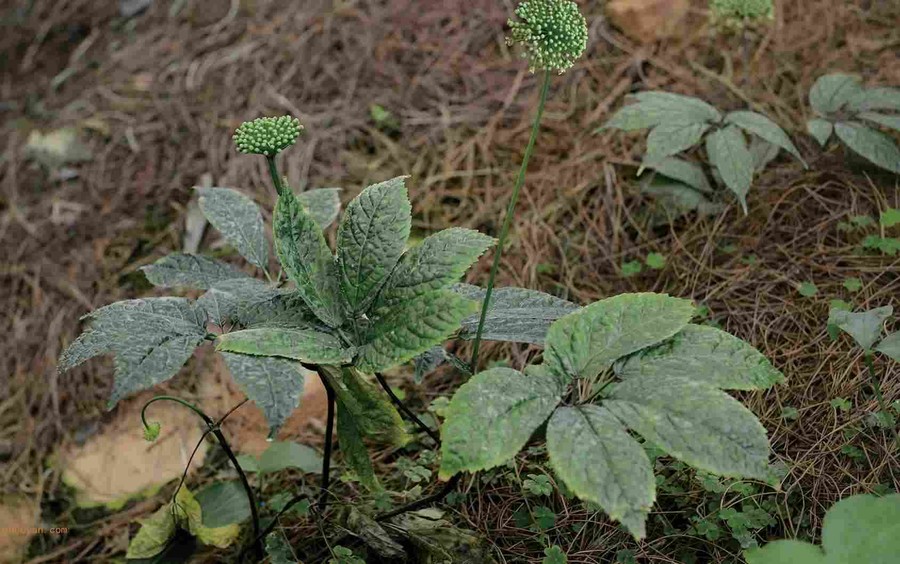
A perennial erect herb, 20-60 cm tall. The main root is thick, fleshy, spindle-shaped, obconical, or cylindrical, often with verrucose (warty) branches. The stem is solitary, erect, and unbranched. Palmately compound leaves, 3-6 whorled at the stem apex; stipules linear, clustered, less than 2 mm long; leaflets usually 5-17, rarely 3-9, membranous, oblong to obovate-oblong, the basal pair smaller, apex long-acuminate, base nearly rounded, often asymmetric, margin finely and densely serrate, with small bristles at the tooth tips, sparsely bristly along both surfaces of the veins. Umbels solitary; with 80-100 or more flowers, pedicels minutely pubescent; peduncle 13-30 cm long; flowers small, with scale-like bracts at base; calyx 5-toothed; petals 5, yellow-green, oblong-ovate, apex acute; stamens 5, filaments linear; ovary inferior, 2-locular, styles 2, slightly incurved, fused at the base. Drupe-like berry, nearly reniform, about 1 cm in diameter, bright red when ripe. Seeds 1-3, globose-compressed, white. Flowering June to August, fruiting August to October.
Habitat and Distribution
Wildly found growing under mountain slope forests, now mostly cultivated at elevations of 800-1000 m on mountain foothills, gentle slopes of mounds, or under artificial shade. Distributed in Jiangxi, Hubei, Guangdong, Guangxi, Sichuan, Yunnan, and other regions. Wild specimens are now rare, with most being cultivated.
Harvesting and Processing
Generally, harvesting occurs after 4 years of cultivation. Those harvested in August to September are called "spring Sanqi," which have good quality and high yield, while those harvested in November are called "winter Sanqi," with inferior quality and lower yield. The dug-up root tubers are washed clean of soil, sorted by size, and sun-dried or fire-dried (36-38°C) for 2-3 days. When approximately 60% dry, the branch roots, fibrous roots, and rhizomes are separately cut off, then sun-dried or fire-dried for another 2-3 days. They are then rubbed or placed in a rotating drum to tumble and rub against each other. After removing, they are sun-dried or fire-dried again, repeating this process 4-5 times. For the final cycle, some rope rush grass or green mung beans may be added until the root tubers become smooth, round, and thoroughly dry.
Medicinal Properties
The main root is mostly conical or cylindrical, 1-6 cm long and 1-4 cm in diameter. The surface is grayish-brown or grayish-yellow, with intermittent longitudinal wrinkles and branch root scars. There is a stem scar at the apex, surrounded by nodular protrusions. Heavy in weight, firm in texture; the cross-section is grayish-green, yellowish-green, or grayish-white, with the xylem slightly arranged in a radial pattern. Odor: faint; Taste: bitter with a sweet aftertaste. The branch roots (Jintiao) are cylindrical or conical, 2-6 cm long, with an upper diameter of about 0.8 cm and a lower diameter of about 0.3 cm. The rhizome (Jiankou) is irregularly wrinkled in block-like or strip-like shapes, with several distinct stem scars and annular lines on the surface; the cross-section has a grayish-green or white center and a dark green or gray periphery.
Chemical Constituents
This product mainly contains ginsenoside Rg.1quercetin, acetic acid, caryophyllene, ginsenoside Re, leucine,β-β-sitosterol-D-glucoside, panaxynol, and others.
Pharmacology
It has hemostatic, anti-platelet aggregation, thrombolytic, hemolytic, and hematopoietic effects on the blood and hematopoietic system; anti-arrhythmic, anti-atherosclerotic, anti-hypoxia, anti-shock, and cerebral ischemia-improving effects on the cardiovascular system; central nervous system inhibitory and analgesic effects on the nervous system; it can enhance immune function, protect liver function, fight tumors, delay aging, lower blood sugar, reduce inflammation, regulate substance metabolism, and promote growth; its toxicity is low, and long-term use is essentially free of side effects.
Properties and Channel Entry
Sweet, slightly bitter, warm. Enters the Liver, Stomach, Heart, Lung, and Large Intestine channels.
Functions and Indications
Disperses stasis and stops bleeding, reduces swelling and alleviates pain
Dosage and Administration
Oral administration: decoction, 3-9 g; ground into powder, 1-3 g; or made into pills or powders
Precautions and Contraindications
Caution should be exercised in pregnant women.
Prescriptions
1. For traumatic internal injuries: 15 g of *Panax notoginseng* powder, mashed together with live crab, steeped in hot wine and taken warm. (From "Compilation of Guangxi Ethnic Herbal Medicine") 2. For chronic prostatitis: 3 g of *Panax notoginseng* powder, taken once every other day with plain boiled water. [From "Henan Traditional Chinese Medicine" 1985, (3): 27] 3. For blood deficiency dizziness: 3 g of *Panax notoginseng*, ground into fine powder; one pigeon, remove internal organs, fill the cavity with the powder, steam and eat. (From "Qujing District Chinese Herbal Medicine Manual") 4. For Qi and blood deficiency: 3 g of *Panax notoginseng*, 6 g of *Talinum paniculatum*. Grind into fine powder, steam with meat patty and eat. (From "Qujing District Chinese Herbal Medicine Manual") 5. For dysmenorrhea: 2-3 g of *Panax notoginseng* powder, taken with warm boiled water before or during menstrual pain. [From "Shanghai Journal of Traditional Chinese Medicine" 1984, (3): 21]