Pinyin: Mingdangshen
Aliases
Tushen, Fenshashen, Shanluobo, Mingshashen.
Source
Dried root of the Apiaceae plant Changium smyrnioides Wolff.
Botanical Description
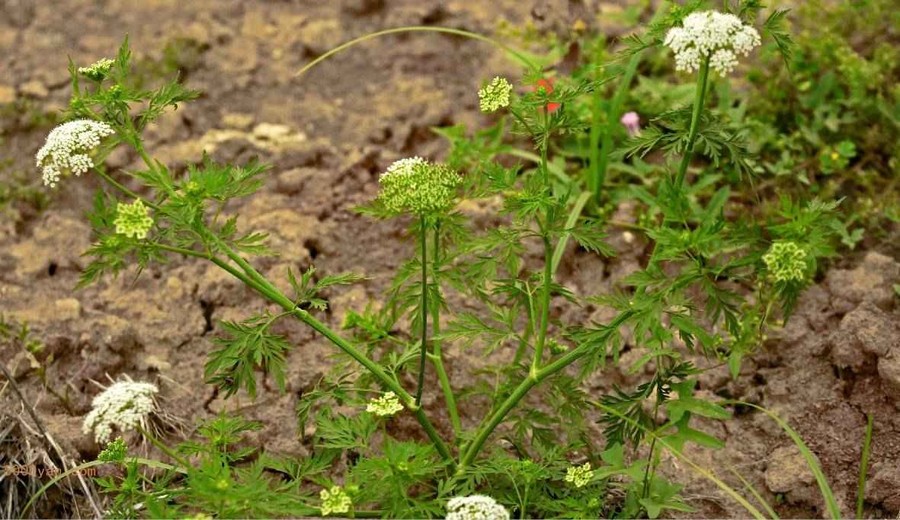
Perennial herb, 50-100 cm tall. Entire plant covered with white frost, glabrous (hairless). Roots have two shapes: one is cylindrical and slender, the other is fusiform or elliptical, both with a pale yellow or yellowish-brown surface and white cross-section. Stem erect, cylindrical, with fine longitudinal striations on the surface, hollow, branched in the upper part, grayish-green. Basal leaves have long petioles, 3-15 cm long; leaf blade ternate or 2-3 times pinnately divided, primary pinnae broadly ovate, 4-10 cm long, petiolules 2-5 cm long, secondary pinnae ovate or oblong-ovate, 2-4 cm long, petiolules 1-2 cm long, tertiary pinnae ovate or ovate-orbicular, 1-2 cm long, base truncate or subcuneate, margin 3-lobed or pinnatifid, ultimate segments oblong-lanceolate, 2-4 mm long, 1-2 mm wide; upper stem leaves scaly or sheath-like. Compound umbel terminal or lateral, involucre 0-3; rays 4-10, 2.5-10 cm long; involucels several; umbellets with 8-20 flowers, slightly purplish-red in bud, white when open; calyx teeth small; petals oblong or ovate-lanceolate, 1.2-2 mm long, 1-1.2 mm wide, apex acuminate and inflexed; stamens 5, filaments about 3 mm long, anthers ovate-orbicular; stylopodium raised, styles erect when young, recurved when fruit matures. Schizocarp ovate-orbicular to ovate-oblong, 3-4 mm long, 2.5-3 mm wide, mericarps slightly narrowed at both ends, dorsally convex, with 8-12 ribbed ridges on the surface, primary ribs not prominent. Transverse section of mericarp elliptical or indistinctly pentagonal, with 3-5 vittae in each furrow, 4-6 on the commissure, endosperm deeply concave on the ventral side, horseshoe-shaped. Flowering period April to May, fruiting period May to June.
Habitat and Distribution
Born in mountainous areas under sparse shrub forests with fertile soil or in rocky crevices on hillsides. Distributed in Jiangsu, Zhejiang, Anhui, Jiangxi, Hubei, and other regions.
Harvesting and Processing
Harvested and dug from April to May, remove the fibrous roots, wash clean, boil in boiling water until the center is no longer white, remove, scrape off the outer skin, rinse, and dry.
Medicinal Properties
This product is slender cylindrical, long fusiform, or irregular strip-like, 6-20 cm long, 0.5-2 cm in diameter. The surface is yellow-white or light brown, smooth or with longitudinal grooves and fibrous root scars, some with reddish-brown spots. The texture is hard and brittle; the fracture surface is horny, with a thin, yellow-white bark that is sometimes easily separated from the whitish xylem. Odor: faint; Taste: bland.
Chemical Constituents
This product primarily contains methyl 6,9-octadecadiynoate.βContains volatile oil components such as pinene, as well as free fatty oil and bound fatty oil, along with phospholipids, phospholipid-bound fatty acids, and others. It also contains Changium polysaccharides, amino acids, and trace elements.
Pharmacology
Has the effect of promoting immune function and anti-lipid peroxidation, and shows a significant promoting effect on small intestinal peristalsis in normal mice.
Properties and Channel Entry
Sweet, slightly bitter, and slightly cold in nature. Enters the Lung, Spleen, and Liver channels.
Functions and Indications
Moistens the Lungs and transforms Phlegm, nourishes Yin and harmonizes the Stomach, calms the Liver, and resolves toxicity. Used for Lung-Heat cough, vomiting and regurgitation, poor appetite with dry mouth, red eyes and dizziness, furuncles and sores.
Dosage and Administration
Internal: decoct in water, 6-12 g; or prepared as concentrated decoction.
Precautions and Contraindications
Contraindicated in cases of Spleen deficiency with diarrhea, nocturnal emission with spermatorrhea, and in pregnant women.
Prescriptions
1. For lung-heat cough: Mingdangshen (Changium smyrnioides), Sangbaipi (Morus alba root bark), and Pipaye (Eriobotrya japonica leaf) 9 g each, with Shenggancao (Glycyrrhiza glabra raw) 3 g. Decoct and take orally. (Zhejiang Medicinal Flora) 2. For pregnancy vomiting: Mingdangshen (Changium smyrnioides), Zhuru (Bambusa tuldoides shavings), and Shengbaizhu (Atractylodes macrocephala raw) 9 g each, Huangqin (Scutellaria baicalensis) 5 g, Gancao (Glycyrrhiza glabra) 3 g. Decoct in water and take orally. (Anhui Chinese Herbal Medicine) 3. For fatigue and overexertion injuries, anemia with dizziness: Mingdangshen (Changium smyrnioides, finely sliced) 30 g, eggs 2, beaten and mixed well, steam on rice until cooked, then eat. (Food Chinese Medicine and Simple Prescriptions) 4. For hypertension: Mingdangshen (Changium smyrnioides) 15 g, Huainiuxi (Achyranthes bidentata) 15 g. Decoct in water and take orally. (Food Chinese Medicine and Simple Prescriptions) 5. For early-stage leukorrhea: Tu Renshen (Talinum paniculatum root, sliced) 90 g, steam with aged Shaoxing wine on rice until cooked, divide into three doses. (Baicao Jing) 6. For syphilitic sores: Tu Renshen (Talinum paniculatum root), decoct in wine and take orally. (Gangmu Shiyi, citing Wang Anqing's Caiyao Zhi) 7. For furuncle and swelling toxicity: Mingdangshen (Changium smyrnioides) 9 g, Pugongying (Taraxacum mongolicum) and Zihuadiding (Viola yedoensis) 15 g each. Decoct in water and take orally. (Anhui Chinese Herbal Medicine)