Pinyin: Feilongzhangxue
Aliases
Huangjiao, Feilongzhanxue, Feijianxue
Source
1Toddalia asiaticaDried root or root bark of (L.) Lam.
Botanical Description
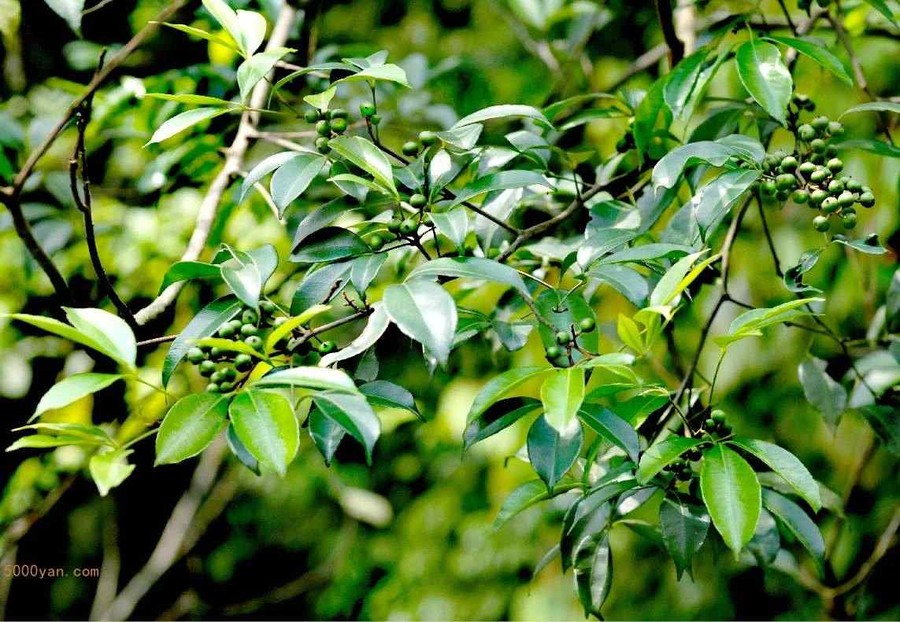
Woody, vine-like liana. Branches and branchlets often bear downward-curving prickles; older branches brown, young branches light green or yellow-green, often covered with brownish-rust-colored short pubescence and white rounded lenticels. Leaves ternate, alternate; petiole 3-5 cm long; leaflets sessile; leaflets leathery, obovate, obovate-oblong, or oblong, apex acute or slightly acute and obtuse, base cuneate, margin with fine blunt serrations, with transparent glands in the serrations and on the leaf blade, glabrous on both surfaces. Flowers unisexual, white to pale yellow; sepals and petals both 4-5; male flowers usually arranged in axillary paniculate cymes, stamens 4-5, petals about 3 mm long; female flowers slightly larger than male flowers, sterile stamens 4-5, less than half the length of the pistil, ovary superior, nearly globose, pubescent, 3-5-locular, with 2 superposed ovules per locule. Drupe nearly globose, 8-10 mm in diameter, orange-yellow to vermilion, with dark-colored glands, pericarp fleshy, surface with 3-5 slightly raised ribs. Seeds reniform, black, glossy. Flowering period October to December, fruiting period December to February of the following year.
Habitat and Distribution
It grows in mountain forests, roadsides, thickets, or sparse forests. It is distributed in Southwest China and in Shaanxi, Zhejiang, Fujian, Taiwan, Hubei, Hunan, Guangdong, Hainan, and Guangxi.
Harvesting and Processing
It can be harvested year-round, dig up the root, wash it clean, use fresh or cut into sections and dry in the sun.
Medicinal Properties
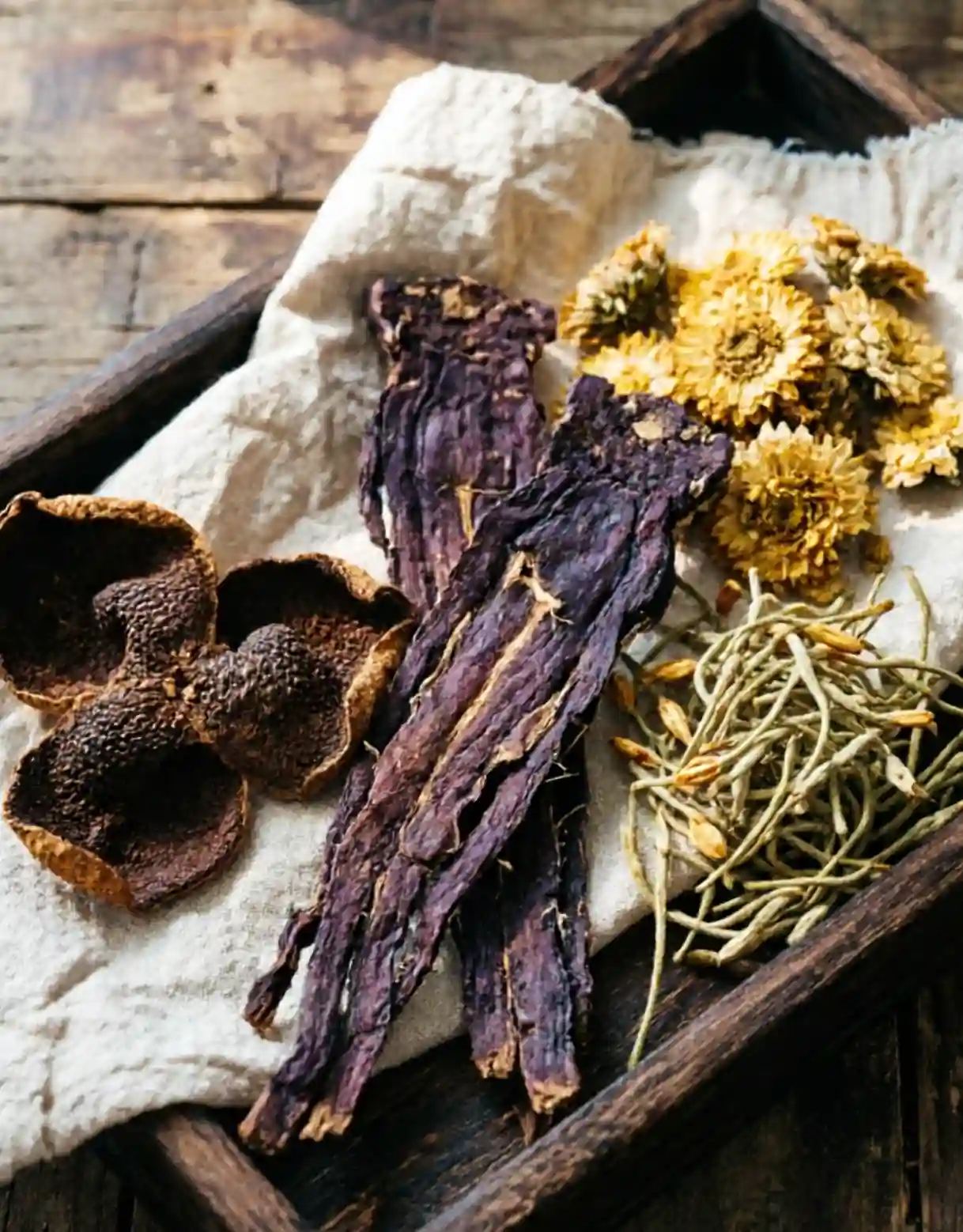
Root is cylindrical, slightly curved, approximately 30 cm long, 0.5-4.0 cm in diameter, with some root heads reaching up to 8 cm in diameter. The surface is grayish-brown to deep yellowish-brown, rough, with fine longitudinal striations and slightly raised, white, round to oblong lenticels. The cork layer is easily exfoliated, revealing a brown to light reddish-brown bark. The texture is hard and not easily broken. The transverse section shows a distinct boundary between the bark and wood. The wood is light yellow with prominent annual rings. Odor: faint; Taste: pungent and bitter, with a cool and acrid sensation. The root bark appears as irregular, long, blocky pieces, 5-10 mm thick, hard, and not easily broken. Both the cross-section and longitudinal section show a granular texture, yellowish-brown to brown, with a light brown inner surface and longitudinal striations.
Chemical Constituents
This product primarily contains chelerythrine, dihydrochelerythrine, toddalolactone, berberine, toddaculone, and diosmin among its constituents.
Pharmacology
Anti-inflammatory, analgesic, antiviral, antibacterial, diuretic, and antispasmodic.
Properties and Channel Entry
Acrid, slightly bitter, warm; slightly toxic.
Functions and Indications
Expels Wind, alleviates pain, disperses stasis, stops bleeding, resolves toxicity, and reduces swelling. Indicated for Wind-Damp impediment pain (Bi syndrome), low back pain, stomach pain, dysmenorrhea, amenorrhea, traumatic injuries, fatigue-induced hemoptysis, epistaxis, stasis-related metrorrhagia and metrostaxis, and sores, carbuncles, and toxic swellings.
Dosage and Administration
Oral: decocted in water, 9-15 g; or steeped in wine; or prepared as powder
Precautions and Contraindications
Contraindicated during pregnancy.
Prescriptions
1. For rheumatic arthritis: Toddalia asiatica, Ficus pumila, Spatholobus suberectus, and Smilax china 18 g each, Clematis chinensis 9 g. Soak in 500 ml of white spirits. Take 30-60 ml each time, 3 times daily. (National Chinese Herbal Medicine Compilation) 2. For rheumatic swelling and pain, traumatic pain, and intercostal neuralgia: dried root bark of Toddalia asiatica 12-18 g. Decoct in water for oral administration, or soak in spirits for consumption. (Guangzhou Military Unit Common Chinese Herbal Medicine Manual) 3. For traumatic injuries: Toddalia asiatica 9 g, Rosa chinensis root 6 g, Achyranthes bidentata 9 g. Grind into powder together, use wine as a guide. (Guiyang Folk Herbal Medicine) 4. For blood stasis amenorrhea: Toddalia asiatica 60 g, Sargentodoxa cuneata 60 g, Cyathula officinalis 60 g, Carthamus tinctorius 15 g. Soak in spirits. Take 5-15 g each time. (Sichuan Chinese Materia Medica Annals 1979) 5. For consumptive injury with hemoptysis and blood stasis with flooding and spotting: Toddalia asiatica 30 g. Decoct in water and take with infant urine. (Sichuan Chinese Materia Medica Annals 1979)