Pinyin: Fuzi
Source
Ranunculaceae plant AconitumAconitum carmichaeliiThe processed product of the rootlets of *Aconitum carmichaelii* Debx.
Botanical Description
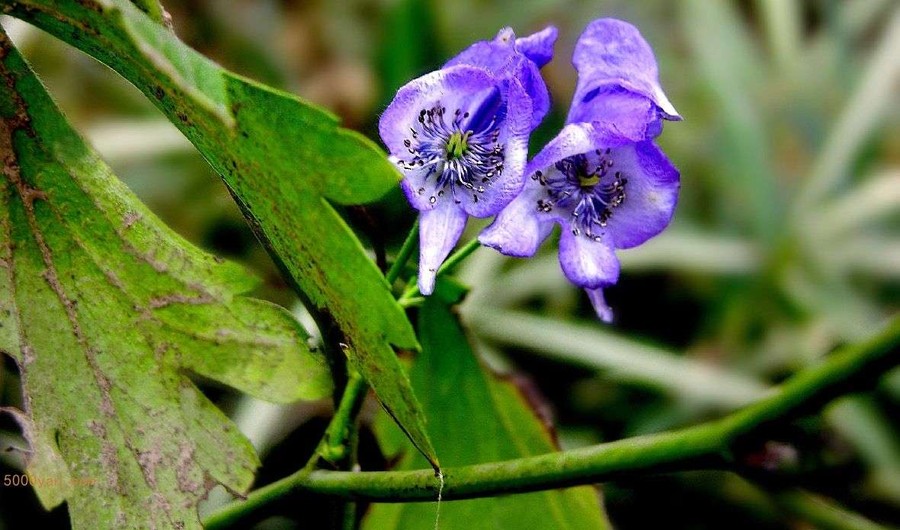
See "Chuanwu" entry.
Harvesting and Processing
Harvest from late June to early August, remove the mother root, fibrous roots, and sediment, commonly known as "muddy Fuzi," and process into the following specifications:
1. Select large, uniform-sized raw aconite, wash clean, soak overnight in a brine solution of edible bittern, then add salt and continue soaking. Remove daily to sun-dry, gradually extending the drying time until a large amount of crystalline salt grains (salt frost) appear on the surface and the texture becomes hard. This is commonly called "Salt-processed Aconite." 2. Take raw aconite, wash according to size, soak in an edible bittern hydrolysate for several days, then boil together with the soaking liquid until thoroughly cooked. Remove, rinse in water, cut longitudinally into slices approximately 0.5 cm thick, then soak again in water. Use a coloring solution to dye the slices a strong tea color. Remove, steam until an oily sheen appears, then bake until half-dry, and finally sun-dry or continue to bake until dry. This is commonly called "Black Sliced Aconite." 3. Select uniformly sized raw aconite, wash clean, soak in an edible bittern brine solution for several days, then boil together with the soaking liquid until thoroughly cooked. Remove, peel off the outer skin. Cut longitudinally into slices approximately 0.3 cm thick, soak in water, then remove, steam thoroughly, and sun-dry. This is commonly called "White Sliced Aconite."
Medicinal Properties
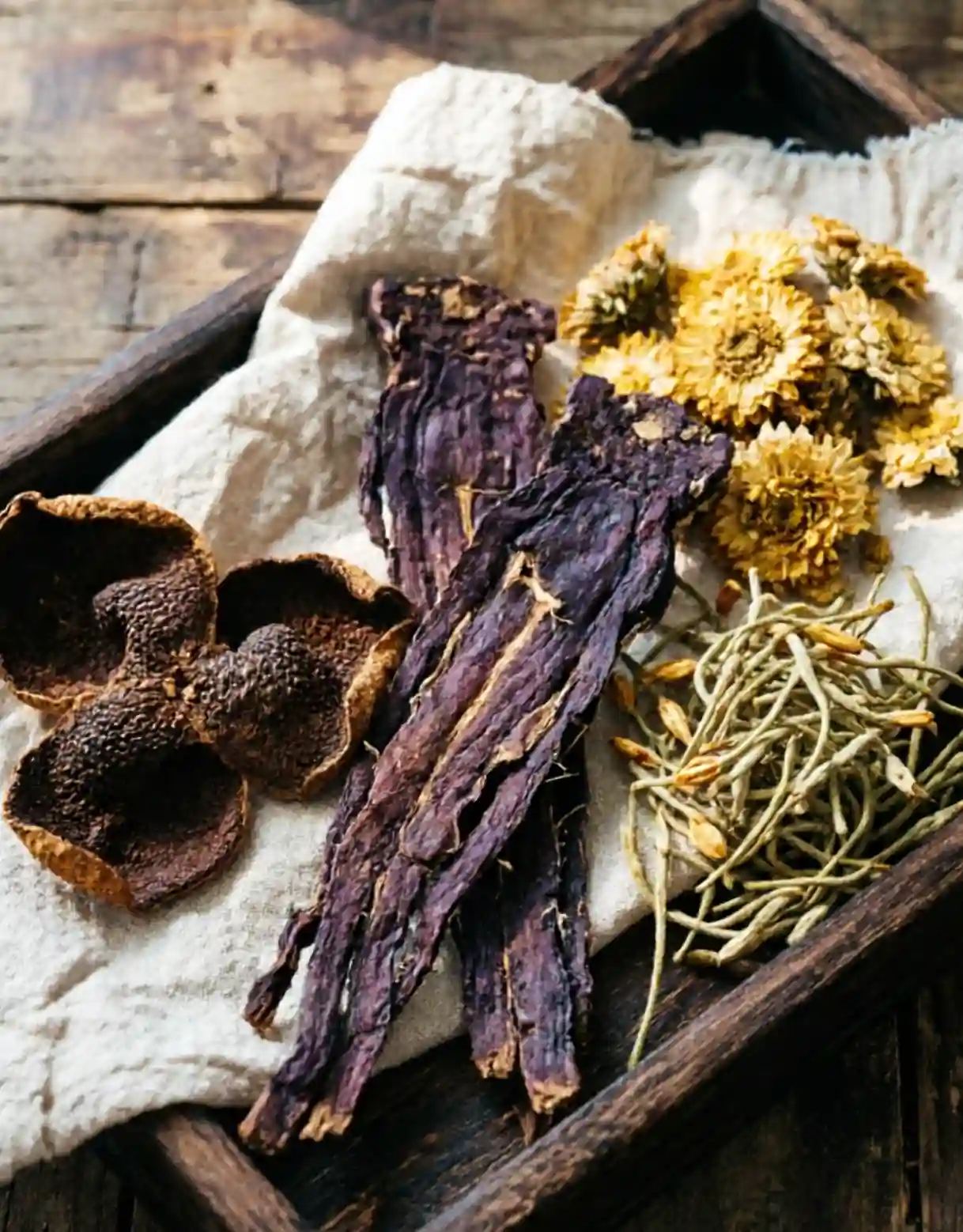
1. YAN FU ZI (Prepared aconite root with salt): Conical in shape, 4-7 cm long, 3-5 cm in diameter. Externally grayish-black with a salt frost; the apex has a depressed bud scar, and the surrounding area has nodular protruding rootlets or rootlet scars. Heavy in weight; the transverse section is grayish-brown, showing small cavities filled with salt frost and polygonal cambium ring lines, with irregularly arranged vascular bundles inside the ring lines. Odor: faint; Taste: salty, numbing, and irritating to the tongue.
2. Heishunpian (Black Sliced Aconite): Longitudinal slices, wide at the top and narrow at the bottom; 1.7-5 cm long, 0.9-3 cm wide, 0.2-0.5 cm thick. Outer bark is blackish-brown, cut surface is dull yellow, oily and lustrous, semi-transparent, with longitudinal vascular bundles. Texture is hard and brittle, fracture surface is horny. Odor: faint; Taste: mild. 3. Baifupian (White Sliced Aconite): Longitudinal slices, without outer bark, yellowish-white, semi-transparent, approximately 0.3 cm thick.
Chemical Constituents
This product mainly contains alkaloid components, such as benzoylmesaconine, benzoylaconine, benzoylhypaconine, aconitine, benzoylmesaconitine, fuzinine, fuzinoside, etc.
Pharmacology
Cardiotonic; anti-myocardial ischemia; anti-shock; inhibits coagulation function and anti-thrombosis; anti-inflammatory; analgesic; local anesthetic; enhances humoral immunity; stimulates spontaneous intestinal contraction, inhibits gastric emptying; antiasthmatic, relaxes trachea; has effects such as counteracting smooth muscle spasm. Toxic.
Properties and Channel Entry
Pungent and sweet, extremely hot, toxic. Enters the Heart, Kidney, and Spleen channels.
Functions and Indications
Returns Yang to rescue from collapse, supplements Fire to assist Yang, disperses Cold to alleviate pain. Indications: Yang depletion and collapse, cold extremities and faint pulse, impotence and uterine coldness, deficiency-cold vomiting and diarrhea, yin-cold edema, Yang deficiency with external contraction, Wind-Cold-Damp impediment, chest impediment and heart pain, epigastric and abdominal cold pain, Cold-Damp impediment pain.
Dosage and Administration
Oral administration: decoct in water, 3-9 g (processed product), or 18-30 g for rescuing from collapse and restoring Yang; or made into pills or powder. External use: appropriate amount, grind into powder for topical application, or cut into thin slices to cover the affected area or acupoints for moxibustion with moxa cones. For oral use, it should be processed and decocted for a long time; for external use, raw products are mostly used.
Precautions and Contraindications
Contraindicated in Yin deficiency with Yang excess, true Heat with false Cold patterns, and during pregnancy. Avoid alcohol consumption while taking this medication, and do not use baijiu (Chinese liquor) as a guiding herb. Incompatible with Banxia (Pinellia ternata), Gualou (Trichosanthes kirilowii), Bailian (Ampelopsis japonica), Baiji (Bletilla striata), and Beimu (Fritillaria spp.). Improper use may cause toxicity.
Prescriptions
1. For vomiting, diarrhea, sweating, fever with aversion to cold, limb spasms, and cold extremities: Gancao (Glycyrrhiza) 60 g (honey-fried), Ganjiang (Zingiber) 45 g, Fuzi (Aconitum, raw, peeled, broken into eight pieces) 1 piece. Decoct the three ingredients in 3 sheng of water until 1 sheng and 2 ge remain, strain the residue, and take warm in two divided doses. (Sini Decoction from *Shanghan Lun*). 2. For pediatric diarrhea with undigested food: Fuzi (Aconitum) 15 g, Hezi (Terminalia) 30 g, Zaoxin Tu (stove earth) 30 g. Grind into powder, make pills with aged rice paste, each pill the size of a millet grain, and take with clear rice water. (Fuhe Pills from *Douzhen Chuanxin Lu*). 3. For vomiting and acid reflux: 1 large Fuzi (Aconitum) and 1 piece of Shengjiang (Zingiber, finely chopped). Boil and grind into a paste, take with rice drink. (*Jingyan Fang*). 4. For toothache due to Yin deficiency: Grind raw Fuzi (Aconitum) into powder, mix with saliva, and apply to the soles of both feet; highly effective. (*Hua Tuo Shenyi Miji*). 5. For cold extremities in stroke: Raw Fuzi (Aconitum) 0.3 g and Muxiang (Saussurea) 0.15 g. Finely chop, take 1.5 g per dose with 2 slices of Shengjiang (Zingiber), decoct, and take. (Fuzi Powder from *Puji Fang*).