Pinyin: Shancigu
Aliases
Mao Cigu, Ni Bingzi, Suanpan Qi, Cai Pei Lan.
Source
Orchidaceae plant *Pleione bulbocodioides* (Franch.) RolfePleione bulbocodioidesDried pseudobulb of (Franch.) Rolfe.
Botanical Description
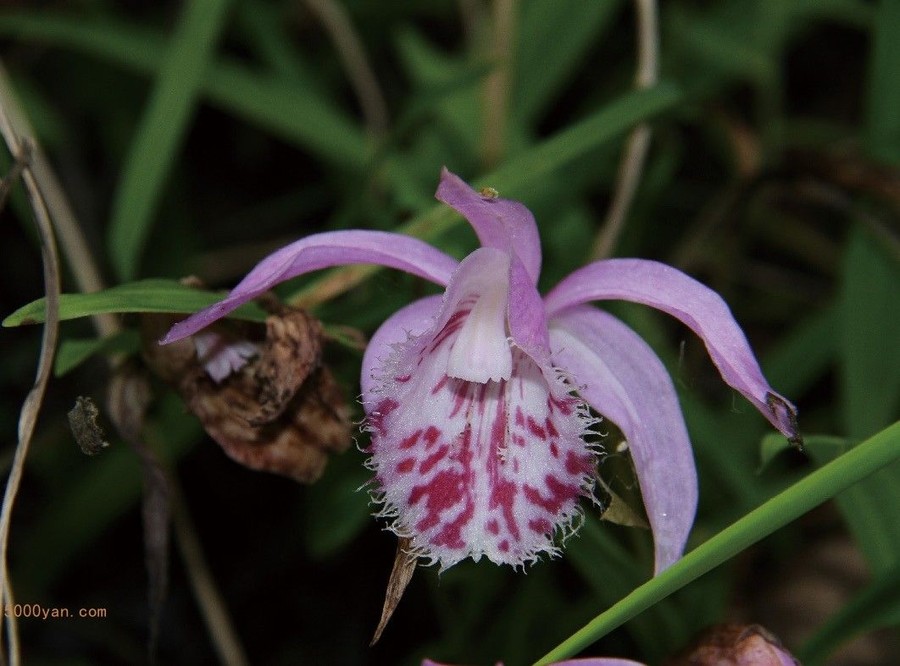
Terrestrial plant, 15-25 cm tall. Pseudobulb narrowly ovoid or long-neck bottle-shaped, 1-2 cm long, with 1 leaf at the apex, leaving a cup-shaped tooth ring after leaf fall. Leaves and flowers appear simultaneously, elliptic-lanceolate, 10-25 cm long, 2-5 cm wide, apex slightly obtuse or acuminate, base narrowed into a petiole, embracing the scape. Scape bears 1 flower at the apex. Floral bracts oblong, nearly acute, equal to or longer than the ovary; flowers pale purple or pink; sepals erect, narrowly lanceolate, up to 4 cm long, 5-7 mm wide, apex acute; labellum base cuneate, indistinctly 3-lobed, lateral lobes semi-ovate, apex obtuse, mid-lobe semi-circular or nearly cuneate, apex emarginate or nearly entire, margin irregularly serrate, inner surface with 3-5 undulate or nearly erect lamellae. Flowering period April to May, fruiting period July.
Habitat and Distribution
Born under forests at altitudes of 630-3000 m or on soil-covered stone walls beside ravines. Distributed in East China, Central South China, Southwest China, and areas such as Shaanxi and Gansu.
Harvesting and Processing
Excavated in summer and autumn, remove the above-ground parts and sediment, separate by size, steam or boil in a pot of boiling water until thoroughly cooked, then dry.
Medicinal Properties
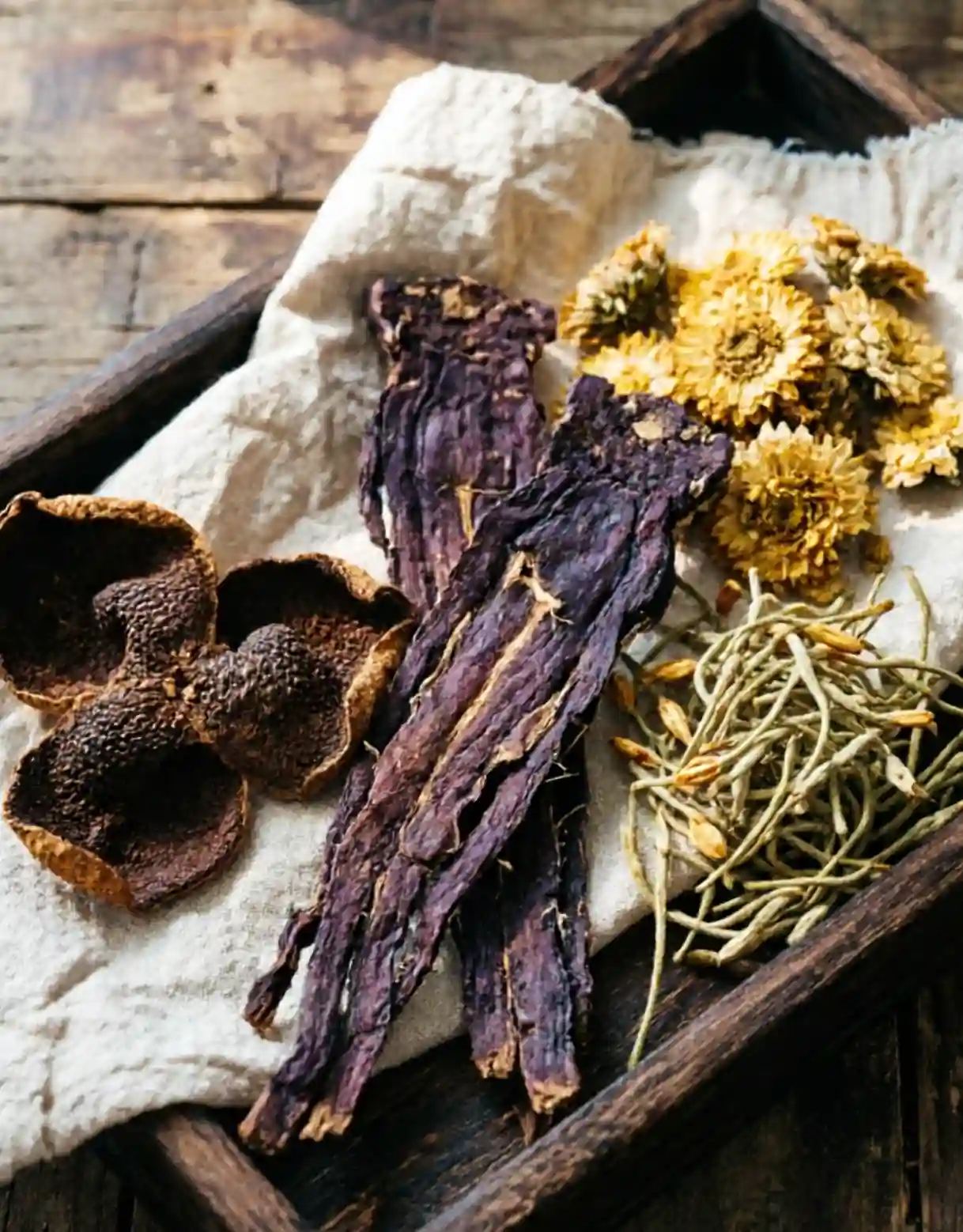
This product is conical, bottleneck-shaped, or irregularly clumped, with a diameter of 1-2 cm and a height of 1.5-2.5 cm. The apex is gradually pointed with a disc-shaped broken tip, the base is enlarged, rounded, and flat with a central depression, and there are 1-2 annular nodes, mostly on one side. The surface is yellowish-white when the outer bark is removed, light brown when the bark is intact, smooth, with irregular wrinkles. The cross-section is light yellow, horny, and translucent.
Chemical Constituents
Contains glucomannan, cremastosine I, cremastosine II, p-hydroxybenzaldehyde and other constituents.
Pharmacology
Has antihypertensive effects.
Properties and Channel Entry
Sweet, slightly acrid, cool. Enters the Liver and Spleen channels.
Functions and Indications
Clears Heat and resolves toxicity, transforms Phlegm and dissipates masses
Dosage and Administration
Oral: Decoct 3-9 g; or grind into juice; or use in pills or powder
Precautions and Contraindications
Caution should be exercised in patients with deficient constitution or weak constitution.
Prescriptions
1. For skin cracks: Fresh *Cremastra appendiculata* pseudobulb, mashed and applied topically, or cut in half and rubbed on the affected area. (Hunan Herbal Medicine Record) 2. For goiter: *Cremastra appendiculata*, pumice, *Sargassum*, and *Fritillaria*, equal parts. Ground into powder. Take 15 g each time, mixed with boiling water. It can resolve within ten days. (Complete Works of External Medicine, Xiaoliu Shenying San) 3. For esophageal cancer: *Cremastra appendiculata* and *Syzygium aromaticum* 9 g each, *Diospyros kaki* calyx 5 pieces. Decoct in water for oral administration. (Hubei Chinese Herbal Medicine Record) 4. For heat cough: *Pleione bulbocodioides* pseudobulb 9-12 g. Decoct in water for oral administration. (Hunan Herbal Medicine Record) 5. For pulmonary tuberculosis cough: Fresh *Cremastra appendiculata* pseudobulb 21-24 g. Cut into thin slices, decoct in water, add sugar, and take. (Zhejiang Medicinal Plants Record) 6. For furuncles, carbuncles, swollen toxins, lymph node tuberculosis, and venomous snake bites: *Pleione bulbocodioides* pseudobulb 9-15 g. Decoct in water for oral administration. For external use, mash an appropriate amount and apply topically. (Hunan Herbal Medicine Record) 7. For felon (finger infection) and furuncles: *Pleione bulbocodioides* pseudobulb 9-15 g. Decoct in water and take with the dregs. Also, take an appropriate amount of pseudobulb, mash with liquor or vinegar, and apply externally to the affected area. (Zhejiang Medicinal Plants Record) 8. For venomous snake bites: Fresh *Cremastra appendiculata* an appropriate amount, mashed. Apply from the distal end of the swelling around the wound, gradually approaching the injury site. (Shanxi Chinese Herbal Medicine)