Pinyin: Dahuang
Ali
1
Jiangjun, Shu Dahuang, Niushe Dahuang.
Source
1. For pneumonia: Renshen 6 g, decoct in water and take orally.Rheum palma tumL. of dried root and rhizome.
Botanical Description
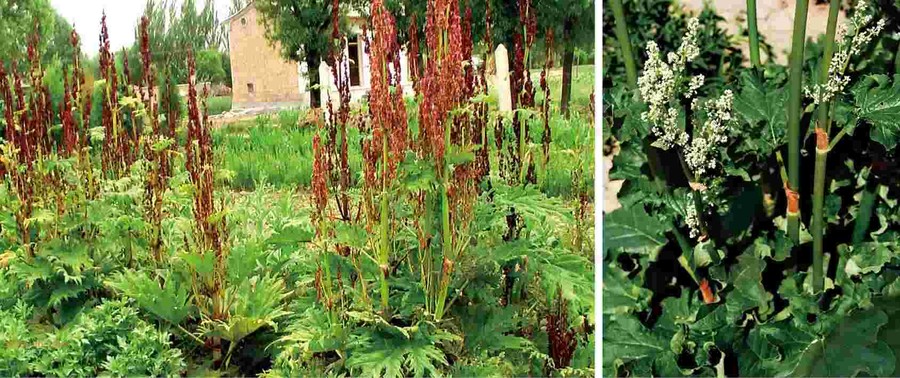
1. Yaoyong Dahuang (Medicinal Rhubarb): A tall perennial herb. Rhizome robust, stem erect, about 2 m tall, hollow, glabrous. Basal leaves shallowly 5-lobed, lobes large-toothed or broadly triangular, sparsely papillate above, pubescent beneath; stem leaves smaller, with short petioles; ocrea membranous, translucent, with short hairs. Flowers relatively large, pale yellowish-green, buds elliptic; perianth segments 6, in 2 whorls; stamens 9; styles 3. Fruiting branches spreading, winged achenes with opaque margins. Flowering June-July, fruiting July-August. 2. Zhangye Dahuang (Palmate Rhubarb): A tall perennial herb. Rhizome robust. Stem erect, about 2 m tall, hollow, glabrous. Basal leaves large, with thick fleshy long petioles about as long as the blade; blade broadly cordate or suborbicular, palmately 3-7 deeply lobed, lobes often further pinnately divided, sparsely papillate above, pubescent beneath; stem leaves smaller, with short petioles; ocrea tubular, densely pubescent. Inflorescence a large terminal panicle; pedicels slender, with a joint in the middle-lower part. Flowers purplish-red or reddish-purple; perianth segments 6, in 2 whorls; stamens 9; styles 3. Achenes 3-angled, winged along the angles, apex slightly depressed, base subcordate, dark brown. Flowering June-July, fruiting July-August.
Habitat and Distribution
1. Medicinal rhubarb: grows at forest edges or grassy slopes in mountainous areas. Distributed in southern Shaanxi, western Henan, western Hubei, Sichuan, Guizhou, and Yunnan. 2. Palm-leaved rhubarb: grows at forest edges or grassy slopes in mountainous areas, wild or cultivated. Distributed in Shaanxi, southeastern Gansu, Qinghai, western Sichuan, northwestern Yunnan, and eastern Xizang.
Harvesting and Processing
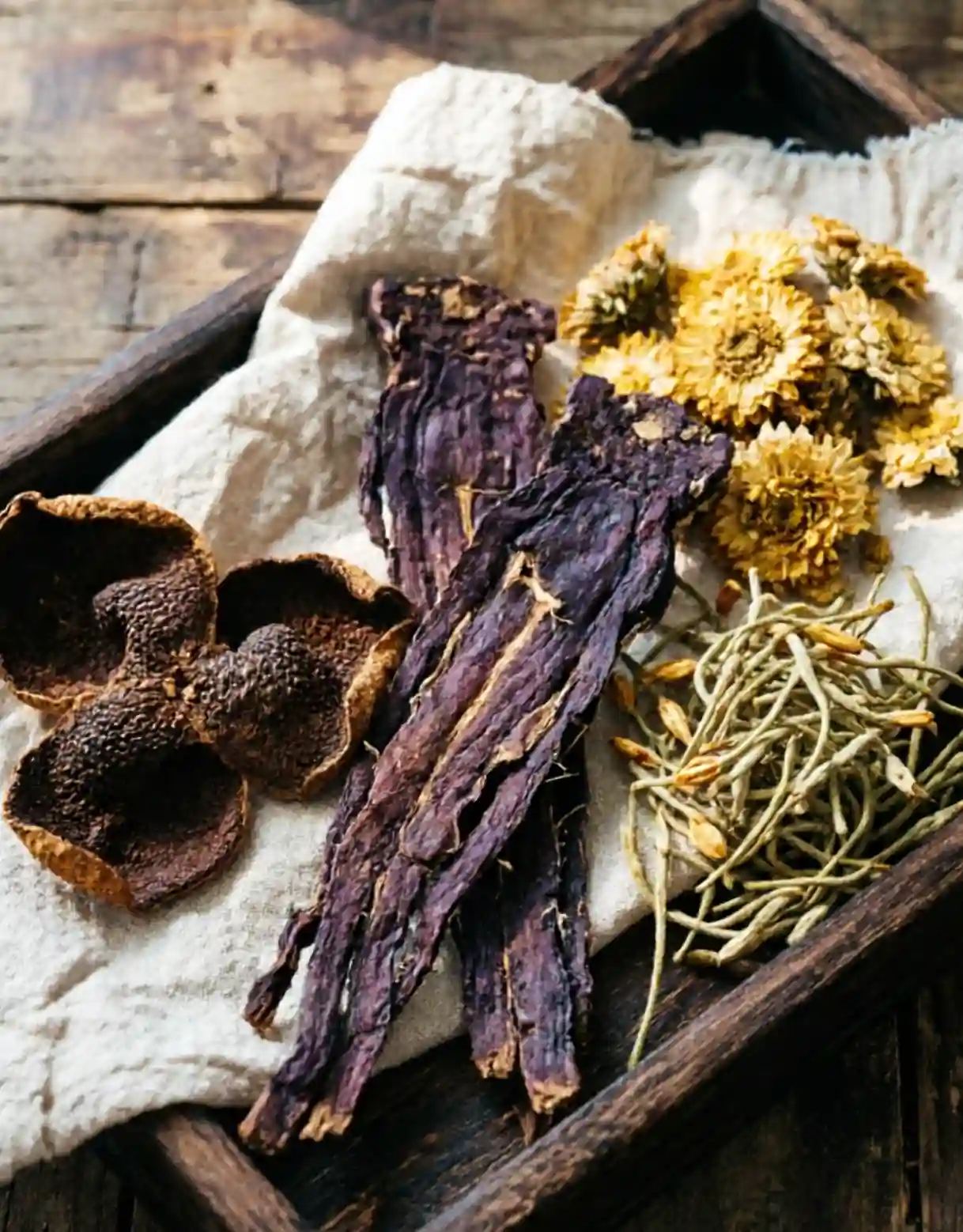
Excavated in late autumn when stems and leaves wither or before sprouting in the following spring, remove the fine roots, scrape off the outer bark, cut into segments or slices, string them together with rope and dry, or dry directly.
Medicinal Properties
This product is irregularly cylindrical, conical, ovoid, or lump-shaped, 3-17 cm long, 3-10 cm in diameter. The surface of the completely peeled product is yellowish-brown to reddish-brown, sometimes with visible grayish-white reticulate patterns and scattered star spots (anomalous vascular bundles); the remaining outer bark is brownish, often with rope holes and coarse wrinkles. The texture is firm, occasionally slightly loose in the center, and the cut surface is reddish-brown or yellowish-brown, showing a granular texture; the pith of the rhizome is broad, with star spots arranged in rings or scattered; the root wood is well-developed, with radial striations, a distinct cambium ring, and no star spots. Odor: aromatic; Taste: bitter and slightly astringent, sticky when chewed, with a sandy texture.
Chemical Constituents
This product primarily contains aloe emodin, chrysophanol, physcion, rhein, emodin, and other components.
Pharmacology
It has cathartic, cholagogic, hepatoprotective, and anti-gastric and duodenal ulcer effects on the digestive system, and stimulates intestinal smooth muscle. It possesses antibacterial, antifungal, antiviral, antitumor, anti-inflammatory, hemostatic, lipid-lowering, and diuretic effects; it can improve azotemia.
Properties and Channel Entry
Bitter, cold. Enters the Spleen, Stomach, Large Intestine, Liver, and Pericardium channels.
Functions and Indications
Purges accumulation and attacks stagnation, clears Heat and drains Fire, cools the Blood and resolves toxicity, breaks up stasis and unblocks the menses, disinhibits Dampness and reduces jaundice. Used for constipation due to excess Heat and food accumulation, vomiting and epistaxis due to Blood-Heat, red eyes and swollen throat, boils, sores, and furuncles, intestinal abscess with abdominal pain, Blood stasis amenorrhea, postpartum Blood stasis obstruction, traumatic injuries, dysenteric disorders due to Damp-Heat, jaundice with dark urine, Lin syndrome, and edema; external use for burns and scalds. Wine-processed Dahuang excels at clearing Heat-toxin in the Blood aspect of the Upper Jiao, used for red eyes and swollen throat, and painful swollen gums. Cooked Dahuang has a milder purging effect, drains Fire and resolves toxicity, used for Fire-toxin sores and ulcers. Dahuang Charcoal cools the Blood, transforms stasis, and stops bleeding, used for bleeding disorders due to Blood-Heat with Blood stasis.
Dosage and Administration
Oral administration: decoction, 3-12 g; when used raw, Rhubarb has a strong purgative effect - for purging and unblocking the bowels, it should be added later and not decocted for long; alternatively, steep in boiling water and drink the liquid; ground into powder, 0.5-2 g; or made into pills or powders. External use: appropriate amount, ground into powder and mixed for application, or decocted in water for washing or applying. The decoction can also be used for enema.
Precautions and Contraindications
For Spleen and Stomach deficiency-cold pattern, Blood deficiency and Qi weakness, use with caution during pregnancy, postpartum, menstruation, and lactation. Oral administration of raw Dahuang may cause nausea, vomiting, abdominal pain, and other adverse reactions, which generally resolve after discontinuation.
Prescriptions
1. For edema, promoting urination: Dahuang (Rhubarb), Baizhu (White Atractylodes), Fangji (Tetrandra) in equal parts. Grind into powder, make into pills with honey the size of wutong seeds. Take ten pills with rice water. Stop when urination is smooth; if not, increase the dose. (Puji Fang, Dahuang Wan) 2. For heat-induced abscesses and swellings: Dahuang (Rhubarb) 45 g, Baiji (Bletilla) 30 g, Poxiao (Glauber's salt) 60 g. Grind the above into powder, mix with well water to apply externally, moisten when dry. (Jingyue Quanshu, Dahuang Daodu San) 3. For constipation: Dahuang (Rhubarb, cut and stir-fried) 150 g, Damaren (Hemp seed, ground) 60 g. Grind the above into powder. Make into pills with honey the size of wutong seeds. Take ten pills after meals with warm water. (Puji Fang, Dahuang Wan) 4. For typhoid fever on the seventh or eighth day, with jaundice the color of an orange, difficulty urinating, and slight abdominal fullness: Yinchenhao (Oriental Wormwood) 180 g, Zhizi (Gardenia fruit, broken) fourteen pieces, Dahuang (Rhubarb, peeled) 90 g. Decoct the above three ingredients in 1.2 sheng of water. First boil Yinchenhao, reduce by 0.6 sheng, then add the other two ingredients, decoct to 0.3 sheng, and remove the dregs. Take in three doses. Urination should become smooth, with urine like soap bean juice, bright red in color. After one night, the abdominal fullness will reduce. The jaundice will be eliminated through urination. (Shanghan Lun, Yinchenhao Tang)