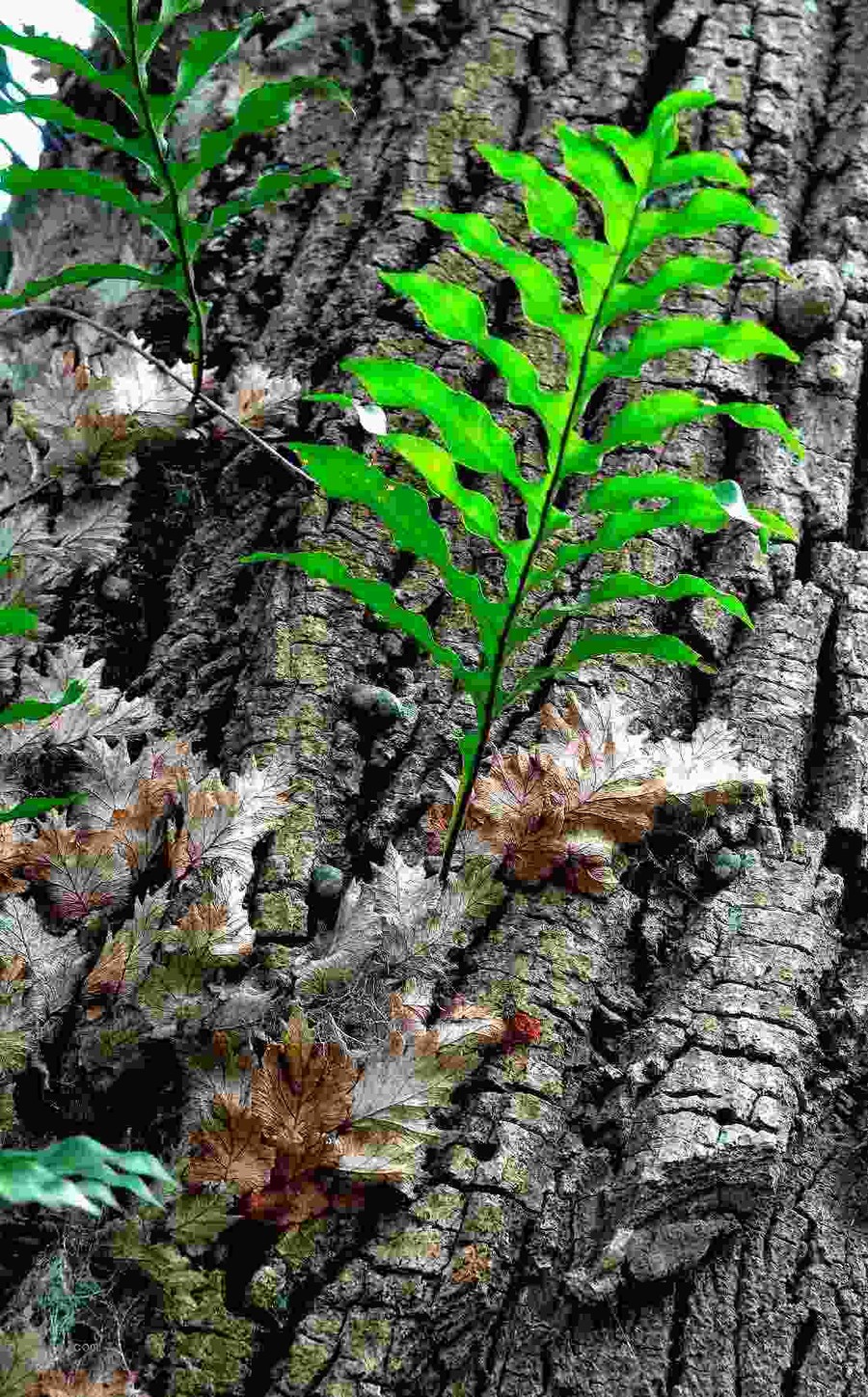
Pinyin: Gusuibu
Aliases
Houjiang, Shimaojiang, Guoshanlong, Shanhu.
Source
Plant of the family Polypodiaceae, *Drynaria roosii*Drynaria fortuneiDry rhizome of (Kunze) J.Sm.
Botanical Description
Plant height 25-40 cm. Rhizome creeping, thick and fleshy, densely covered with subulate-lanceolate scales, with green hairs. Leaves dimorphic; sterile leaves gray-brown, ovate, sessile, dry-membranous, cordate at base, sparsely short-hairy on the abaxial surface, margin coarsely and shallowly lobed; fertile leaves tall, papery, green, glabrous, oblong-elliptic, gradually narrowing toward base and becoming undulate, decurrent into a winged short petiole, deeply pinnatifid above the middle; lobes 7-13 pairs, slightly ascending, shortly acute, margin with indistinct sparse obtuse teeth; reticulate venation prominent on both surfaces. Sori orbicular, borne at the junction of included veinlets, arranged in 2-3 rows on each side of the midrib; indusium absent.
Habitat and Distribution
Attached to rocks or trees in forests at an altitude of 200-1800 m. Distributed in Southwest China and Zhejiang, Jiangxi, Fujian, Hubei, Hunan, Guangdong, and Guangxi.
Harvesting and Processing
It can be harvested year-round, remove mud and sand, dry, or further burn off the fine hairs (scales).
Medicinal Properties
The rhizome is irregularly dorsiventrally flattened, strip-shaped, lumpy, or flaky, often curved, with constrictions and branches on both sides. The surface is densely covered with brown or reddish-brown small scales; the appressed scales are membranous and shield-shaped; the erect scales are lanceolate with pointed tips and fringed (ciliate) margins, and are more densely distributed at the base of the petiole and the tender end of the rhizome. The areas where scales have fallen off appear brown, with fine longitudinal striations and grooves visible. The upper surface bears petiole scars, while the lower surface shows longitudinal ridges and fine root scars. The texture is hard; the cross-section is reddish-brown with white steles arranged in a long, flat oval shape. Odor: aromatic; Taste: slightly sweet and astringent.
Chemical Constituents
This product mainly contains naringin, 21-hopene, cycloartenol acetate, cycloeucalenol acetate, cyclolaudenol acetate,β- β-sitosterol, naringenin, etc.
Pharmacology
Has bone-strengthening effects; can inhibit the ototoxicity of streptomycin; has lipid-lowering, cardiotonic, sedative, analgesic, and antibacterial effects.
Properties and Channel Entry
Bitter, warm. Enters the Liver and Kidney channels.
Functions and Indications
Tonifies the Kidneys, strengthens the bones, activates Blood circulation, and alleviates pain
Dosage and Administration
Internal use: decoction, 10-20 g; or made into pills or powder
Precautions and Contraindications
Patients with Yin deficiency and internal Heat, or those without Blood stasis, should use with caution.
Prescriptions
1. For kidney deficiency low back pain and rheumatic lower back and leg pain: Gusuibu (Drynaria fortunei) and Sangjisheng (Taxillus chinensis) 15 g each, Qinjiao (Gentiana macrophylla) and Xixiancao (Siegesbeckia orientalis) 9 g each, decoct in water and take orally. (Selected Chinese Herbal Medicines from Shaanxi, Gansu, Ningxia, and Qinghai) 2. For chronic diarrhea due to kidney deficiency: Gusuibu 15 g, Buguzhi (Psoralea corylifolia) 9 g, Shanyao (Dioscorea opposita) 15 g, Wuweizi (Schisandra chinensis) 6 g, decoct in water and take orally. (Shanxi Chinese Herbal Medicine) 3. For pediatric malnutrition (gan accumulation): Gusuibu (powdered) 9 g, steam with lean pork and consume. (Jiangxi Herbal Medicine Manual) 4. For persistent hair loss after illness: Gusuibu and wild rose branches, a small amount of each, decoct the juice and brush onto the scalp. (Compendium of Materia Medica) 5. For alopecia areata and hair loss: Gusuibu 15 g, wine 90 g, soak for more than 10 days, filter the liquid, and apply to the affected area 2-3 times daily. (Anhui Chinese Herbal Medicine)