Pinyin: Baihe
Aliases
Chongmai, Baihesuan, Suannaoshu.
Source
Liliaceae plant LiliumLilium browniiF.E.Brown var.viridulumBaker's dried fleshy scale leaves.
Botanical Description
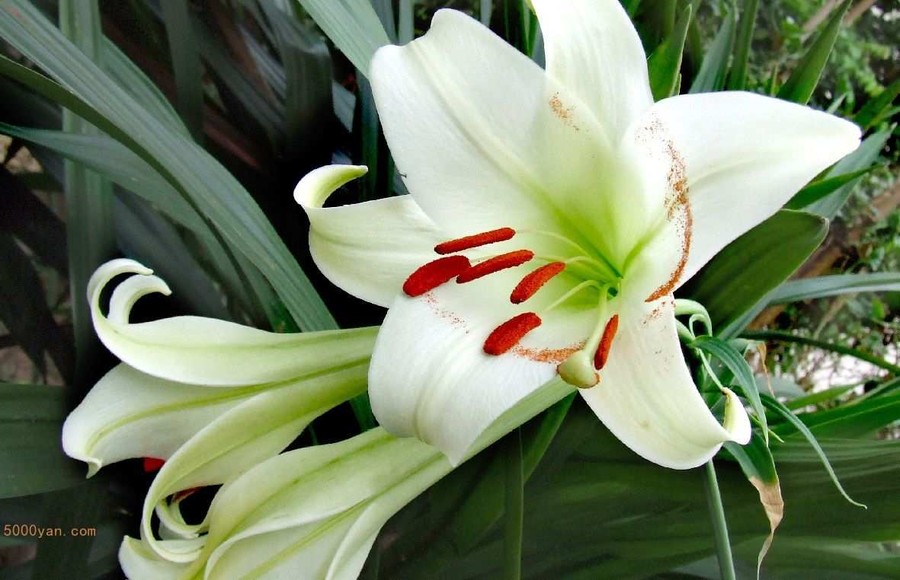
Perennial herb, 70-150 cm tall. Stem with purple stripes, glabrous; bulb globose, approximately 5 cm in diameter, bulb scales spreading, without nodes, white. Leaves scattered, with short petioles; upper leaves often smaller than middle leaves, leaf blades oblanceolate to obovate, 7-10 cm long, 2-3 cm wide, apex acute, base obliquely narrow, entire margin, glabrous, with 3-5 veins. Flowers 1-4, trumpet-shaped, fragrant; perianth segments 6, obovate, 15-20 cm long, 3-4.5 cm wide, mostly white, with purplish-brown on the back, without spots, apex curved but not recurved, nectary with small papillae on both sides; stamens 6, curved forward, filaments 9.5-11 cm long, pubescent, anthers elliptic, dorsifixed, pollen grains brownish-red; ovary cylindrical, approximately 3.5 cm long, style 11 cm long, glabrous, stigma 3-lobed. Capsule oblong, approximately 5 cm long, 3 cm wide, with ridges; seeds numerous. Flowering and fruiting period: June to September.
Habitat and Distribution
Born at altitudes below 900 m in hillside grass, rock crevices, or near villages. Also cultivated. Distributed in Hebei, Shanxi, Shaanxi, Anhui, Zhejiang, Jiangxi, Henan, Hubei, Hunan, and other regions.
Harvesting and Processing
Harvested in autumn, washed clean, scale leaves peeled off, briefly blanched in boiling water, and dried.
Medicinal Properties
The scales are long-elliptical in shape, with an acute apex and a broader base, slightly undulate and curled inward, measuring 1.5-3 cm in length, 0.5-1 cm in width, and approximately 4 mm in thickness, with 3-5 obscure or indistinct veins. The surface is white or pale yellow, smooth and translucent; the texture is hard and brittle, breaking easily with a flat, horny fracture; it is odorless and has a slightly bitter taste.
Chemical Constituents
This product mainly contains Minjiang lily glycoside, deacyl lily saponin, daucosterol, deacyl lily saponin, and lily saponin.β- Solasonine, 1-O- p-coumaroylglycerol, nuatigenin, and others.
Pharmacology
Antitussive, antiasthmatic, and expectorant; anti-stress injury; sedative and hypnotic; enhances immune function, etc.
Properties and Channel Entry
Sweet, cold. Enters the Heart and Lung channels.
Functions and Indications
Nourishes Yin and moistens the Lungs, clears Heat and calms the Spirit
Dosage and Administration
Oral: decoct in water, 6-12 g; or made into pills or powder; also can be steamed or cooked in porridge. External use: appropriate amount, mashed for application.
Precautions and Contraindications
Contraindicated in cases of wind-cold cough and cold-type diarrhea with loose stools.
Prescriptions
1. For persistent cough or blood in sputum: Kuandonghua (Farfarae Flos) and Baihe (Lilii Bulbus, roasted and steamed) in equal parts. Grind into fine powder, mix with refined honey to form pills the size of Longan fruit. Take 1 pill after meals, chew finely before sleep, swallow with ginger decoction, or let dissolve in the mouth for better effect. (From *Jisheng Xufang*, Baihua Gao). 2. For pemphigus with damp sores: Crush fresh Baihe (Lilii Bulbus) and apply topically; relief occurs within 1-2 days. (From *Binhu Ji Jian Fang*). 3. For deafness and ear pain: Powder dried Baihe (Lilii Bulbus), take 6 g with warm water, twice daily. (From *Qianjin Yaofang*). 4. For neurasthenia, irritability, and insomnia: Baihe (Lilii Bulbus) 15 g, Suanzaoren (Ziziphi Spinosae Semen) 15 g, Yuanzhi (Polygalae Radix) 9 g. Decoct in water and take orally. (From *Xinjiang Zhongcaoyao Shouce*). 5. For lung abscess (Fei Yong): Baihe (Lilii Bulbus), either boiled or steamed, consume frequently; steaming with honey is better. (From *Jingyan Guangji*, Baihe Jian).