Pinyin: Nanbanlangen
Aliases
Tubanlangen, Landiangen, Banlangen.
Source
Acanthaceae plant Strobilanthes cusia.Baphicacanthus cusiaDried rhizome and root of (Nees) Bremek.
Botanical Description
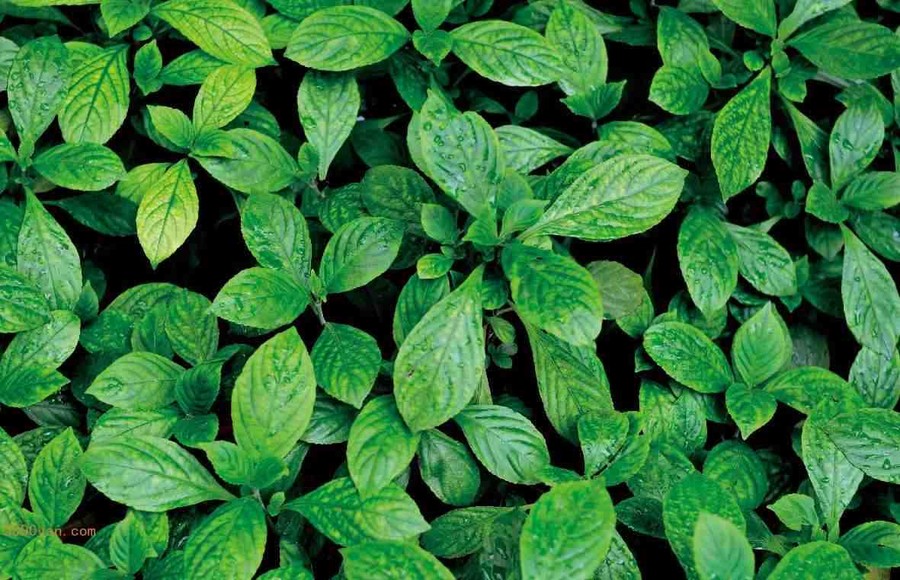
Perennial herb, 30-70 cm tall. Stems and leaves appear blue or dark green when dry. Rhizome stout, with a blue-colored cross-section. Base of the aboveground stem slightly woody, somewhat quadrangular, slightly branched, nodes swollen, covered with brownish minute hairs when young. Leaves opposite; leaf blades obovate-elliptic to ovate-elliptic; apex acute, slightly obtuse, base gradually narrowed, margin shallowly serrate, undulate, or entire; upper surface glabrous, with dense, narrow, linear cystoliths; lower surface with sparse brownish soft hairs on veins when young, lateral veins 5-6 pairs. Flowers sessile, arranged in sparse spikes, terminal or axillary; bracts leaf-like, narrowly obovate, caducous; calyx lobes 5, linear, usually one larger and spatulate, glabrous; corolla funnelform, pale purple, 5-lobed, nearly equal, apex slightly emarginate; stamens 4, didynamous, pollen ellipsoid, with bands bearing two wavy ridges; ovary superior, style slender. Capsule slightly narrow-spatulate, 1.5-2 cm long. Seeds 4, minutely hairy. Flowering June-October, fruiting July-November.
Habitat and Distribution
Found in mountainous areas and forest edges in moist environments, growing wild or cultivated. Distributed in Jiangsu, Zhejiang, Fujian, Hubei, Guangdong, Guangxi, Sichuan, Guizhou, Yunnan, and other regions.
Harvesting and Processing
Harvested in summer and autumn, dig up the roots, remove the above-ground stems, wash clean, and sun-dry.
Medicinal Properties
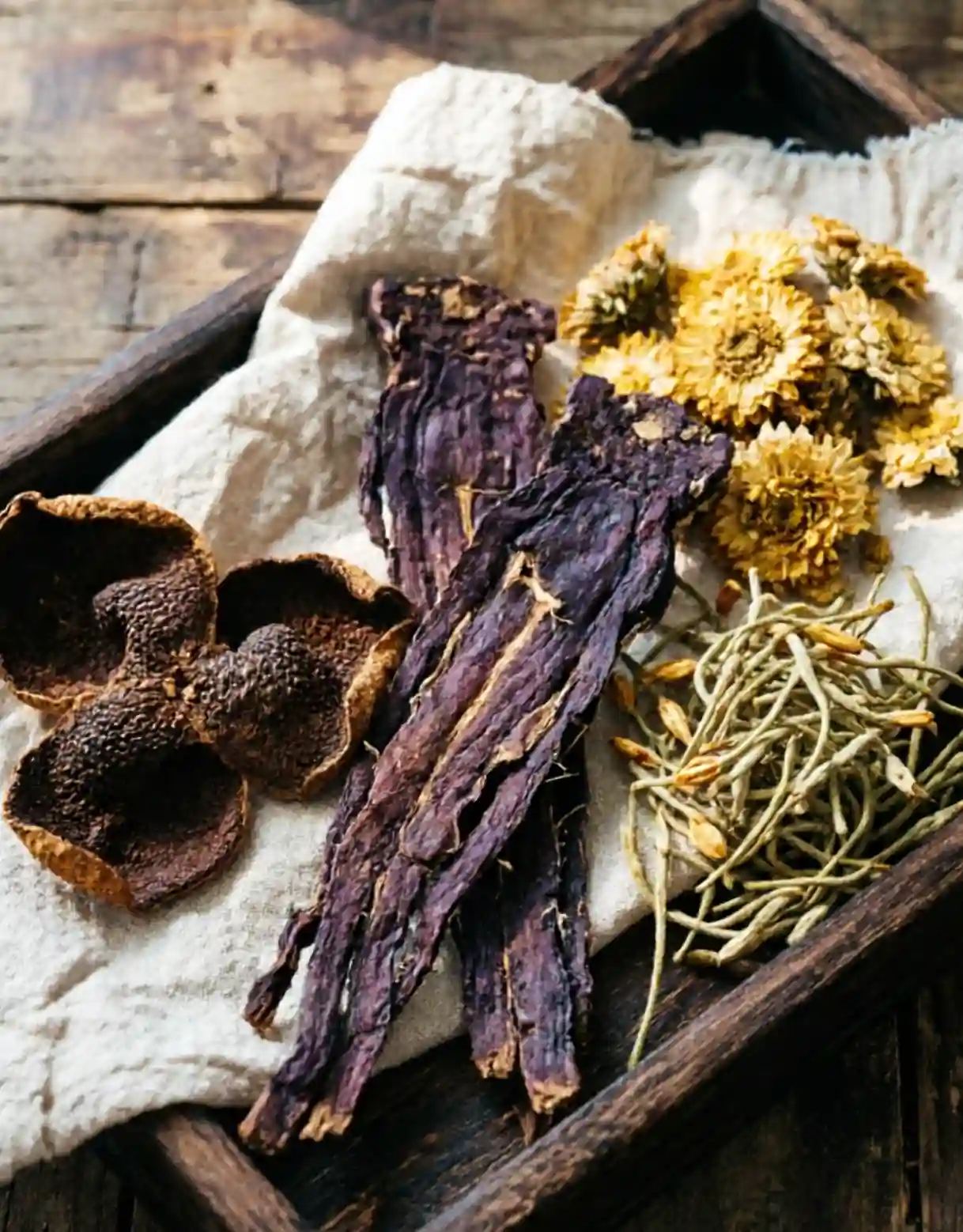
The rhizome and root measure 10-30 cm in total length, with the rhizome measuring 5-10 cm. The rhizome is cylindrical, often curved, sometimes branched, with a diameter of 2-6 mm; the upper part often has a short aerial stem, sometimes branched. The surface is gray-brown, with enlarged nodes where slender, slightly curved roots are attached, and the surface has fine wrinkles. The stem and rhizome are brittle, easy to break, with an uneven, somewhat fibrous fracture surface and a large central pith. The root is slightly tough and flexible. Odor: faint; Taste: bland.
Chemical Constituents
This product contains chrysophanol, indican, indirubin, lupeone, lupeol, betulin,β- Contains components such as sitosterol.
Properties and Channel Entry
Bitter, cold. Enters the Heart and Stomach channels.
Functions and Indications
Clears Heat and resolves toxicity, cools Blood and disperses macules. Used for epidemic seasonal toxins, fever with sore throat, epidemic toxin-induced macules, and erysipelas.
Dosage and Administration
Internal: decoct in water, 15-30 g; for large doses, up to 60-120 g; or made into pills or powder
Precautions and Contraindications
Patients with Spleen and Stomach deficiency-cold and without actual Heat-toxin should use with caution.
Prescriptions
1. For epidemic parotitis (mumps): Nanbanlangen 30 g, or with Jinyinhua and Pugongying 15 g each, decoct in water and take orally; for external use, crush fresh Maban leaves and apply topically. (Compendium of New Zhejiang Materia Medica) 2. For sore throat: Nanbanlangen 30 g, Kaihoujian 30 g, Shandougen 30 g, Mabo 9 g. Decoct in water and take orally. (Chongqing Herbal Medicine) 3. For preventing infant asthmatoid pneumonia: Nanbanlangen, Jinyinhua, Yizhihuanghua, 4.5 g each for children aged 4-7 years, 3 g each for those under 3 years. Decoct in water, take 3-4 times daily. (Compendium of New Zhejiang Materia Medica) 4. For summer low-grade fever that persists and does not subside: Nanbanlangen 30 g, Chaihu 9 g; for those with weak constitution, add Beishashen or Haierishen 9 g. Decoct in water. Take 1 dose daily for 7-10 consecutive days. (Compendium of New Zhejiang Materia Medica) 5. For heat-toxin sores: Nanbanlangen 30 g, Yinhuateng 30 g, Pugongying 30 g, Tufuling 15 g. Stew with meat and take orally. (Chongqing Herbal Medicine)