Pinyin: Quanshen
Aliases
Zishen, Mumeng, Zhongrong, Tongchang.
Source
Polygonaceae plant *Polygonum bistorta*.Polygonum bistortaL. dried rhizome.
Botanical Description
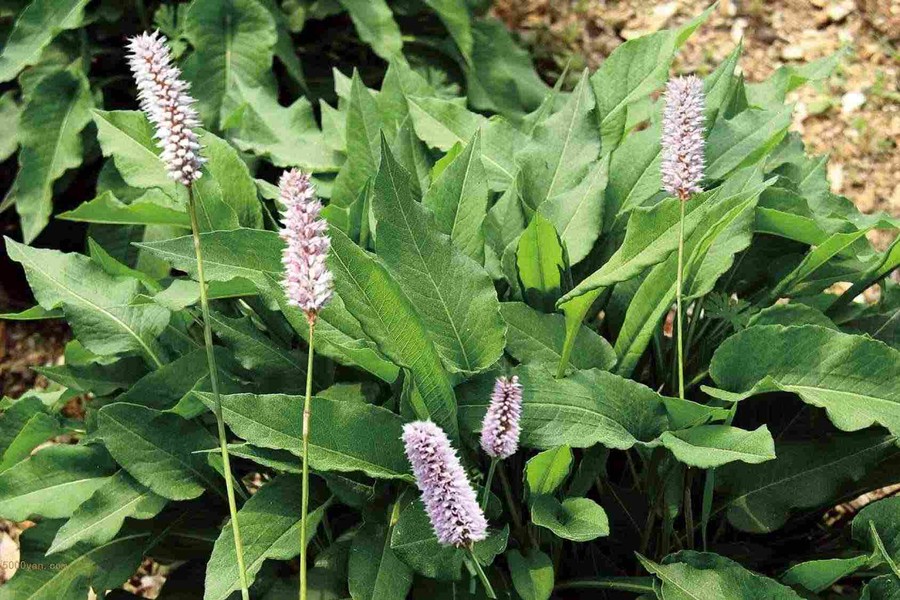
Perennial herb, 35-90 cm tall. Rhizome thick, curved, outer skin purplish-brown. Stem erect, solitary, glabrous (hairless). Basal leaves with long petioles; leaf blade leathery, oblong-lanceolate or lanceolate, 10-20 cm long, 2-6 cm wide, apex acuminate, base rounded or truncate, sometimes cordate, decurrent into wings along the petiole, margin revolute, both surfaces sparsely hairy, becoming glabrous with age, with reticulate veins beneath; cauline leaves alternate, petioles gradually shortened upward to amplexicaul, stipules sheath-like, membranous, 2-5 cm long. Raceme spicate, terminal, cylindrical, erect or slightly curved, 3-6 cm long; flowers dense, bracts ovate, membranous, pedicels slender; flowers pale red or white, about 2.5 mm in diameter, perianth 5-parted, lobes elliptic; stamens 8, nearly as long as or slightly longer than perianth; styles 3. Achene trigonous-ellipsoid, reddish-brown, shiny, enclosed within persistent perianth. Flowering period June to September, fruiting period September to November.
Habitat and Distribution
Born in mountain field grass clumps or under forests in damp and shady areas. Distributed in Liaoning, Inner Mongolia, Hebei, Shanxi, Shaanxi, Ningxia, Gansu, Xinjiang, Shandong, Jiangsu, Anhui, Zhejiang, Henan, Hubei, Hunan, and other places.
Harvesting and Processing
Harvested in early spring at the time of sprouting or in autumn when the stems and leaves are about to wither; remove mud and sand, dry in the sun, and remove fibrous roots.
Medicinal Properties
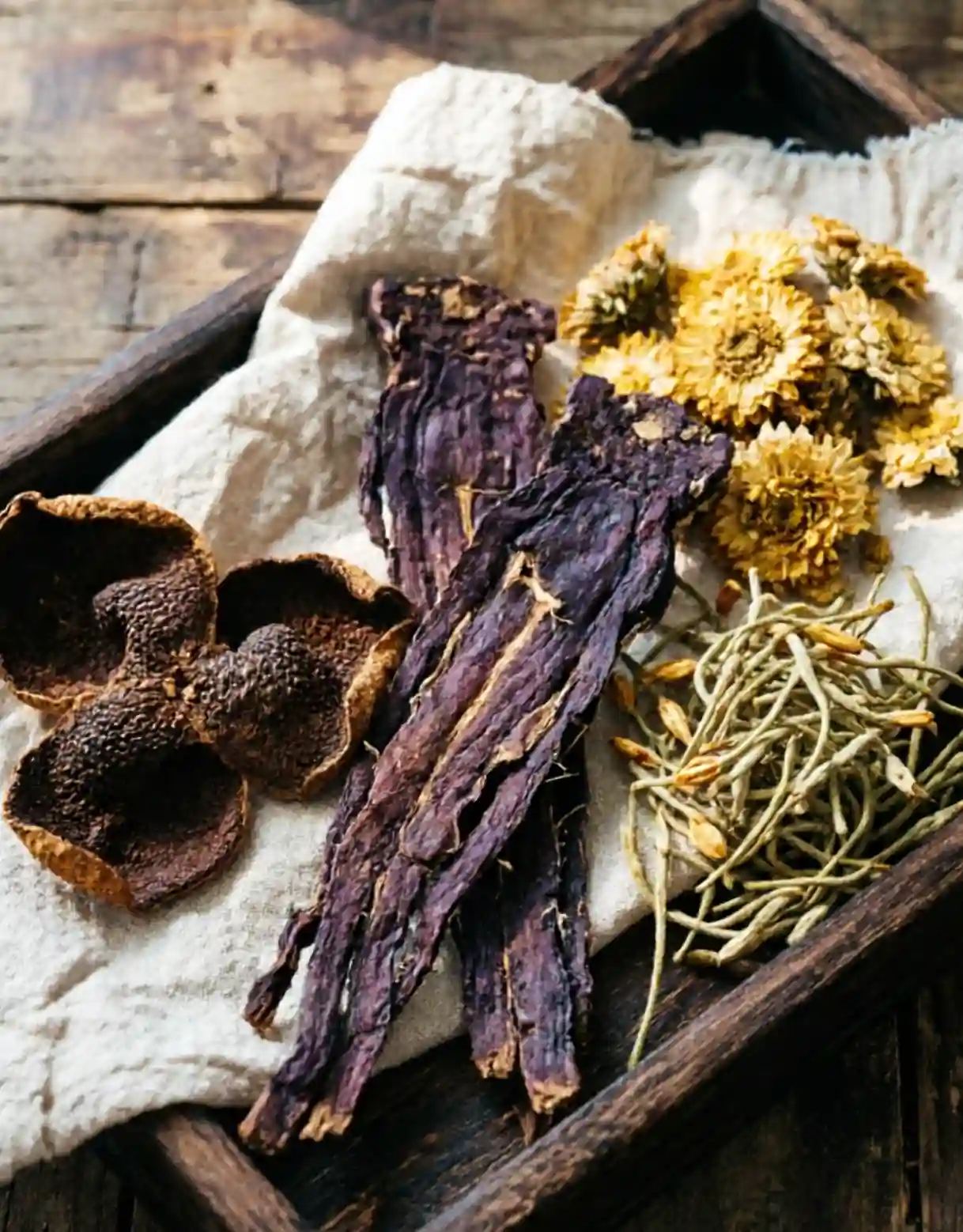
This product is elongated, flat, or flat-cylindrical, curved, sometimes rolled inward, with both ends slightly pointed or one end gradually tapering, 6-13 cm long and 1-2.5 cm in diameter. The surface is purple-brown or purple-black, rough, raised on one side and slightly flat or with a shallow groove on the other, densely covered with coarse annular striations, with residual fibrous roots or root scars. The texture is hard; the cut surface is light brownish-red or brownish-red, with yellow-white dotted vascular bundles arranged in rings. Odor: faint; Taste: bitter and astringent.
Chemical Constituents
This product primarily contains gallic acid, as well as hydrolyzable tannins and condensed tannins. It also contains (+)-catechin, (-)-epicatechin, 6-galloylglucose, 3,6-digalloylglucose, glucose, and other components.
Pharmacology
Has antibacterial and hemostatic effects; can significantly reduce cholinesterase activity, and can lower cholesterol in the serum and liver of rats, and has a preventive effect on diabetes induced by alloxan in rats.
Properties and Channel Entry
Bitter, astringent, and slightly cold. Enters the Lung, Liver, and Large Intestine channels.
Functions and Indications
Clears Heat and resolves toxicity, reduces swelling, and stops bleeding
Dosage and Administration
Internal use: decoct in water, 3-12 g; or made into pills or powder. External use: appropriate amount, pounded into paste for application, or decocted in water for gargling or fumigation-washing.
Precautions and Contraindications
Not suitable for those without Excess Heat and Fire Toxin. Contraindicated in patients with Yin-type abscesses (deep-rooted sores).
Prescriptions
1. For dysentery: Fresh *Bistorta officinalis* and fresh *Taraxacum mongolicum* 12 g each, fresh *Scutellaria baicalensis* 9 g. Decoct in water for oral administration. Reduce dosage for children. (National Compilation of Chinese Herbal Medicine) 2. For chronic bronchitis: *Bistorta officinalis* 9 g, *Citri reticulatae* Pericarpium 9 g, *Glycyrrhiza uralensis* 6 g. Decoct in water for oral administration. (Xining Chinese Herbal Medicine) 3. For acute tonsillitis: *Bistorta officinalis* 9 g, *Taraxacum mongolicum* 15 g. Decoct in water for oral administration. (Xining Chinese Herbal Medicine) 4. For burns and scalds: Grind *Bistorta officinalis* into powder, mix with sesame oil, and apply evenly to the affected area, 1-2 times daily. (Guizhou Chinese Herbal Medicine Data) 5. For persistent hematemesis: *Bistorta officinalis*, *Panax ginseng*, and *Colla Corii Asini* (stir-fried) in equal parts. Grind into powder. Take 3 g with *Mume Fructus* decoction. Another formula removes ginseng and adds *Glycyrrhiza uralensis*, taken with *Oryza sativa* (rice) decoction. (Sheng Hui Fang) 6. For hemoptysis, epistaxis, and gastric ulcer: *Bistorta officinalis* 45 g, grind into fine powder. Take 4.5 g per dose, 2 times daily. (Ningxia Chinese Herbal Medicine Manual) 7. For hemorrhoidal bleeding: Decoct *Bistorta officinalis* 15 g in water, and use the decoction for fumigation and washing of the affected area. (Southern Herbal Medicine) 8. For unnamed toxic swellings: *Bistorta officinalis* rhizome 6-9 g, decoct in water for oral administration. (Hunan Materia Medica)