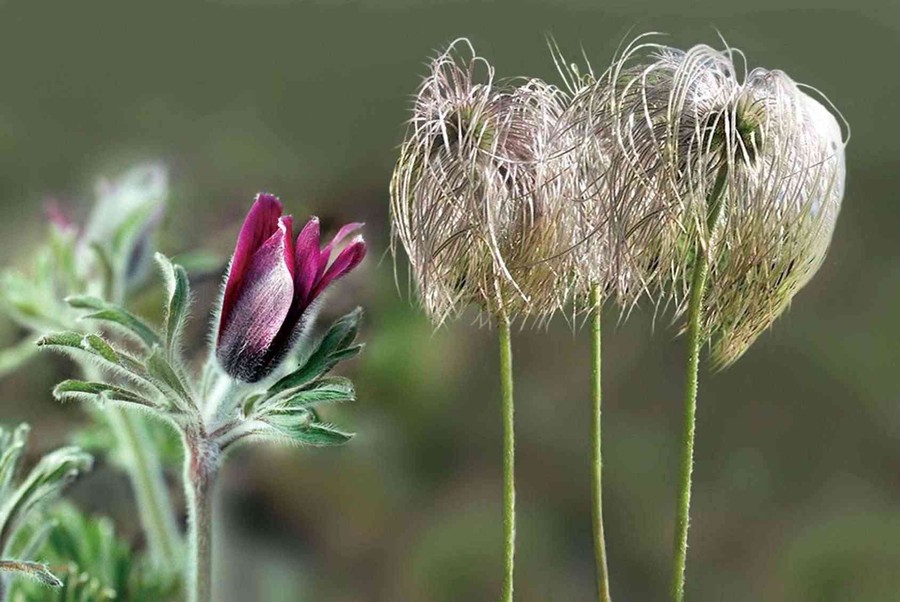
Pinyin: Baitouweng
Aliases
Yezhangren, Huwangshizhe, Baitougong.
Source
1Pulsatilla chinensisDry root of (Bge.) Regel.
Botanical Description
Perennial herb, 15-35 cm tall. Rhizome thick, diameter 8-15 mm. Basal leaves 4-5, emerging above ground at flowering time, leaves 3-parted; petiole 7-15 cm long, densely covered with long hairs; leaf blade broadly ovate in outline, 4.5-14 cm long, 6.5-16 cm wide, sparsely hairy above, becoming glabrous later, densely long-hairy beneath, 3-parted, central segment petiolulate or nearly sessile, 3-parted, central lobule cuneate-ovate or narrowly cuneate, entire or toothed, lateral lobules unequally 2-lobed; lateral segments sessile or nearly so, unequally 3-parted. Scape 1-2, elongating after flowering, 15-35 cm tall, bracts 3, connate at base, tube 3-10 cm long, lobes linear, densely long-hairy outside, glabrous inside; flowers bisexual, solitary, erect pedicel 2.5-5.5 cm long; sepals 6, in 2 whorls, narrowly ovate or oblong-ovate, 2.8-4.4 cm long, 9-20 mm wide, blue-purple, densely hairy outside; petals absent; stamens numerous, about half the length of sepals; carpels numerous, hairy. Achenes 3-4 mm long, long-hairy, apex with persistent feathery style, 3.5-6.5 cm long. Flowering period April to May, fruiting period June to July.
Habitat and Distribution
Born in plains or low mountain hillside grasslands, forest edges, or arid, rocky slopes. Distributed in Northeast, North China, and Shaanxi, Gansu, Shandong, Jiangsu, Anhui, Henan, Hubei, and Sichuan.
Harvesting and Processing
Harvested in spring and autumn, remove sediment and sand, then dry.
Medicinal Properties
This product is subcylindrical or conical in shape, slightly twisted, 6-20 cm long and 0.5-2 cm in diameter. The surface is yellowish-brown or brownish-brown, with irregular longitudinal wrinkles or furrows; the bark is easily exfoliated, revealing the yellow xylem, sometimes with reticulate cracks or fissures, and often with decayed pits near the root crown. The root crown is slightly enlarged, with white hairs, and occasionally remnants of sheath-like petiole bases are visible. The texture is hard and brittle; in cross-section, the bark is yellowish-white or pale yellowish-brown, and the xylem is pale yellow. Odor: faint; Taste: slightly bitter and astringent.
Chemical Constituents
This product contains pulsatilla saponin B4, betulinic acid, anemonin, pulsatillin, shikimic acid, and others.
Pharmacology
Has antibacterial, anti-amoebic, anti-pathogenic, sedative, and analgesic effects.
Properties and Channel Entry
Bitter, cold. Enters the Stomach and Large Intestine channels.
Functions and Indications
Clears Heat and resolves toxicity, cools Blood and stops dysentery, used for heat-toxic bloody dysentery, vaginal itching and morbid leukorrhea.
Dosage and Administration
Internal: decoct in water, 15-30 g; or made into pills or powder. External: appropriate amount, decoct for washing or mash for application.
Precautions and Contraindications
Patients with deficiency-cold diarrhea and dysentery should use with caution.
Prescriptions
1. For dysenteric diarrhea with tenesmus: Baitouweng 60 g, Huanglian, Huangbai, and Qinpi 90 g each. Decoct the four ingredients in 7 sheng of water until 2 sheng remain, then strain. Take 1 sheng warm; if not cured, continue taking. (Jinkui Yaolüe, Baitouweng Tang) 2. For warm malaria with onset and coma-like unconsciousness: Baitouweng 30 g, Chaihu, Banxia, Huangqin, and Binglang 6 g each, Gancao 2.1 g, decoct in water and take orally. (Bencao Huiyan) 3. For external hemorrhoids: Pulverize fresh Baitouweng root and apply directly to stop bleeding and relieve pain. (Weisheng Yijian Fang) 4. For inguinal hernia or unilateral scrotal swelling: Baitouweng and Lizhihe 60 g each, soak in wine, stir-fry and grind into powder. Take 9 g each morning, mixed with plain water. (Bencao Huiyan) 5. For wheezing: Baitouweng 6 g, decoct in water and take orally. (Wentang Jiyan Fang)