Pinyin: Beishashen
Aliases
Zhenbeishashen, Yintiaoshen, Liaoshashen, Yexiangcaigen.
Source
Apiaceae plant *Glehnia littoralis*.Glehnia littoralisDried root of Fr.Schmidt ex Miq.
Botanical Description
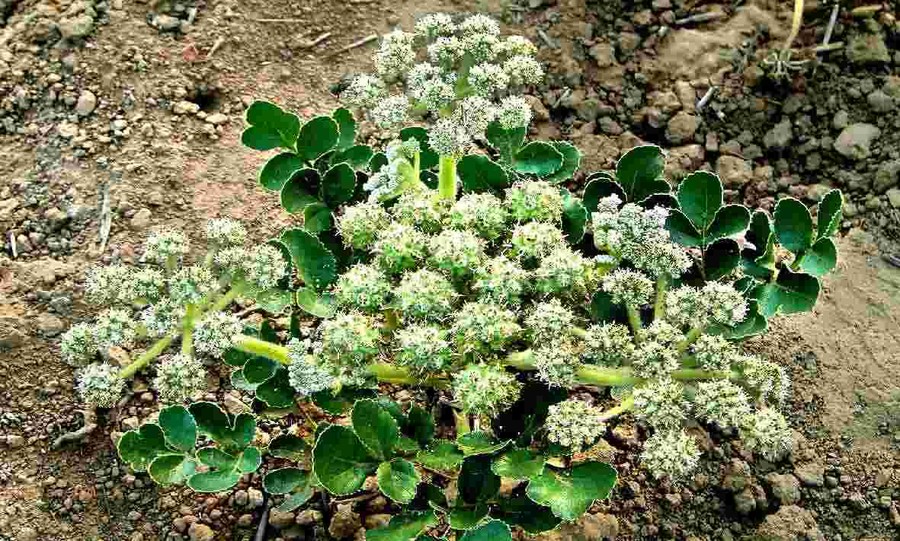
Perennial herb, 5-20 cm tall. Entire plant covered with white pubescence. Taproot slender, cylindrical, up to 30 cm long, 0.5-1.5 cm in diameter, rarely branched. Aerial stem short, underground part elongated. Basal leaves thick, with long petioles; petiole 5-15 cm long, base broadly sheathing, margin membranous; leaf blade outline ovate to triangular-ovate, ternate or ternate-2-pinnatisect, ultimate segments obovate to ovate, 1-6 cm long, 1-4 cm wide, apex rounded to acuminate, base cuneate to truncate, margin with incised serrations, teeth white cartilaginous; petioles and veins with fine stiff hairs. Stem leaves similar in shape to basal leaves, petiole base gradually expanded and sheathing. Compound umbel terminal, densely covered with gray-brown long hairs, 3-6 cm in diameter; peduncle 2-6 cm long; rays 8-16, unequal, 1-3 cm long; involucral bracts absent; involucel of several bracteoles, linear-lanceolate, densely hairy on margin and back; umbellules with 15-20 flowers; calyx teeth 5, narrowly triangular-lanceolate, sparsely hispid; petals white; stylopodium short conical. Schizocarp globose or ellipsoid, 6-13 mm long, 6-10 mm wide, densely covered with brown long hairs and tomentum; ribs with corky wings; mericarp transversely section flat-elliptic, with 5 angles, commissure flat, numerous vittae forming a ring, endosperm slightly concave on ventral side. Flowering period May to July, fruiting period June to August.
Habitat and Distribution
Born on coastal sandy land, sandy beaches, or cultivated in fertile, loose sandy soil. Distributed in Liaoning, Hebei, Shandong, Jiangsu, Zhejiang, Fujian, Taiwan, Guangdong and other regions.
Harvesting and Processing
Harvested in summer and autumn, dig up, remove fibrous roots, wash, air-dry slightly, blanch in boiling water, remove outer bark, and dry. Alternatively, wash and dry directly.
Medicinal Properties
This product is slender and cylindrical, occasionally branched, 15-45 cm long, 0.4-1.2 cm in diameter. The surface is pale yellowish-white, slightly rough, occasionally with remnants of outer bark; specimens without the outer bark removed have a yellowish-brown surface. The entire body exhibits fine longitudinal wrinkles and furrows, along with brownish-yellow dotted fine root scars; the apex often retains yellowish-brown rhizome remnants. The upper part is slightly thinner, the middle part slightly thicker, and the lower part gradually tapers. The texture is brittle and easily broken; the fractured surface shows a pale yellowish-white bark region and a yellow wood region. The odor is distinctive, and the taste is slightly sweet.
Chemical Constituents
This product contains components such as xanthotoxin, alloimperatorin, scopoletin, marmesin, bergapten, secoisolariciresinol, caffeic acid, syringin, and Glehnia littoralis polysaccharides.
Pharmacology
Has antipyretic, analgesic, and immunosuppressive effects.
Properties and Channel Entry
Sweet, slightly bitter, and slightly cold. Enters the Lung and Stomach channels.
Functions and Indications
Nourishes Yin, clears the Lungs, benefits the Stomach, and generates body fluids
Dosage and Administration
Internal use: decoction, 5-10 g; or in pill, powder, or paste form.
Precautions and Contraindications
It should not be used with Lilium brownii
Prescriptions
1. For all cases of Yin deficiency with fire flaring, appearing deficient yet excess, rebellious Qi not descending, clear Qi not ascending, with vexation, thirst, cough, distention and fullness without appetite: *Glehniae Radix* (Bei Shashen) 15 g. Decoct in water for oral administration. (From "Compendium of Materia Medica" citing "Lin Zhongxian's Medical Cases") 2. For Yin deficiency with fire flaring, cough without phlegm, bone-steaming and consumptive fever, dry and rough skin, bitter taste, thirst, and vexation: *Glehniae Radix* (Bei Shashen), *Ophiopogonis Radix* (Mai Men Dong), *Anemarrhenae Rhizoma* (Zhi Mu), *Fritillariae Thunbergii Bulbus* (Chuan Bei Mu), *Rehmanniae Radix Praeparata* (Huai Shu Di Huang), *Trionycis Carapax* (Bie Jia), and *Lycii Cortex* (Di Gu Pi) each 120 g. Prepare either as pills or as an ointment. Take 9 g each morning, with plain boiled water. (From "Compendium of Materia Medica" citing "Weisheng Yijian Fang") 3. For Yin deficiency cough or chronic cough with hoarseness: *Glehniae Radix* (Bei Shashen), *Scrophulariae Radix* (Xuan Shen), *Anemarrhenae Rhizoma* (Zhi Mu), and *Arctii Fructus* (Niu Bang Zi) each 9 g, *Rehmanniae Radix* (Sheng Di Huang) 15 g. Decoct in water for oral administration. (From "Shanxi Chinese Herbal Medicine") 4. For pulmonary tuberculosis cough: *Glehniae Radix* (Bei Shashen) 9 g, *Ophiopogonis Radix* (Mai Dong) 6 g, *Glycyrrhizae Radix et Rhizoma* (Gan Cao) 3 g. Infuse in boiling water and drink as tea. (From "Food Herbs and Simple Prescriptions") 5. For acute and chronic bronchitis: *Glehniae Radix* (Bei Shashen) and *Plantaginis Semen* (Che Qian Zi) each 10 g, *Glycyrrhizae Radix et Rhizoma* (Sheng Gan Cao) 5 g. Decoct in water. Take in 2-3 divided doses daily. (From "Food Herbs and Simple Prescriptions") 6. For various types of Lung-Heat cough with purulent sputum, hemoptysis, epistaxis, and asthma: *Glehniae Radix* (Bei Shashen) 90 g, *Chebulae Fructus* (He Zi), *Gardeniae Fructus* (Zhi Zi), *Rubiae Radix et Rhizoma* (Qian Cao), *Arnebiae Radix* (Zi Cao), and *Laciferae* (Zi Cao Rong) each 15 g, *Toosendan Fructus* (Chuan Lian Zi) 9 g. Grind together into a fine powder. Take 3-6 g each time, decocted and taken 2-3 times daily. (From "Chinese Ethnic Medicine Records" - Qiwei Shashen Tang) 7. For dry thirst and poor appetite after febrile disease: *Glehniae Radix* (Bei Shashen), *Ophiopogonis Radix* (Mai Dong), and *Dendrobii Caulis* (Shi Hu) each 12 g. *Rehmanniae Radix* (Sheng Di Huang) and *Polygonati Odorati Rhizoma* (Yu Zhu) each 15 g. Decoct in water for oral administration. (From "Qingdao Chinese Herbal Medicine Manual") 8. For deficient fire toothache: *Glehniae Radix* (Bei Shashen) and *Lycii Cortex* (Di Gu Pi) each 15 g, *Rehmanniae Radix* (Sheng Di Huang) and *Anemarrhenae Rhizoma* (Zhi Mu) each 9 g, *Asari Radix et Rhizoma* (Xi Xin) 1.5 g. Decoct in water for oral administration. (From "Anhui Chinese Herbal Medicine")