Pinyin: Chuanshanlong
Aliases
Chuanlonggu, Goushanyao, Chuanshangu, Huotenggen.
Source
Dioscoreaceae plant *Dioscorea nipponica* Makino.Dioscorea nipponicaThe dried rhizome of *Panax ginseng* C.A. Mey.
Botanical Description
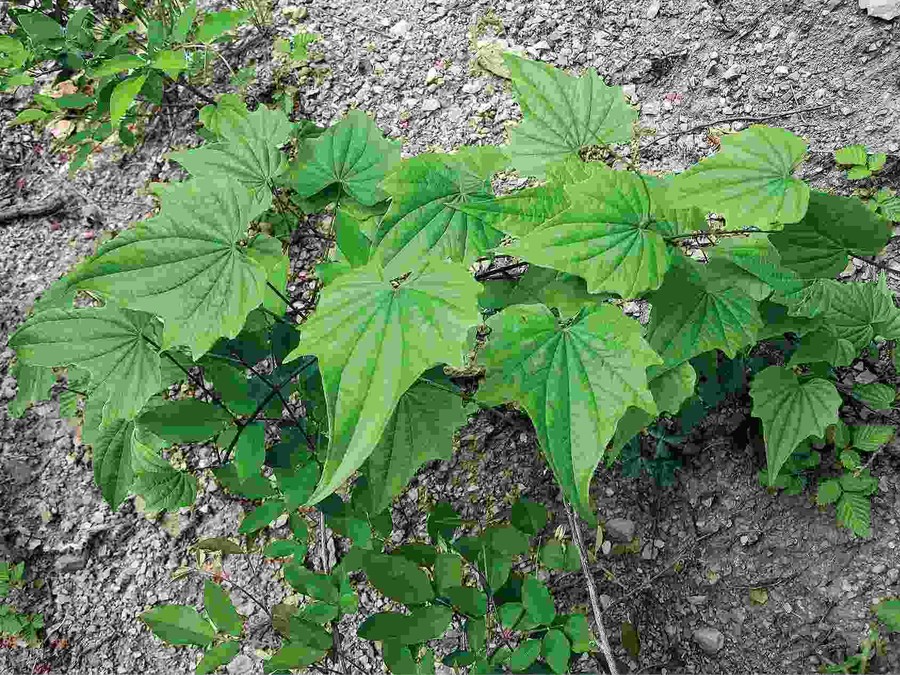
A perennial twining vine, reaching up to 5 m in length. Rhizome creeping, cylindrical, woody, much branched, with distinctly exfoliating cork layer. Stem twining leftward, cylindrical, nearly glabrous. Leaves alternate, simple; petiole 10-20 cm long; leaf blade palmately cordate, highly variable, basal leaves 10-15 cm long and 9-13 cm wide, margin with unequal triangular shallow, medium, or deep lobes; apical leaves smaller, nearly entire; leaf surface yellowish-green, glossy, glabrous or sparsely covered with fine white hairs, especially denser along veins. Flowers unisexual, dioecious. Male inflorescence an axillary spike, often with 2-4 flowers forming a small umbel at the base, and a single flower at the apex; bracts lanceolate, apex acuminate, shorter than perianth; perianth disc-shaped, 6-lobed, lobes obtuse at apex; stamens 6, inserted at the center of perianth lobes, anthers introrse. Female inflorescence a solitary spike; perianth 6-lobed, lobes lanceolate; pistil with stigma 3-lobed, each lobe further 2-lobed. Capsule turning withered yellow at maturity, trigonous, apex concave, base nearly rounded, each angle winged, variable in size, generally about 2 cm long and 1.5 cm wide. Seeds 2 per locule, sometimes only 1 developing, attached to the base of the central axis, surrounded by unequal membranous wings, upper portion rectangular, about twice as long as wide. Flowering June to August, fruiting August to October.
Habitat and Distribution
Growing at altitudes of 300-2000 m on slopes, forest edges, both sides of river valleys, or in shrub thickets, also found along mountain ridges, roadsides, and ditches. Distributed in Northeast, North, Northwest (except Xinjiang) China, as well as Henan, Hubei, Shandong, Jiangsu, Anhui, Zhejiang, Jiangxi, Sichuan, and other regions.
Harvesting and Processing
Harvested in spring and autumn, washed clean, rootlets and outer bark removed, and dried in the sun.
Medicinal Properties
The rhizome is subcylindrical and slightly curved, 15-20 cm long and 1.0-1.5 cm in diameter. The surface is yellowish-white or brownish-yellow, with irregular longitudinal grooves, spinous root remnants, and protruding stem scars on one side. The texture is hard, the cross-section is flat, white or yellowish-white, scattered with light brown vascular bundle spots. Odor: faint; Taste: bitter and astringent.
Chemical Constituents
This product mainly contains dioscin, gracillin, and smilax saponins and other components.
Pharmacology
It has antitussive, expectorant, and antiasthmatic effects; it can lower rabbit arterial pressure, slow heart rate, increase myocardial contractility, increase 24-hour urine output, improve coronary blood flow, and significantly reduce blood cholesterol levels; it enhances immune function and has an anti-influenza virus effect, among others.
Properties and Channel Entry
Sweet and bitter, warm. Enters the Liver, Kidney, and Lung channels.
Functions and Indications
Dispels Wind and eliminates Dampness, relaxes tendons and unblocks collaterals, activates Blood and alleviates pain, stops cough and calms wheezing. Used for Wind-Damp impediment disease (Bi syndrome), joint swelling, pain and numbness, traumatic injuries, lumbar sprain, cough and wheezing.
Dosage and Administration
Internal: decoction, 6-9 g dried or 30-45 g fresh; or steep in wine. External: appropriate amount, fresh product mashed for application.
Precautions and Contraindications
During crushing and processing, take protective measures to prevent allergic reactions.
Prescriptions
1. For lower back and leg pain, and numbness of tendons and bones: fresh Chuanshanlong rhizome 60 g. Boil in a pot of water, can be decocted 5-6 times; adding brown sugar enhances the effect. (From *Northeast Medicinal Flora*) 2. For strain injury: Chuanshanlong 15 g. Decoct in water, then mix with brown sugar and yellow wine. Take once in the morning and once in the evening daily. (From *Zhejiang Folk Commonly Used Herbs*) 3. For Kashin-Beck disease and lower back and leg pain: Chuanshanlong 60 g, soak in 500 g of white liquor for 7 days. Take 30 g each time, twice daily. (From *Hebei Chinese Herbal Medicine Handbook*) 4. For sudden lumbar sprain and twisting pain: Chuanshanlong 15 g. Decoct in water and take orally. (From *Hebei Chinese Herbal Medicine Handbook*) 5. For malaria: Chuanshanlong 9 g, Qingwaqi and Yemianhua each 6 g. Decoct in water and take before the onset of symptoms. (From *Shaanxi Chinese Herbal Medicine*) 6. For carbuncles and malignant sores: fresh Chuanshanlong and fresh Zhumagen in equal amounts. Pound into a paste and apply to the affected area. (From *Shaanxi Chinese Herbal Medicine*) 7. For chronic bronchitis: Chuanshanlong 15 g. Decoct in water and take orally. (From *Qinling Bashan Natural Medicine Gazette*) 8. For rheumatic fever: Chuanshanlong rhizome 9 g. Decoct in water and take orally. (From *Zhejiang Medicinal Plant Gazette*)