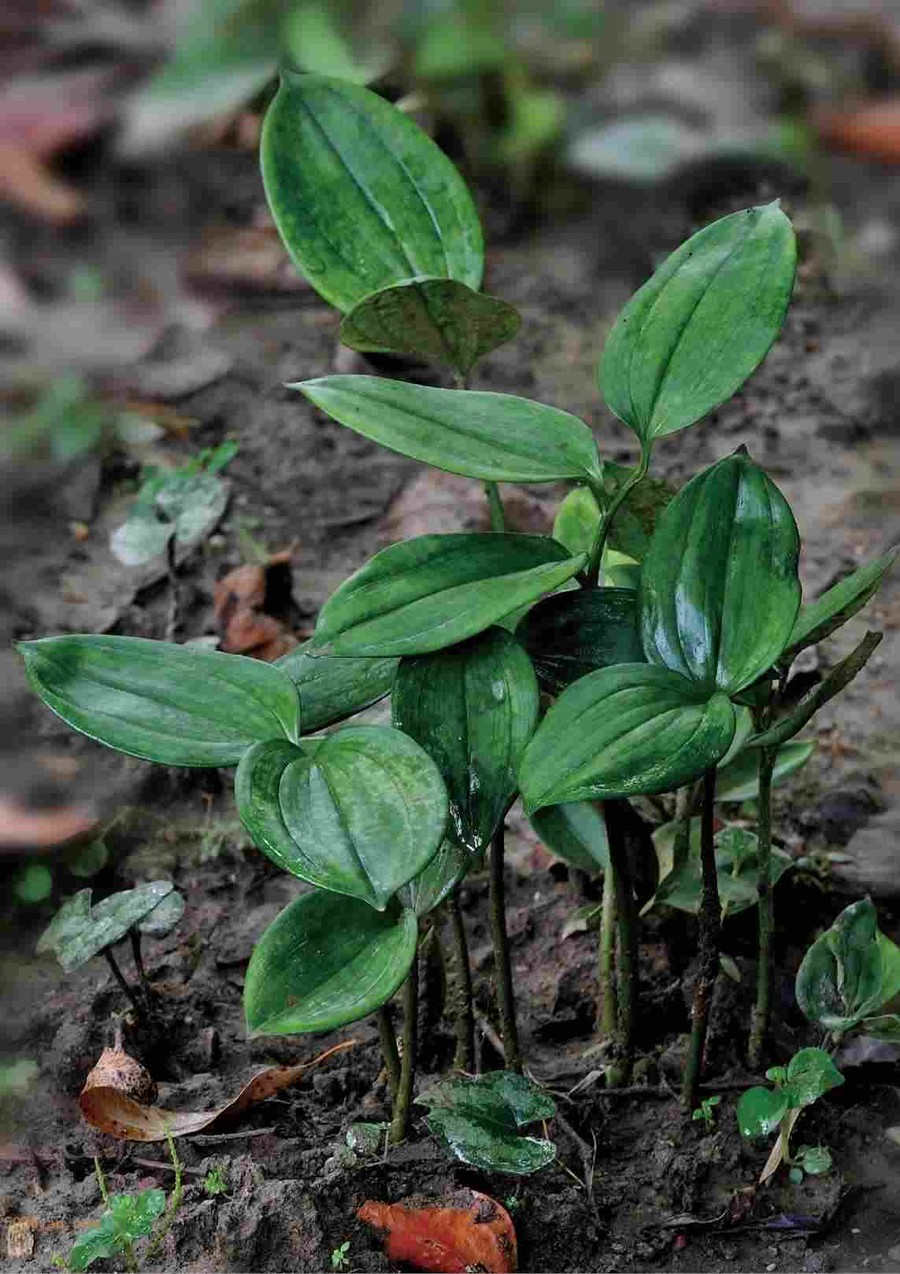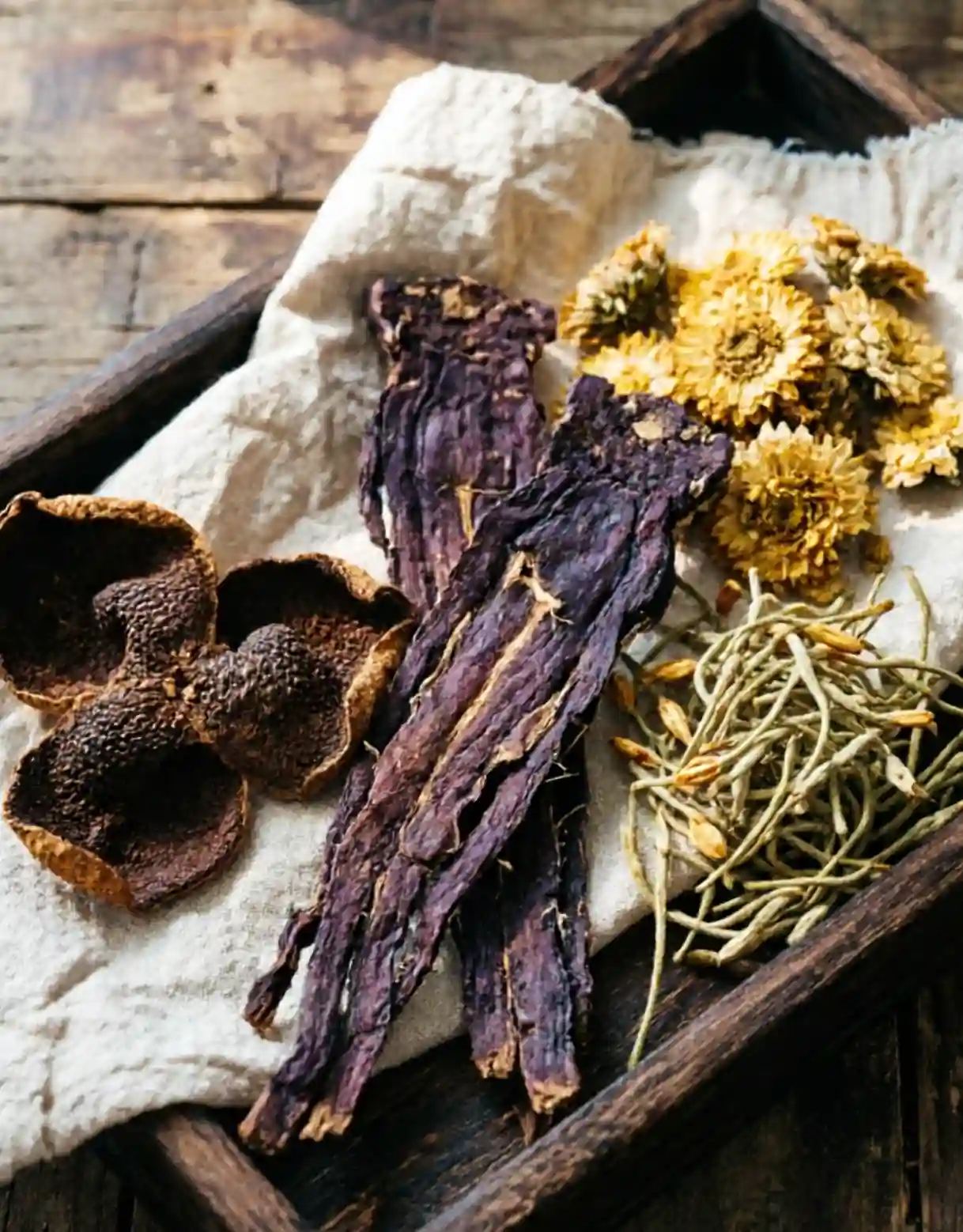
Pinyin: Yuzhu
Aliases
Yuzhu, Shanyuzhu, Zhuqigen.
Source
Liliaceae plant *Polygonatum odoratum* (Mill.) DrucePolygonatum odoratumDried rhizome of (Mill.) Druce.
Botanical Description
Perennial herb. Rhizome creeping, fleshy, yellowish-white, densely covered with numerous fibrous roots. Stem solitary, 20-60 cm tall. Leaves 7-12, alternate, sessile; leaf blade elliptic to ovate-oblong, 5-12 cm long, 2-3 cm wide, apex acute, base cuneate, upper surface green, lower surface grayish-white; veins raised, smooth or papillose. Flowers axillary, usually 1-3 in clusters, peduncle 1-1.5 cm long, without bracts or with linear-lanceolate bracts; perianth tubular, 13-20 mm in total length, yellowish-green to white, apex 6-lobed, lobes ovate, about 3 mm long, often tinged with green; stamens 6, inserted at the middle of the perianth tube, filaments filiform, nearly smooth to papillose; ovary 3-4 mm long, style 10-14 mm long. Berry globose, 7-10 mm in diameter, bluish-black when ripe. Flowering period April to June, fruiting period July to September.
Habitat and Distribution
Grows under forests and on shaded, damp mountain slopes. Distributed in Northeast, North, East China, and Shaanxi, Gansu, Qinghai, Taiwan, Henan, Hubei, Hunan, Guangdong, and other regions.
Harvesting and Processing
Harvested in autumn, remove the fibrous roots, wash clean, sun-dry until soft, then repeatedly knead and sun-dry until no hard core remains, then fully sun-dry; or steam thoroughly, knead until translucent, then sun-dry.
Medicinal Properties
This product is long-cylindrical, slightly flattened, rarely branched, 4-18 cm long, 0.3-1.6 cm in diameter. The surface is yellowish-white or pale yellowish-brown, semi-transparent, with longitudinal wrinkles and slightly raised nodes, white dot-like fibrous root scars and disc-shaped stem scars. The texture is hard and brittle or slightly soft, easily broken, with a horny or granular fracture. Odor: faint; Taste: sweet, sticky when chewed.
Chemical Constituents
This product contains Yuzhu polysaccharides (glucose, etc.), vitexin,α-Cubebin oil and isopropyl myristate, along with polygonatum furanosteroid glycoside, among others.
Pharmacology
Has the effects of lowering blood lipids, enhancing immune function, and lowering blood sugar.
Properties and Channel Entry
Sweet, slightly cold. Enters the Lung and Stomach channels.
Functions and Indications
Nourishes Yin and moistens Dryness, generates body fluids and quenches thirst. Used for Lung and Stomach Yin damage, dry-heat cough, dry throat and thirst, and internal heat wasting-thirst disorder.
Dosage and Administration
Internal: decoct in water, 6-12 g; or prepare as a paste, steep in wine, or make into pills or powder. External: appropriate amount, crush fresh product for application; or prepare as a paste for spreading. Use raw for those with Yin deficiency and Heat, and use processed for those with mild Heat.
Precautions and Contraindications
Contraindicated in patients with phlegm-dampness and Qi stagnation; use with caution in those with Spleen deficiency and loose stools.
Prescriptions
1. For lung heat with cough: Yuzhu 12 g, Xingren 9 g, Shigao 9 g, Maidong 9 g, Gancao 6 g. Decoct in water and take orally. (Shandong Handbook of Chinese Herbal Medicine) 2. For deficient cough: Yuzhu 12 g, Baihe 9 g. Decoct in water and take orally. (Inner Mongolia Chinese Herbal Medicine) 3. For fever, dry mouth, and difficult urination: Yuzhu 150 g. Decoct the juice and drink. (Waitai) 4. For stomach heat with dry mouth and constipation: Yuzhu 15 g, Maidong 9 g, Shashen 9 g, Shengshigao 15 g. Decoct in water and take orally. (Shandong Handbook of Chinese Herbal Medicine) 5. For diabetes: Yuzhu, Shengdihuang, Gouqi each 500 g. Add 7.5 kg of water and simmer into a paste. Take 1 spoonful each time, 3 times daily. (Northern Commonly Used Chinese Herbal Medicine Handbook)