Pinyin: Weilingxian
Aliases
Nengxiao, Tiejiao Weilingxian, Heijiao Weilingxian, Heigutou.
Source
Ranunculaceae plant Clematis chinensisClematis chinensisOsbeck's dried root and rhizome.
Botanical Description
Woody vine, 3-10 m long. The entire plant turns black after drying. Stems nearly glabrous. Leaves opposite; once-pinnately compound, with 5 leaflets, sometimes 3 or 7; leaflets papery, narrowly ovate, ovate, or ovate-lanceolate, apex acute or acuminate, base rounded, broadly cuneate, or shallowly cordate, margin entire, both surfaces nearly glabrous, or sparsely pubescent below. Paniculate cymes, many-flowered, axillary or terminal; flowers bisexual; sepals 4, oblong or obovate, spreading, white, apex often mucronate, outer margin densely villous, or with short pubescence in the middle; petals absent; stamens numerous, unequal, glabrous; carpels numerous, pubescent. Achenes flattened, ovate, sparsely appressed-pubescent, persistent styles feathery. Flowering June to September, fruiting August to November.
Habitat and Distribution
Growing at altitudes of 80-1500 m on hillsides, valley shrublands, ditch edges, and grassy roadside areas; distributed in southern Shaanxi, southern Jiangsu, south of the Huai River in Anhui, Zhejiang, Jiangxi, Fujian, Taiwan, Henan, Hubei, Hunan, Guangdong, Guangxi, Sichuan, Guizhou, and southern Yunnan.
Harvesting and Processing
Harvested in autumn, dug out, remove sediment and sand, and sun-dry.
Medicinal Properties
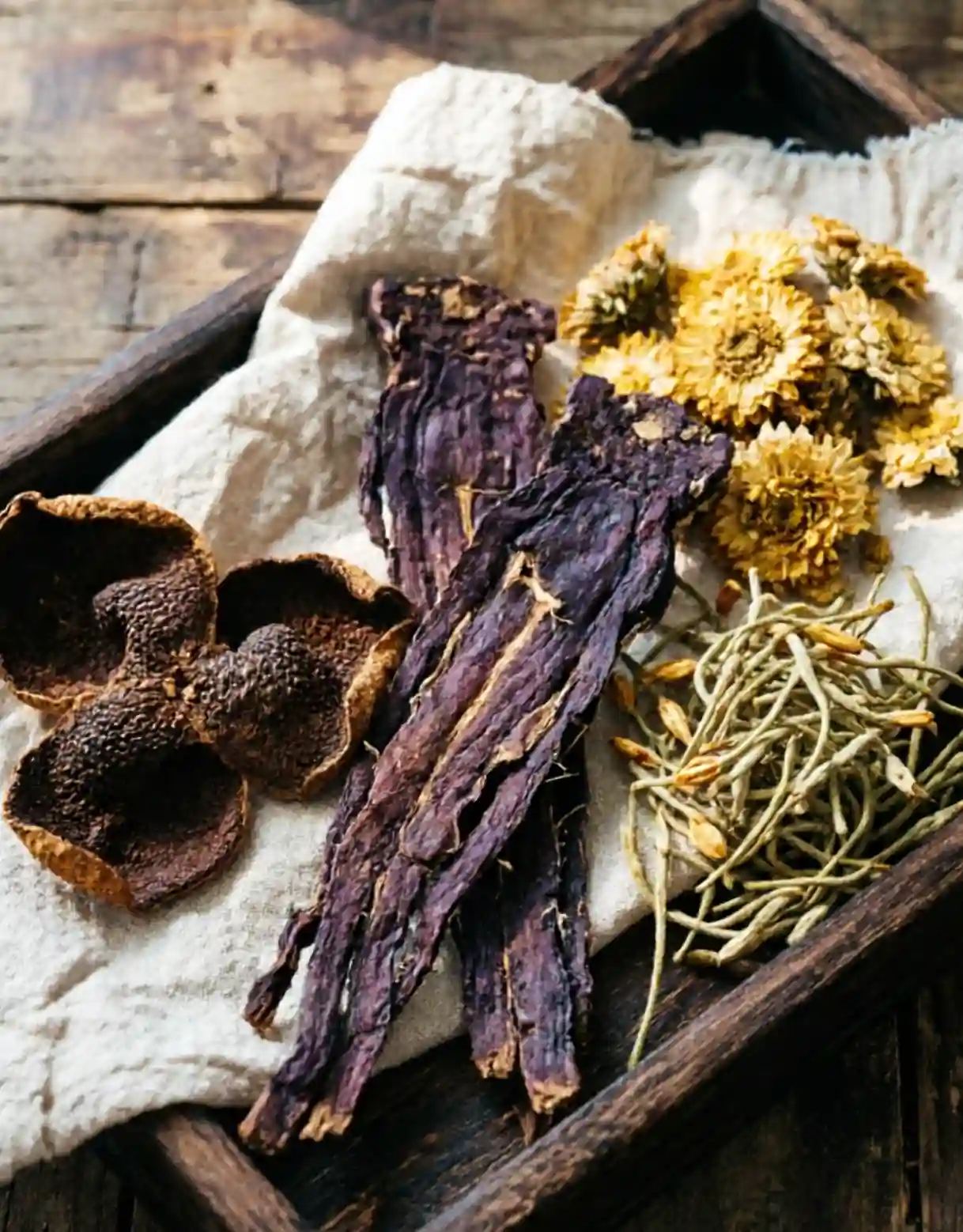
The rhizome is cylindrical, 1.5-10 cm long, 0.3-1.5 cm in diameter, with numerous fine roots attached on both sides and below; the surface is pale brownish-yellow to brown, with the bark often peeling off to reveal a fibrous texture, nodes are raised, and the top often retains a residual woody stem base; the texture is relatively tough and firm, the fracture is fibrous. The root is long-cylindrical, slightly twisted, 7-20 cm long, 0.1-0.3 cm in diameter; the surface is brown or dark brown with fine longitudinal wrinkles, sometimes the bark peels off to expose a pale yellow wood; the texture is hard and brittle, easily broken, the bark layer at the fracture is relatively wide, often with a gap between it and the wood. Odor: faint; Taste: slightly bitter.
Chemical Constituents
This product mainly contains oleanolic acid, hederagenin, and clematis-23-O- Arabinose saponins, Clematis monosaccharide saponins, Clematis disaccharide saponins, Clematis trisaccharide saponins, etc.
Pharmacology
It has the effects of enhancing rhythmic contractions or relaxing smooth muscle; it also possesses analgesic, cholagogic, labor-inducing, antimicrobial, antidiuretic, and antihypertensive actions.
Properties and Channel Entry
Acrid, salty, warm. Enters the Urinary Bladder channel.
Functions and Indications
Expels Wind and Dampness, unblocks the channels and collaterals
Dosage and Administration
Internal: decoct in water, 6-9 g; for bone stuck in throat, up to 30 g; or made into pills or powder; or steeped in wine. External: appropriate amount, mashed for application; or decocted in water for fumigation and washing; or used as a vesicant.
Precautions and Contraindications
Qi and Blood deficiency and pregnant women should use with caution.
Prescriptions
1. For numbness of hands and feet, episodic pain, unbearable pain from contusions or falls, or paralysis: Clematis chinensis (stir-fried) 150 g, unprocessed Aconitum carmichaelii and Trogopterus dung each 120 g, grind into powder. Make into pills with vinegar paste, the size of wutong seeds: Take 7 pills each time with salt water, avoid tea. (Pu Ji Fang) 2. For urinary tract stones: Clematis chinensis 60-90 g, Lysimachia christinae 50-60 g, one dose daily, decoct and take. [Shanghai Journal of Traditional Chinese Medicine 1983, (5): 30] 3. For various throat obstructions: Clematis chinensis 36 g, Amomum villosum 30 g, one cup of granulated sugar, two cups of water, decoct to one cup. Take warm. (Gang Mu) 4. For acute mastitis: Clematis chinensis in appropriate amount. Grind into powder, mix with rice vinegar into a paste, apply to the affected area after 30 minutes, replace when dry, generally heals in 1-3 days. [Zhejiang Journal of Traditional Chinese Medicine 1984, (1): 39]

