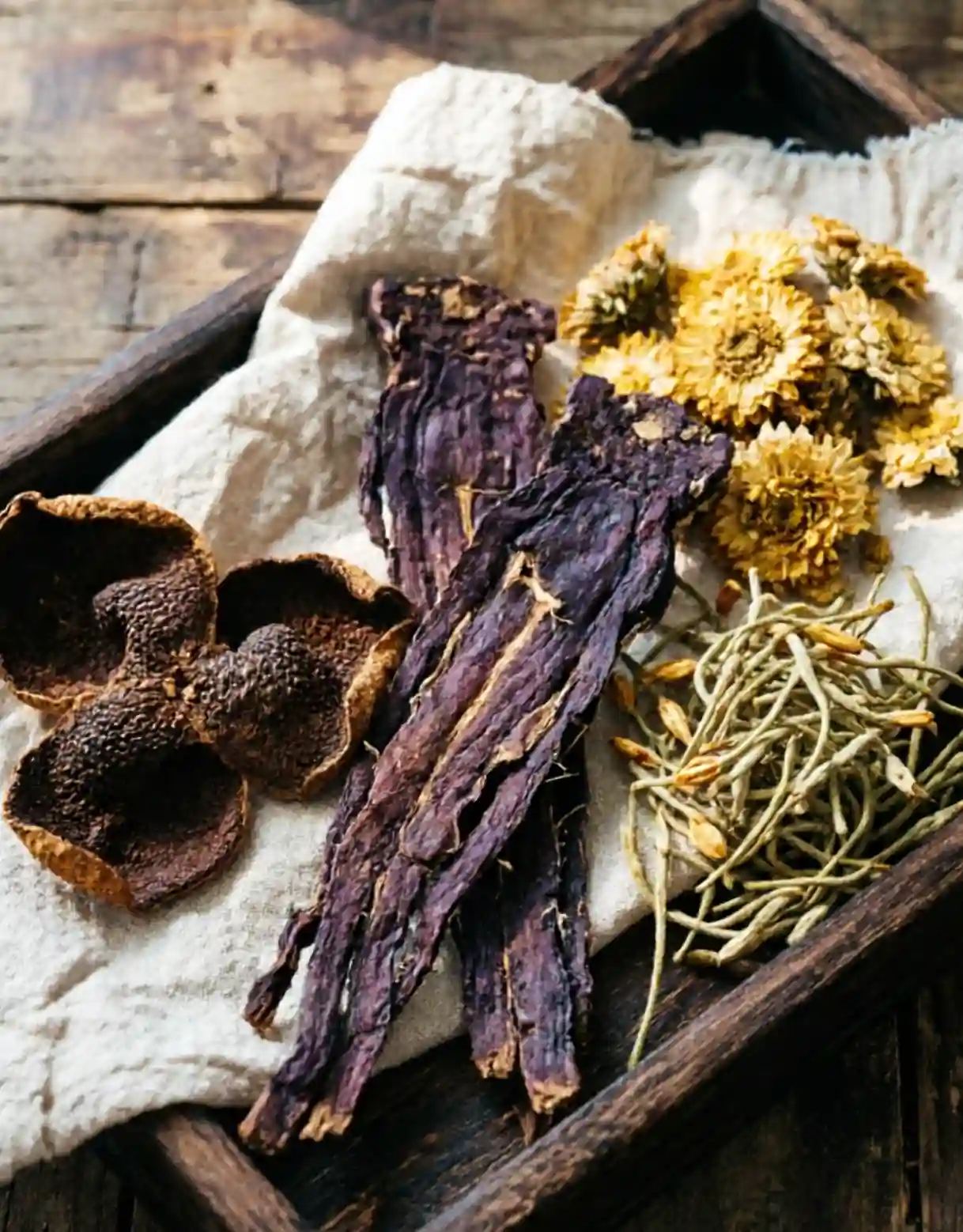
Pinyin: Shengma
Aliases
Zhou Shengma, Jigu Shengma, Guilian Shengma
1. Lai.
Internal use: decoct 3-10 g, large dose 10-30 g, or grind into powder and take 1-3 g. External use: appropriate amount, grind into powder and apply.
Ranunculaceae plant *Cimicifuga dahurica* (Turcz.) Maxim.Cimicifuga dahuricaDried root and rhizome of (Turcz.) Maxim.
Botanical Description
Perennial herb, up to 1 m tall. Rhizome thick, much branched, surface black, with many sunken round pit-like scars of old stems. Stem erect, glabrous or sparsely hairy. Lower cauline leaves 2–3 times ternately compound; terminal leaflet broadly rhombic, 3-lobed, base subcordate or rounded, margin irregularly serrate, lateral leaflets long elliptic-ovate, slightly oblique, margin irregularly serrate, glabrous above, sparsely hairy along veins beneath; upper cauline leaves similar to lower but smaller, with short petioles. Compound raceme; flowers unisexual, dioecious, male inflorescence large, up to 30 cm long, with 7–20 branches, female inflorescence slightly smaller, with fewer branches; rachis and pedicels with gray glandular hairs and short pubescence; bracts subulate; sepals 5, petaloid, white, broadly elliptic or broadly obovate, caducous; petals absent; staminodes 2-cleft, each with one empty anther at apex; stamens numerous, filaments filiform; carpels 4–7, sparsely gray pubescent or subglabrous, sessile or shortly stalked. Follicles, apex with appressed white pubescence. Seeds ellipsoid, brown, surrounded by membranous scaly wings, with transverse scaly wings in center. Flowering July–August, fruiting August–September.
Habitat and Distribution
Xing'an Shengma (Cimicifuga dahurica): grows at an altitude of 300-1200 m in forest edges, forests, or hillside grasslands. Distributed in Heilongjiang, Jilin, Liaoning, Inner Mongolia, Hebei, Shanxi, Henan, and Hubei.
Harvesting and Processing
Harvested in autumn, dug up, remove mud and sand, sun-dry until the fibrous roots are dry, then singe off or remove the fibrous roots, and sun-dry thoroughly.
Medicinal Properties
This product appears as irregular elongated masses, mostly branched and nodular, 10-20 cm long and 2-4 cm in diameter. The surface is blackish-brown or brown, rough and uneven, with residues of hard fine fibrous roots, and several circular hollow stem base scars on the upper part, showing reticulate striations on the inner wall of the cavities; the lower part is uneven with root scars. It is light in weight, hard in texture, and difficult to break; the fracture is uneven, fissured, fibrous, yellowish-green or pale yellowish-white. Odor: faint; Taste: slightly bitter and astringent.
Chemical Constituents
This product mainly contains isoferulic acid, ferulic acid, esculetin, caffeic acid, 25-O- Acetyl-cimigenol, cimifugin, cimicifugamide, acteoside A, cimicifugoside C, sinapic acid, etc.
Pharmacology
Antipyretic, reduces body temperature, anti-inflammatory, analgesic; sedative, anticonvulsant; enhances immune function; hepatoprotective, antispasmodic, etc.
Properties and Channel Entry
Acrid, slightly sweet, and slightly cold. Enters the Lung, Spleen, Stomach, and Large Intestine channels.
Functions and Indications
Expels exterior pathogens and promotes eruption of measles, clears Heat and resolves toxicity, and raises the Yang Qi. Used for wind-heat headache, toothache, mouth sores, sore throat, incomplete measles eruption, Yang-toxin macules, rectal prolapse, and uterine prolapse.
Dosage and Administration
Oral administration: decoct in water, for raising Yang, 3-6 g, preferably honey-fried or wine-fried; for clearing Heat and resolving toxicity, up to 15 g, preferably raw; or prepare as pills or powder. External use: appropriate amount, grind into powder for topical application or decoct for gargling; or for washing.
Precautions and Contraindications
Contraindicated in cases of Yin deficiency with Yang floating, wheezing and fullness with rebellious Qi, and already erupted measles. Excessive dosage may cause dizziness, tremors, and limb spasm.
Prescriptions
1. For mouth sores: Shengma, Huangbai, Daqing. Cut the above three herbs, boil in water, and use the decoction as a mouth rinse. Spit out when cold and stop when healed. (From *Waitai* quoting *Jiyan Fang*) 2. For dental caries with gum exposure: Shengma and Baifuzi (dry-fried) 30 g each. Grind the above herbs into a fine powder, mix with fresh Shengdihuang juice, and apply to the tooth root for immediate effect. (From *Shenghui Fang*: Chuan Shengma San) 3. For sudden throat swelling and pain, inability to swallow saliva, to clear Heat and descend Qi: fresh Ye'egan juice 6 he, Danggui 30 g, Shengma 30 g, Gancao 0.9 g. Sift the four herbs, form pills with the Ye'egan juice, wrap each pill in cotton as large as an elm seed, and hold in the mouth while slowly swallowing the juice. Use three times during the day and once at night. (From *Yixin Fang* quoting Seng Shen's Shengma Han Wan) 4. For infantile hematuria: Shengma 1.5 g, boil in 5 he of water until reduced to 1 he, then strain out the dregs. A one-year-old child should consume this dose within one day. (From *Gangmu* quoting *Yao Hezhong Xiao'er Fang*) 5. For sudden toxic swelling with severe pain: Grind Shengma in vinegar and apply frequently to the affected area. (From *Zhouhou Fang*)

