Pinyin: Zhebeimu
Aliases
Tubeimu, Zhebei, Xiangbei, Dabeimu
Source
Liliaceae plant *Fritillaria thunbergii*Fritillaria thunber-giiDried bulb of Miq.
Botanical Description
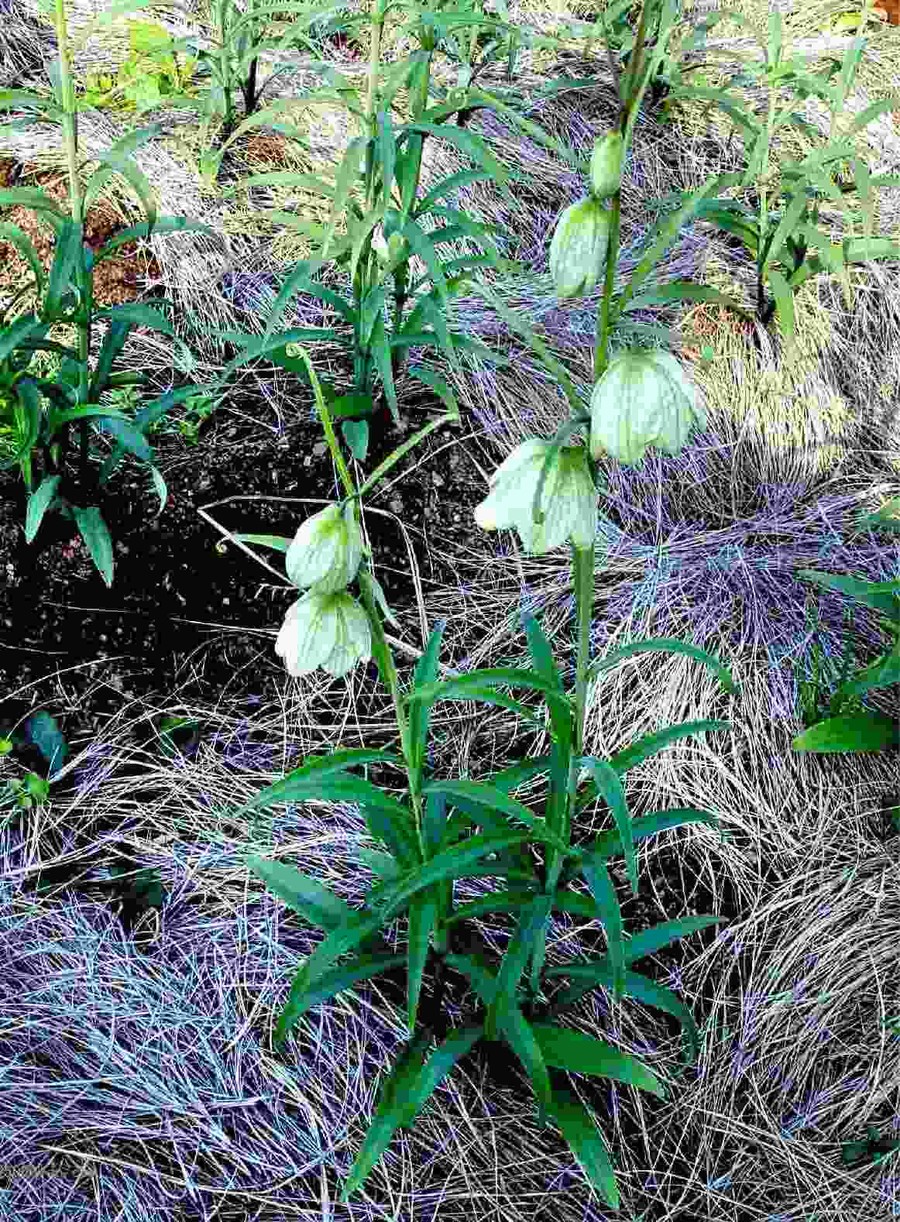
Perennial herb, 50-80 cm tall. Bulb subglobose, 1.5-4 cm in diameter, composed of 2 white fleshy scales opposite each other. Leaves opposite or scattered at the base of the stem, gradually becoming scattered, opposite, and whorled toward the top; leaf blades nearly linear to lanceolate, 7-11 cm long, 1-2.5 cm wide, apex not curled or slightly curved. Flowers 1-6, pale yellow, sometimes slightly tinged with pale purple, the terminal flower with 3-4 leaf-like bracts, the others with 2 bracts; bract apex curled; flowers campanulate, nodding, perianth segments 6, oblong, 2-4 cm long, 1-1.5 cm wide, inner and outer whorls similar, with purple checkered markings on the inner surface, with a nectary above the base; stamens 6, about 2/5 the length of the perianth; anthers nearly basifixed, filaments without small papillae; stigma lobes 1.5-2 mm long. Capsule ovoid, 6-ribbed, 2-2.2 cm long, about 2.5 cm wide, ribs with wings 6-8 mm wide. Flowering period March to April, fruiting period May.
Habitat and Distribution
Born and growing in shaded areas of low-altitude hills or under bamboo forests. Distributed in Jiangsu, Anhui, Zhejiang, and Hunan. There is extensive cultivation in the Ningbo area of Zhejiang.
Harvesting and Processing
Harvested in early summer when the plant wilts, washed clean
Medicinal Properties
(1) Zhu Bei: The whole bulb, oblate-spherical in shape, 1-2.5 cm in diameter, 1-1.5 cm in height. Externally whitish in color, with two outer fleshy scales enclosing 2-3 inner small scales and a remnant stem. Texture firm and brittle, easily broken; fracture white, highly starchy. Odor: faint; Taste: bitter. (2) Da Bei: The single outer scale leaf of the bulb, somewhat crescent-shaped, 1-2 cm in height, 2-3.5 cm in diameter. Externally whitish to pale yellow in color, inner surface white or pale brown, coated with white powder. Texture hard and brittle, easily broken; fracture white to yellowish-white, highly starchy. Odor: faint; Taste: slightly bitter.
Chemical Constituents
This product contains zhebeinime, zhebeinine, verticine, verticinone, peiminine, choline, zhebeininoside, and hupeheninine.
Pharmacology
Has antitussive, sedative, analgesic, and antihypertensive effects; can dilate tracheal smooth muscle, enhance uterine smooth muscle contraction; can slow heart rate; dilate pupils, inhibit salivary secretion; can elevate blood sugar, etc.
Properties and Channel Entry
Bitter, cold. Enters the Lung and Heart channels.
Functions and Indications
Clears Heat, transforms Phlegm, stops cough, resolves toxicity, dissipates masses, and eliminates abscesses. Used for wind-heat cough, phlegm-fire cough, lung abscess, breast abscess, scrofula, and sores and toxins.
Dosage and Administration
Oral administration: decoct in water, 3-10 g; or taken as pills or powder. External use: appropriate amount, ground into powder for application.
Precautions and Contraindications
Caution should be exercised in patients with Cold Phlegm, Damp Phlegm, or Spleen-Stomach deficiency Cold. It should not be used concurrently with Chuanwu (Radix Aconiti), Caowu (Radix Aconiti Kusnezoffii), processed Chuanwu, processed Caowu, or Fuzi (Radix Aconiti Lateralis Preparata).
Prescriptions
1. For colds with cough: Zhe Beimu (Fritillaria thunbergii), Zhimu (Anemarrhena asphodeloides), Sangye (Morus alba leaf), and Xingren (Prunus armeniaca seed) 9 g each, Zisu (Perilla frutescens) 6 g. Decoct in water and take orally. (Shandong Chinese Herbal Medicine Handbook) 2. For breast abscesses and nodules: Chao Baizhi (Angelica dahurica, stir-fried), Ruxiang (Boswellia carterii), Moyao (Commiphora myrrha, each prepared clean), Zhe Beimu (Fritillaria thunbergii), and Guishen (Angelica sinensis body), equal parts ground into powder. Take 15 g per dose, delivered with wine. (Waike Quansheng Ji) 3. For carbuncle, toxin, swelling, and pain: Zhe Beimu (Fritillaria thunbergii) and Lianqiao (Forsythia suspensa) 9 g each, Jinyinhua (Lonicera japonica) 18 g, and Pugongying (Taraxacum mongolicum) 24 g. Decoct in water and take orally. (Shandong Chinese Herbal Medicine Handbook) 4. For ulcerative stomatitis: Zhe Beimu (Fritillaria thunbergii) 4.5 g and Wuzeigu (Sepia esculenta cuttlebone) 25.5 g. Grind the above drugs into a fine powder. Take 6 g each time, 3 times daily. (Shandong Medical Journal, 1966, (3): Xiangxiao San)