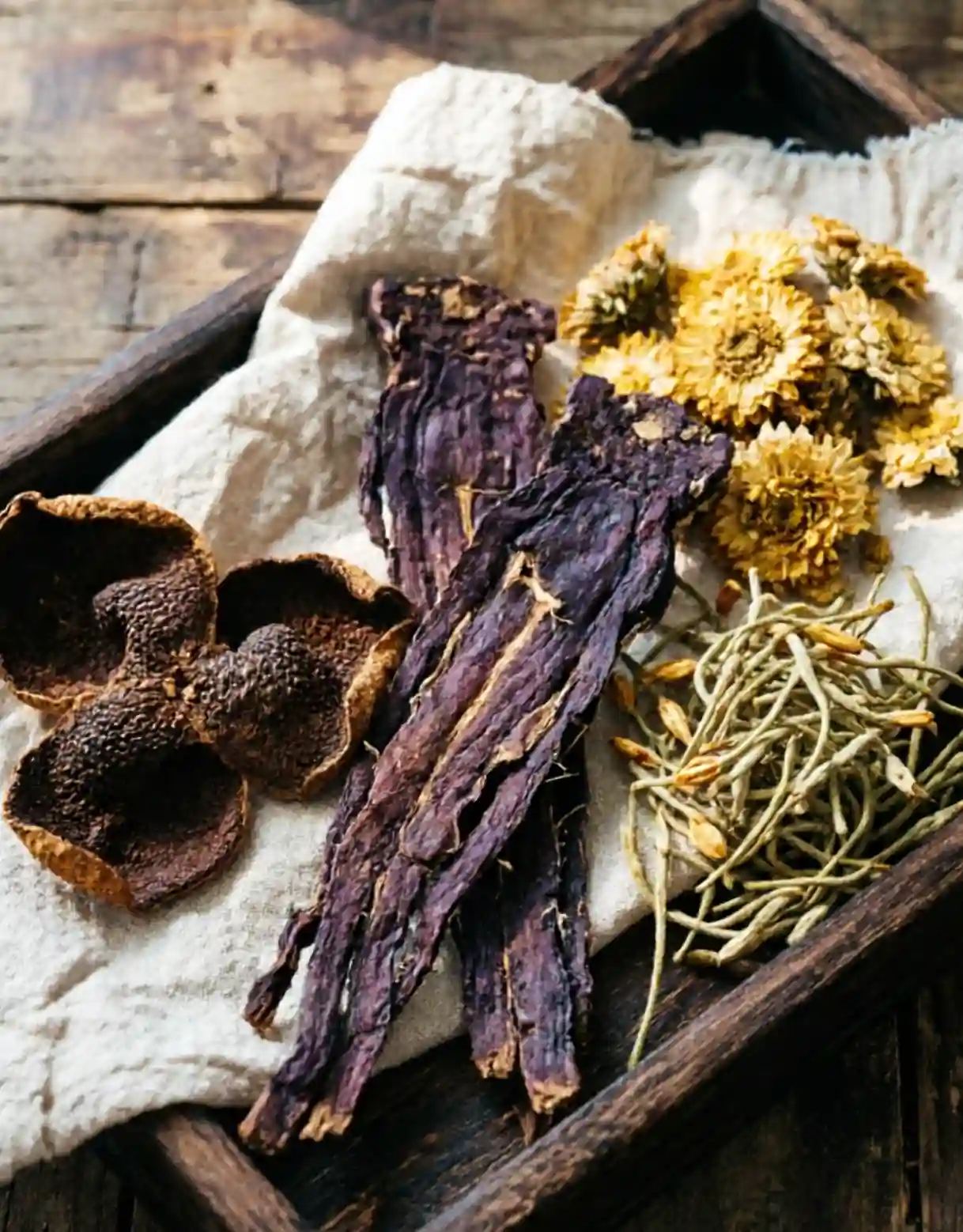
Pinyin: Qianghuo
Aliases
Qiangqing, Tuifengshizhe, Heiyao.
Source
1. For pneumonia: Renshen 6 g, decoct in water and take orally.Notopterygium incisumTing ex H.T.Chang’s dried rhizome and root.
Botanical Description
Perennial herb, 60-150 cm tall. Rhizome robust, cylindrical or irregularly blocky, dark brown to brownish-red, apex with withered leaf sheaths, with a distinctive aroma. Stem erect, cylindrical, hollow, surface light purple, with fine longitudinal striations. Basal and lower stem leaves with long petioles, the petiole base expanding laterally into membranous leaf sheaths clasping the stem; leaves tripinnately compound with 3-4 pairs of leaflets, terminal segments ovate-lanceolate to oblong-ovate, margin incised-lobed to pinnatifid; upper stem leaves reduced to sheaths, nearly sessile, apex with pinnatifid leaflets. Compound umbel terminal or axillary, lateral ones often sterile; involucre bracts 3-6, linear, early deciduous; rays 7-18 (up to 39); umbellules 1-2 cm in diameter, involucel bracts 6-10, linear; flowers numerous, calyx teeth ovate-triangular; petals 5, white, obovate, apex obtuse and concave; stamens with inwardly curved filaments, yellow; styles 2, very short, stylopodium flattened, slightly raised. Mericarps oblong, primary ribs all expanded into wings about 1 mm wide, oil ducts distinct, 3-4 per vallecula, 5-6 on commissure, endosperm ventrally concave forming a groove. Flowering July to September, fruiting August to October.
Habitat and Distribution
This text is not a prescription or formula; it is a habitat and distribution description
Harvesting and Processing
Harvested in spring and autumn, remove fibrous roots and sediment, then dry in the sun.
Medicinal Properties
This product is a cylindrical, slightly curved rhizome, 4-13 cm long and 0.6-2.5 cm in diameter. The apex has stem scars. The surface is brown to dark brown, with exposed areas appearing yellow where the outer bark has fallen off. The internodes are shortened, forming tightly raised rings resembling a silkworm, commonly known as "silkworm Qiang"; or the internodes are elongated, forming a bamboo-like shape, commonly known as "bamboo Qiang." The nodes bear numerous punctate or wart-like raised root scars and brown broken scale leaves. The texture is light, brittle, and easily broken. The fracture surface is uneven, with numerous fissures; the bark is yellow-brown to dark brown, oily, with brown oil spots; the wood is yellow-white with distinct rays; the pith is yellow to yellow-brown. The odor is aromatic, and the taste is slightly bitter and acrid.
Chemical Constituents
This product contains notopterol, isoimperatorin, isoimperatorin lactone, nodakenetin, spathulenol, chlorogenic acid, ferulic acid, and bergapten among other constituents.
Pharmacology
Has antipyretic, analgesic, anti-inflammatory, anti-allergic, anti-myocardial ischemia, anti-arrhythmic, anti-thrombotic, anti-epileptic, antioxidant, antibacterial, sleep-prolonging, and anti-cancer effects.
Properties and Channel Entry
Acrid, bitter, and warm. Enters the Urinary Bladder and Kidney channels.
Functions and Indications
Releases the exterior and disperses cold, expels Wind and eliminates Dampness, alleviates pain
Dosage and Administration
Internal use: decoction, 3-10 g; or made into pills or powder.
Precautions and Contraindications
Patients with Qi and Blood deficiency should use with caution.
Prescriptions
1. For edema due to water qi: Qianghuo (Notopterygium incisum) and fried Luobuzi (Raphanus sativus seeds) 30 g each. Grind into powder, take with wine. (Yide Xiaofang, Chuanhuo San) 2. For pediatric wind-cold (common cold): Qianghuo 3 g, Renshen (Panax ginseng) 3 g, Fangfeng (Saposhnikovia divaricata) 3 g, Chuanxiong (Ligusticum chuanxiong) 3 g. Chop the above into one dose, add three slices of fresh ginger and seven leaves of Bohe (Mentha haplocalyx), decoct in one cup of water until 70% remains, take regardless of meals. (Yingtong Baiwen, Qianghuo Tang) 3. For postpartum febrile disease (cold damage): Qianghuo, Xiangfu (Cyperus rotundus), and Zisu (Perilla frutescens) 4.5 g each, Danggui (Angelica sinensis) 3 g, Baishao (Paeonia lactiflora), Chaihu (Bupleurum chinense), and Chenpi (Citrus reticulata) 3.6 g each. Add three stalks of Congbai (Allium fistulosum), decoct in water, take regardless of meals. (Dantai Yu'an, Qiangsu Yin) 4. For Taiyang channel headache: Fangfeng 0.6 g, Qianghuo 0.6 g, two Hongdou (Vigna angularis). Grind into powder, drip into the nostrils. (Yuji Weiyi) 5. For wind-type headache with vertigo, feeling of fainting and about to collapse: Chuanxiong, Qianghuo, Manjingzi (Vitex trifolia), Fangfeng, Baizhi (Angelica dahurica), Xixin (Asarum sieboldii), Gaoben (Ligusticum sinense), and Shigao (Gypsum) in equal amounts. Decoct in water and take orally. (Yixue Qimeng, Chuanxiong Qianghuo Tang)

