Pinyin: Xuchangqing
Aliases
Liao Diao Zhu, Yi Zhi Jian, San Bai Gen.
Source
Apocynaceae plant Xu ChangqingCynanchum paniculatumDried root and rhizome, or entire plant with roots, of (Bge.) Kitag.
Botanical Description
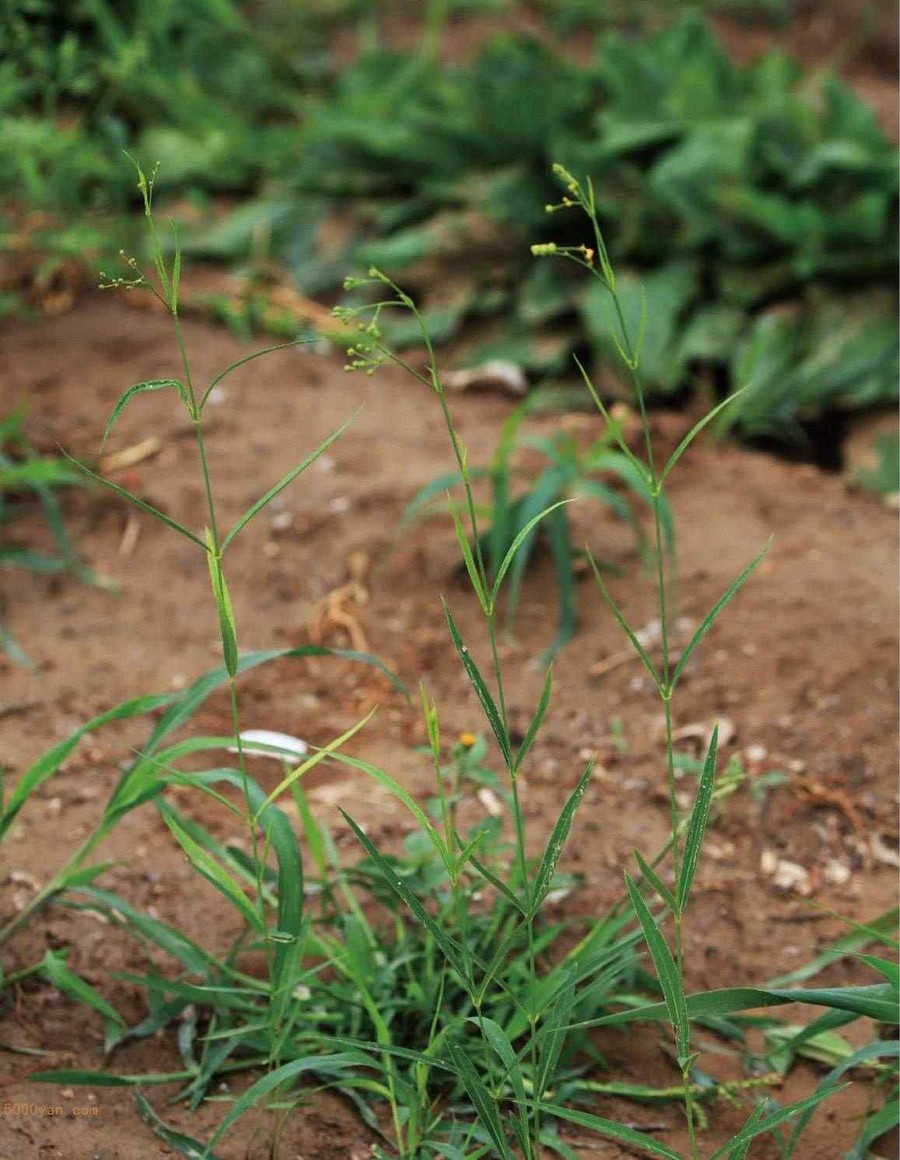
A perennial erect herb, up to 1 m tall. The roots are slender and fibrous, with more than 50 rootlets resembling a horsetail, possessing a special aromatic odor. The stem is slender, rigid, unbranched, glabrous or sparsely pubescent. Leaves opposite, sessile; leaf blades lanceolate to linear, 4-13 cm long, 3-15 mm wide, apex acuminate, base attenuate, both surfaces glabrous or the upper surface sparsely pubescent, margins slightly revolute and ciliate, upper surface dark green, lower surface pale green; midrib prominent. Compound cymose inflorescence, axillary near the stem apex, up to 7 cm long, with more than 10 flowers; calyx 5-lobed, ovate-lanceolate; corolla yellowish-green, 5-lobed, broadly ovate, spreading or recurved; corona 5, yellow, fleshy, reniform, base fused with the stamens; stamens 5, united into a tube, anthers 2-celled, with 1 pendulous pollinium per cell, arms short and horizontally spreading; pistil 1, ovary superior, composed of 2 free carpels, styles 2, stigma pentagonal, apex slightly protruding. Follicles horn-shaped, solitary, about 6 cm long, surface pale brown. Seeds numerous, ovoid and flattened, dark brown, apex with a tuft of white long hairs. Flowering period May to July, fruiting period September to December.
Habitat and Distribution
It grows in grassy areas on sunny slopes. It is distributed in Northeast, East, Central South, Southwest China, as well as Inner Mongolia, Hebei, Shaanxi, and Gansu.
Harvesting and Processing
Harvested in autumn, excavated, remove impurities, and dry in the shade.
Medicinal Properties
The rhizome is irregularly columnar with nodes, 0.5-3.5 cm long and 2-4 mm in diameter. Some have a residual stem at the apex, slender cylindrical, about 2 cm long and 1-2 mm in diameter, with a hollow cross-section; numerous roots arise around the nodes of the rhizome. The roots are slender, cylindrical, curved, 10-16 cm long and 1-1.5 mm in diameter. The surface is pale yellowish-white to pale brownish-yellow or brown, with fine longitudinal wrinkles and slender fibrous roots. The texture is brittle, easily broken, with a starchy cross-section; the bark is whitish or yellowish-white, the cambium ring is light brown, and the xylem is slender. The odor is aromatic, and the taste is slightly pungent and cool.
Chemical Constituents
This product primarily contains paeonol, sarcostin, 2-hydroxy-6-methoxyacetophenone, deacylmetaplexigenin, cynatratoside A, cynatratoside B, cynatratoside C, neocynapanogenin F, and cynanchum paniculatum polysaccharides.
Pharmacology
It has sedative, analgesic, and antipyretic effects; can lower blood pressure, protect against myocardial ischemia, and treat arrhythmias; reduces blood lipids and fights atherosclerosis; inhibits platelet aggregation and prevents thrombosis; exhibits anti-inflammatory and anti-allergic actions; possesses antibacterial properties; decreases ileal tension and inhibits gastrointestinal motility; inhibits hepatic microsomal metabolism and uterine contractions; and has anti-early pregnancy effects.
Properties and Channel Entry
Pungent, warm. Enters the Liver and Stomach channels.
Functions and Indications
Expels Wind, resolves Dampness, alleviates pain, and relieves itching
Dosage and Administration
Oral: decocted in water, 3-10 g, do not decoct for too long; ground into powder 1-3 g, or made into pills, or steeped in wine.
Precautions and Contraindications
Those with weak constitution should take with caution.
Prescriptions
1. For rheumatic pain: *Cynanchum paniculatum* (Xu Changqing) root 24-30 g, lean pork 120 g, aged wine 60 g. Add appropriate amount of water and decoct to half a bowl, take before meals, 2 times daily. (Fujian Folk Herbal Medicine) 2. For chronic low back pain: *Cynanchum paniculatum* (Xu Changqing) and *Polygonum cuspidatum* (Hu Zhang) each 9 g, *Chloranthus henryi* (Hong Si Kuai Wa) 5 g. Grind into powder. Take 0.6-1 g each time, 2-3 times daily, swallow with warm boiled water. (Hubei Chinese Herbal Medicine Records) 3. For cold-induced abdominal pain: *Cynanchum paniculatum* (Xu Changqing) 9 g, *Foeniculum vulgare* (Xiao Huixiang) 6 g. Decoct and take. (Anhui Chinese Herbal Medicine) 4. For traumatic swelling and pain: Fresh *Cynanchum paniculatum* (Xu Changqing) root and fresh *Gardenia jasminoides* (Zhi Zi), equal amounts, pound together and apply externally; also use *Cynanchum paniculatum* (Xu Changqing) 9 g, decoct in water, and take with an appropriate amount of yellow wine. (Anhui Chinese Herbal Medicine) 5. For amenorrhea due to blood deficiency: *Cynanchum paniculatum* (Xu Changqing) 6-9 g, steep in sweet wine and take internally, or stew with meat; or grind into powder and swallow 3 g. (Guiyang Folk Herbal Medicine)