Pinyin: Bajiaofeng
Aliases
Bailongxu, Baijintiao, Baijintiao
Source
Plant of the family Alangiaceae, Alangium chinense.Alangium chinenseThe dried root, fibrous root, and root bark of (Lour.) Harms.
Botanical Description
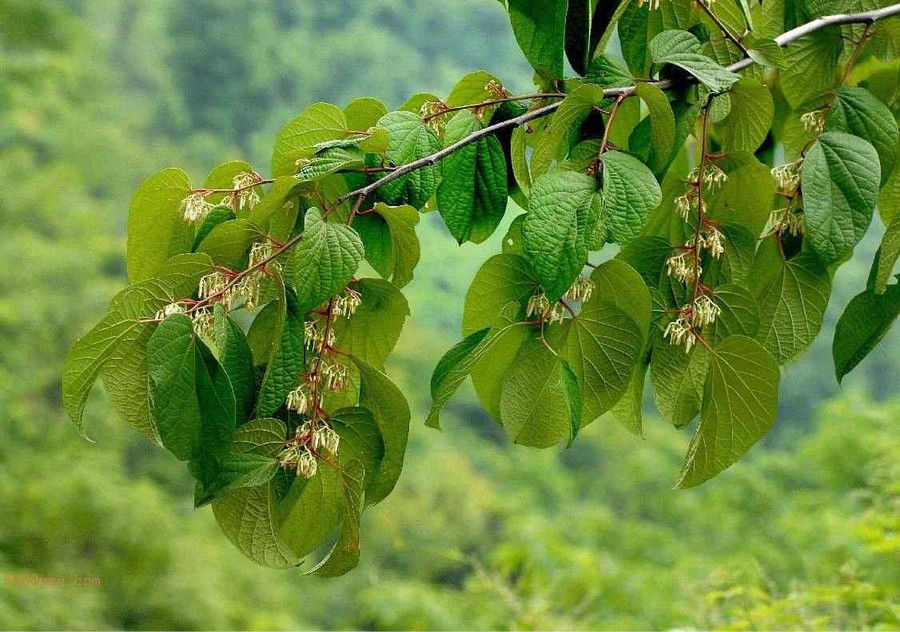
Deciduous tree or shrub, 3-5 m tall. Branchlets slightly zigzag-shaped, young branches purple-green; winter buds conical, born at the base of petioles. Leaves alternate; petiole 2.5-3.5 cm long; leaf blade papery, nearly rounded or elliptic, ovate, apex acute or bluntly acute, base broadly cuneate or truncate, rarely cordate, asymmetrical on both sides, undivided or 3-7(-9)-lobed, lobes short and acute or bluntly acute, upper surface glabrous, lower surface with tufted hairs in vein axils, basal veins 3-5(-7), palmate, lateral veins 3-5 pairs. Cymes axillary, with 7-30(-50) flowers; bracteoles linear or lanceolate, often caducous; corolla cylindrical; calyx apex divided into 6-8 toothed sepals; petals 6-8, linear, 1-1.5 cm long, initially white, later turning yellow, base adnate, upper part reflexed after anthesis; stamens as many as petals and nearly as long; disk nearly spherical; ovary 2-loculed, stigma capitate, often 2-4-lobed. Drupes ovoid, 5-7 mm long, apex with persistent calyx teeth and disk, 1-seeded. Flowering period May-July and September-October, fruiting period July-October.
Habitat and Distribution
Born at altitudes below 1800 m in mountainous areas or sparse forests. Distributed in East China, Central and South China, as well as Shaanxi, Gansu, Taiwan, Sichuan, Guizhou, and Xizang.
Harvesting and Processing
Harvested throughout the year, dig up the root or fibrous roots, wash clean, and sun-dry.
Medicinal Properties
Fine roots cylindrical, slightly undulating and curved, varying in length, with longer ones reaching over 1 m, diameter 2-8 mm, with branches and numerous fine fibrous rootlets or their remnants. Surface grayish-yellow to brownish-yellow, bark longitudinally fissured, sometimes peeling off. Texture hard and brittle, fracture uneven, yellowish-white, mealy. Odor: faint; Taste: bland.
Chemical Constituents
Contains camptothecine and dl-venenatine.β-β-amyrin acetate, triacontanol,β- Sitosterol.
Pharmacology
Has muscle relaxant and respiratory stimulant effects; has inhibitory effects on the cardiovascular system; enhances contraction of intestinal and uterine smooth muscle; enhances the effects of hypnotics; anti-early pregnancy and anti-implantation; anti-inflammatory, etc. Has nephrotoxicity.
Properties and Channel Entry
Acrid, bitter, slightly warm, with mild toxicity. Enters the Liver, Kidney, and Heart channels.
Functions and Indications
Expels Wind and eliminates Dampness, relaxes tendons and activates collaterals, disperses stasis and alleviates pain. Mainly used for Wind-Damp Bi pain, numbness of the limbs, and traumatic injuries from falls and strikes.
Dosage and Administration
Oral: decoct in water, 1-3 g of fibrous roots, 3-6 g of main root; or steep in wine. External use: appropriate amount, mash for external application or decoct in water for washing.
Precautions and Contraindications
Internal use should not be excessive; it is contraindicated in children and the elderly or frail.
Prescriptions
1. For weakness and wheezing cough: Bajiaofeng root 3 g, stew with meat and eat. (Guizhou Herbal Medicine) 2. For bone and sinew pain: Bailongxu 1.2 g, Bainiuxi 9 g. Stew with pig trotters and eat. (Qujing District Chinese Herbal Medicine) 3. For infantile convulsions: Bajiaofeng root 1.5 g, decoct in water and take. (Guizhou Herbal Medicine) 4. For epistaxis (nosebleed): Bajiaofeng 6 g, decoct in water and take orally. (Guizhou Folk Prescription Collection) 5. For allergic dermatitis: Bajiaofeng root (appropriate amount), decoct in water for external washing. (Yunnan Chinese Herbal Medicine)