Pinyin: Caowu
Aliases
Caowutou, Dugong, Zhujie Wutou, Wudu Gen
Source
1. Ranunculaceae plant Beiwutou.Aconitum kusnezoffiiReichb. dried root tuber.
Botanical Description
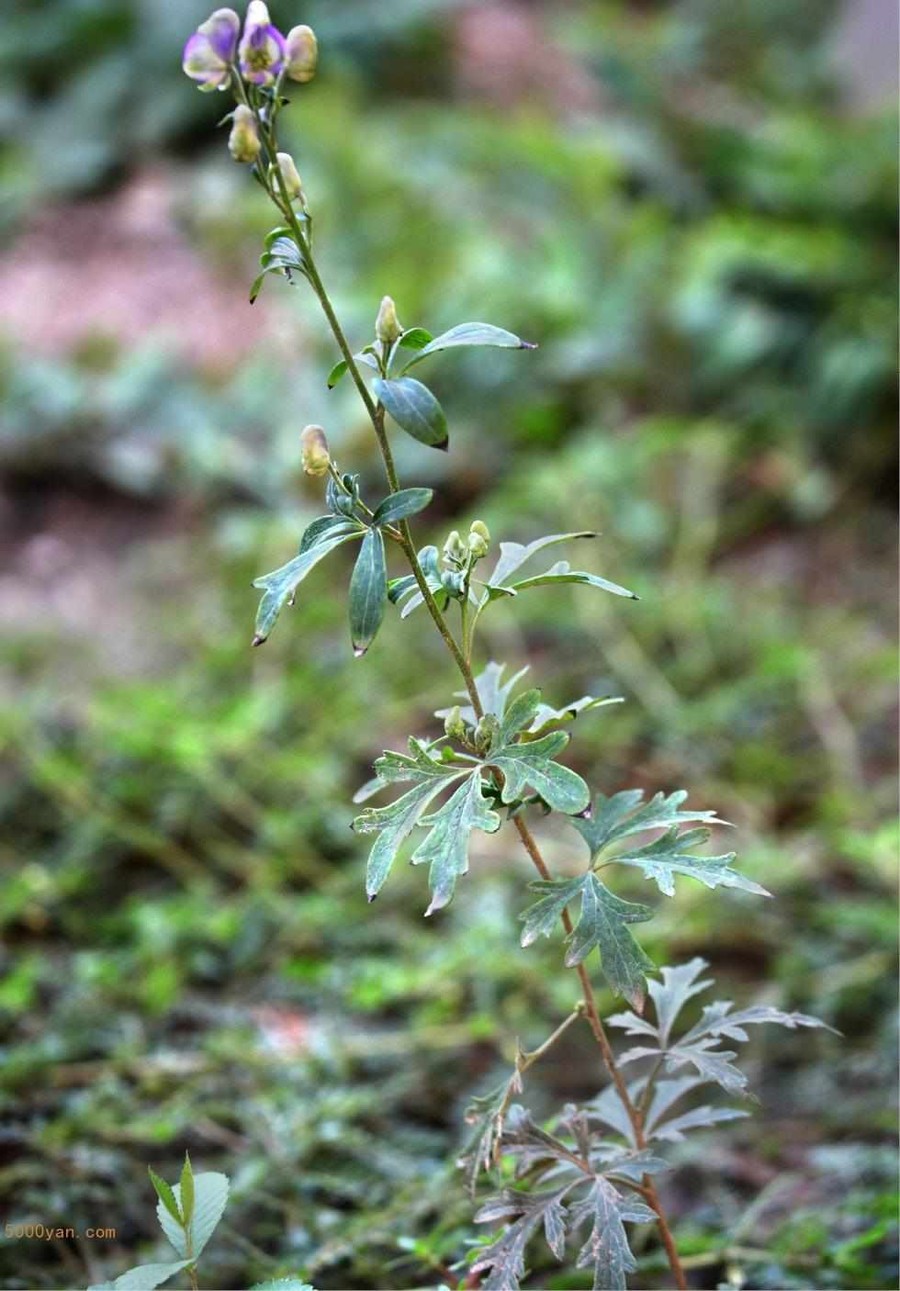
Perennial herb, 65-150 cm tall. Root tuber obconical or carrot-shaped, 2.5-5 cm long, 0.7-15 mm in diameter, outer bark dark brown. Stem erect, usually branched. Leaves alternate, lower stem leaves wither at flowering; petiole 2-12 cm long, glabrous; leaf blade pentagonal, 6-16 cm long, 8-20 cm wide, base cordate, 3-parted, central segment rhombic, nearly pinnatifid, ultimate lobes lanceolate; lateral segments obliquely fan-shaped, unequally 2-cleft, upper surface sparsely covered with short curved hairs, lower surface glabrous, papery or subleathery. Raceme terminal, with 9-22 flowers; rachis and pedicels glabrous; lower bracts 3-lobed, upper bracts linear; lower pedicels 1.8-5 cm long; bracteoles inserted at middle or lower part of pedicel, linear; flowers bisexual, zygomorphic; sepals 5, petaloid, upper sepal galeate or high-galeate, 1.5-2.5 cm high, beaked, lower margin about 1.8 cm long, lateral sepals 1.4-1.7 cm long, lower sepals oblong, outer surface with sparse curved soft hairs or nearly glabrous; petals 2, limb 3-4 mm wide, lip 3-5 mm long, spur 1-4 mm long, recurved or nearly coiled, glabrous; stamens numerous, filaments entire or with 2 small teeth, glabrous; carpels 5, glabrous. Follicles 8-20 mm long. Seeds numerous, flat ellipsoid, about 2.5 mm long, with narrow wings along ridges and transverse membranous wings on one side. Flowering August-September, fruiting September-October.
Habitat and Distribution
It grows on mountain slopes, hills, grassy slopes, sparse forests, and meadows. Distributed in Northeast and North China.
Harvesting and Processing
Harvested in autumn when the stems and leaves wither, remove the fibrous roots and sediment, and dry.
Medicinal Properties
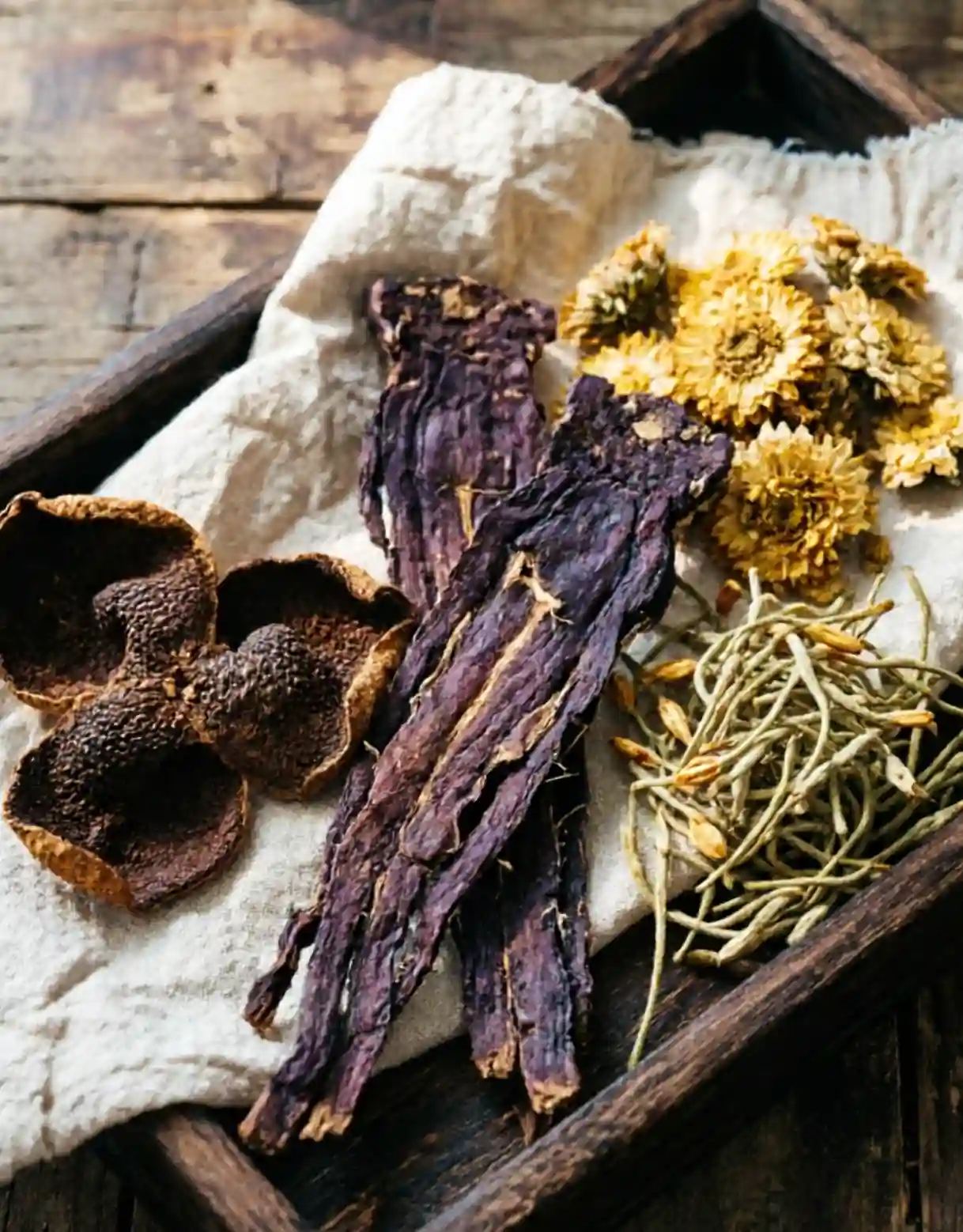
This product is irregularly long conical in shape, slightly curved, 2-7 cm long and 0.6-1.8 cm in diameter. The apex often has a remnant stem and a few adventitious root bases; on one side of the apex there may be a withered bud, and on the opposite side a round or flat-round adventitious root base. The surface is grayish-brown or dark brownish-black, wrinkled, with longitudinal wrinkles, dotted fibrous root scars, and several tumor-like lateral roots. The texture is hard; the transverse section is grayish-white or dark gray, with fissures; the cambium ring is polygonal or subrounded; the pith is relatively large or hollow. Odor: faint; Taste: acrid, numbing the tongue.
Chemical Constituents
This product primarily contains alkaloids and other chemical constituents, including aconitine, hypaconitine, mesaconitine, 3-deoxyaconitine, beiwutine, and higenamine.
Pharmacology
Has anti-inflammatory and analgesic effects; can enhance the effect of adrenaline on the myocardium, counteract the T wave inversion caused by calcium chloride, counteract the initial S-T segment elevation and subsequent S-T segment depression caused by posterior pituitary hormone; also has effects including enhancing the cardiac toxicity of strophanthin G, antihistamine, and local anesthesia.
Properties and Channel Entry
Acrid, bitter, hot; highly toxic. Enters the Heart, Liver, Kidney, and Spleen channels.
Functions and Indications
Expels Wind and eliminates Dampness, warms the channels and alleviates pain
Dosage and Administration
Internal use must be processed (pao zhi) before use
Precautions and Contraindications
For raw product, internal use should be used with caution; contraindicated during pregnancy; incompatible with Banxia, Gualou, Gualouzi, Gualoupi, Tianhuafen, Chuanbeimu, Zhebeimu, Pingbeimu, Yibeimu, Hubeibeimu, Bailian, and Baiji.
Prescriptions
1. For cold-dampness Qi with severe pain in the bones and joints of the limbs: Caowu (boiled until cooked, black skin removed, ground into powder) 0.3 g, Cangzhu 0.3 g, Gancao 0.3 g. Grind together into powder, mix with wine and take orally. (Sanfen San from "Yunlin Shenban") 2. For lower back and leg pain, arthritis: Caowu 4.5 g, Weilingxian 9 g, Dilong 9 g, Niuxi 12 g. Decoct in water and take orally. ("Qingdao Zhongcaoyao Shouce") 3. For knee and ankle joint pain, able to eliminate Wind-Dampness and strengthen the legs: Caowu, Fangfeng, Xixin, each equal parts. Grind into powder and rub into socks and shoes. (Xifeng Fang from "Fushou Jingfang") 4. For unilateral or bilateral headache: Baizhi (stir-fried) 75 g, Chuanxiong 30 g, Sheng Gancao 30 g, Caowu (half raw, half cooked) 30 g. Grind the above ingredients together into powder. Take 3 g per dose, with fine tea or mint decoction. (Shangqing San from "Jingyan Guangji") 5. For heart and stomach attacking pain, cold hernia, frequent attacks that do not heal: Caowu (sliced, stir-fried with vinegar) and Wuzhuyu (stir-fried), each equal parts. Mix with Hongqu (red yeast rice) to form a thin paste and make pills the size of hemp seeds. Take ten pills each time, three times daily. ("Bencao Huiyan")