Pinyin: Ziwan
Aliases
Qingwan, Zilin, Fanhuncaogen, Guanggongxu.
Source
1. For pneumonia: Renshen 6 g, decoct in water and take orally.Aster tataricusDried root and rhizome of L.f.
Botanical Description
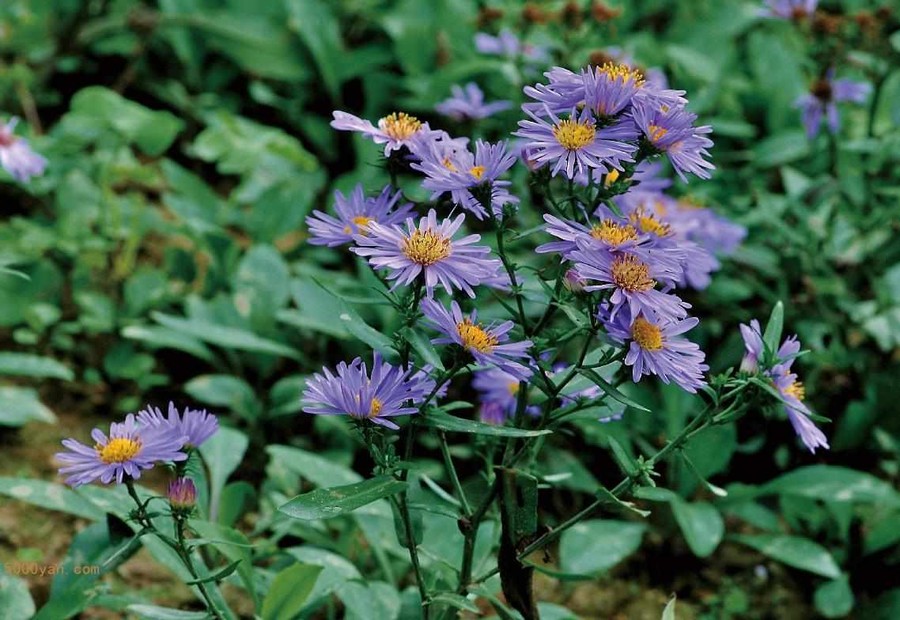
Perennial herb, 40-150 cm tall. Stem erect, usually unbranched, stout, sparsely strigose. Rhizome short, densely covered with numerous fibrous roots. Basal leaves wither and fall at flowering, oblong or elliptic-spatulate, 20-50 cm long, 3-13 cm wide, base decurrent; cauline leaves alternate, sessile; leaf blade long-elliptic or lanceolate, 18-35 cm long, 5-10 cm wide, midrib stout, with 6-10 pairs of pinnate lateral veins. Capitula numerous, 2.5-4.5 cm in diameter, arranged in compound corymbs; involucre hemispherical, 10-25 mm wide, phyllaries in 3 rows. Outer ones gradually shorter, entirely or upper part herbaceous, apex acute or rounded, margin broadly membranous, purplish-red; ray florets at margin, about 20, female, blue-purple, ligule apex 3-toothed, style with 2-branched stigma; central disc florets numerous, bisexual, yellow, apex 5-toothed; stamens 5; stigma 2-branched. Achenes obovate-oblong, flattened, purplish-brown, 2.5-3 mm long, with 1 vein on each side or rarely 3 veins, upper part with short appressed hairs, pappus dirty white or reddish. Flowering July to September, fruiting September to October.
Habitat and Distribution
Growing in low mountain shady slopes, wetlands, mountaintops, low mountain grasslands, and marshes
Harvesting and Processing
Harvested in spring and autumn, remove the nodular rhizome (commonly known as "mother root") and sediment, braid into a plaited shape and sun-dry, or directly sun-dry.
Medicinal Properties
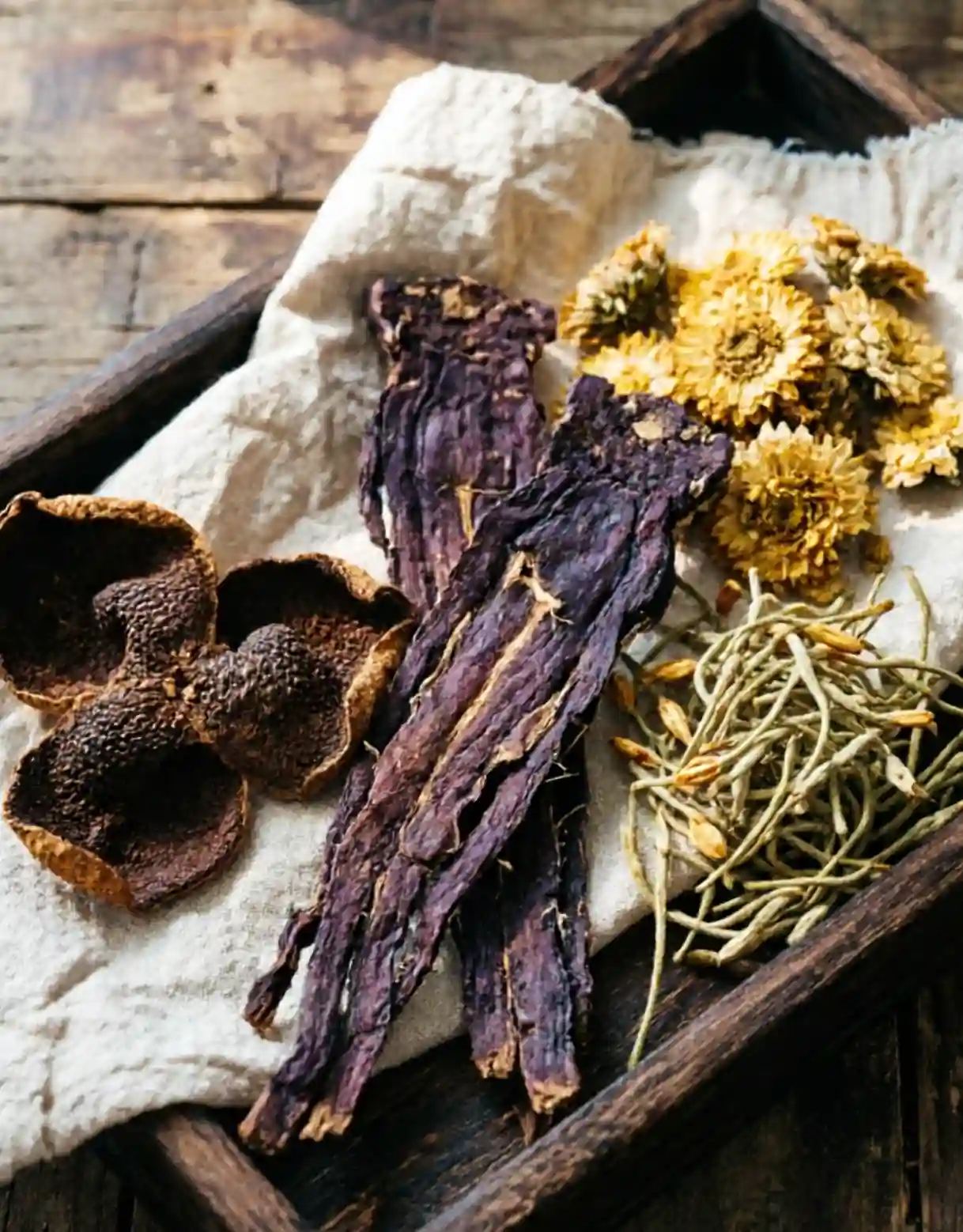
The rhizome is irregularly lump-shaped, varying in size, with remnants of stems and leaves at the apex; texture slightly hard. Numerous slender roots cluster from the rhizome, 3-15 cm long, 0.1-0.3 cm in diameter, mostly braided; surface purplish-red or grayish-red with longitudinal wrinkles; texture relatively soft and flexible. Odor: faintly aromatic; Taste: sweet and slightly bitter.
Chemical Constituents
This product primarily contains shionone, friedelin, astin A, astin B, astin C, rutin, aster saponin A, aster saponin B, aster saponin C, epifriedelanol, and asterolide, among other constituents.
Pharmacology
Has expectorant, antitussive, antibacterial, and hemolytic effects.
Properties and Channel Entry
Acrid, bitter, and warm. Enters the Lung channel.
Functions and Indications
Moistens the Lungs and directs Qi downward, eliminates Phlegm and stops cough. Used for copious phlegm with wheezing and cough, acute and chronic cough, consumptive cough with hemoptysis.
Dosage and Administration
Internal: decoct 4.5-10 g in water; or prepared into pills or powder. For moistening the Lungs, it is preferable to use honey-fried.
Precautions and Contraindications
Those with excess Heat should use with caution.
Prescriptions
1. For chronic cough unhealed: Ziwan (Aster tataricus, root removed) and Kuandonghua (Tussilago farfara) 30 g each, Baibu (Stemona sessilifolia) 15 g. Grind the three ingredients into powder. Take 9 g each time, with three slices of Shengjiang (Zingiber officinale, fresh ginger) and one Wumei (Prunus mume, smoked plum), decoct in water and take after meals and before bed. (From *Bencao Tujing*) 2. For pediatric cough with no voice: Ziwan powder and Xingren (Prunus armeniaca, apricot kernel) paste in equal parts, mix with honey. Form into pills the size of *Euryale ferox* seeds. Take one pill each time, with a decoction of Wuweizi (Schisandra chinensis). (From *Quanyou Xinjian*) 3. For hematemesis, hemoptysis, and cough with blood: Ziwan and Qiancaogen (Rubia cordifolia root) in equal parts. Grind into fine powder, mix with honey to form pills the size of cherry pits. Dissolve one pill in the mouth at any time. (From *Jifeng Puji Fang*, Ziwan Pill) 4. For dysuria: Ziwan and Cheqianzi (Plantago asiatica seed, wrapped in cloth) 12 g each. Decoct in water and take. (From *Anhui Zhongcaoyao*) 5. For habitual constipation: Ziwan, Kuxingren (Prunus armeniaca, bitter apricot kernel), Danggui (Angelica sinensis), and Roucongrong (Cistanche deserticola) 9 g each. Decoct in water and take. (From *Anhui Zhongcaoyao*)