Pinyin: Danshen
Aliases
Chishen, Muyangru, Shanshen.
Source
Plant of the Lamiaceae family, Salvia miltiorrhiza.Salvia miltiorrhizaThe dried root and rhizome of Bge.
Botanical Description
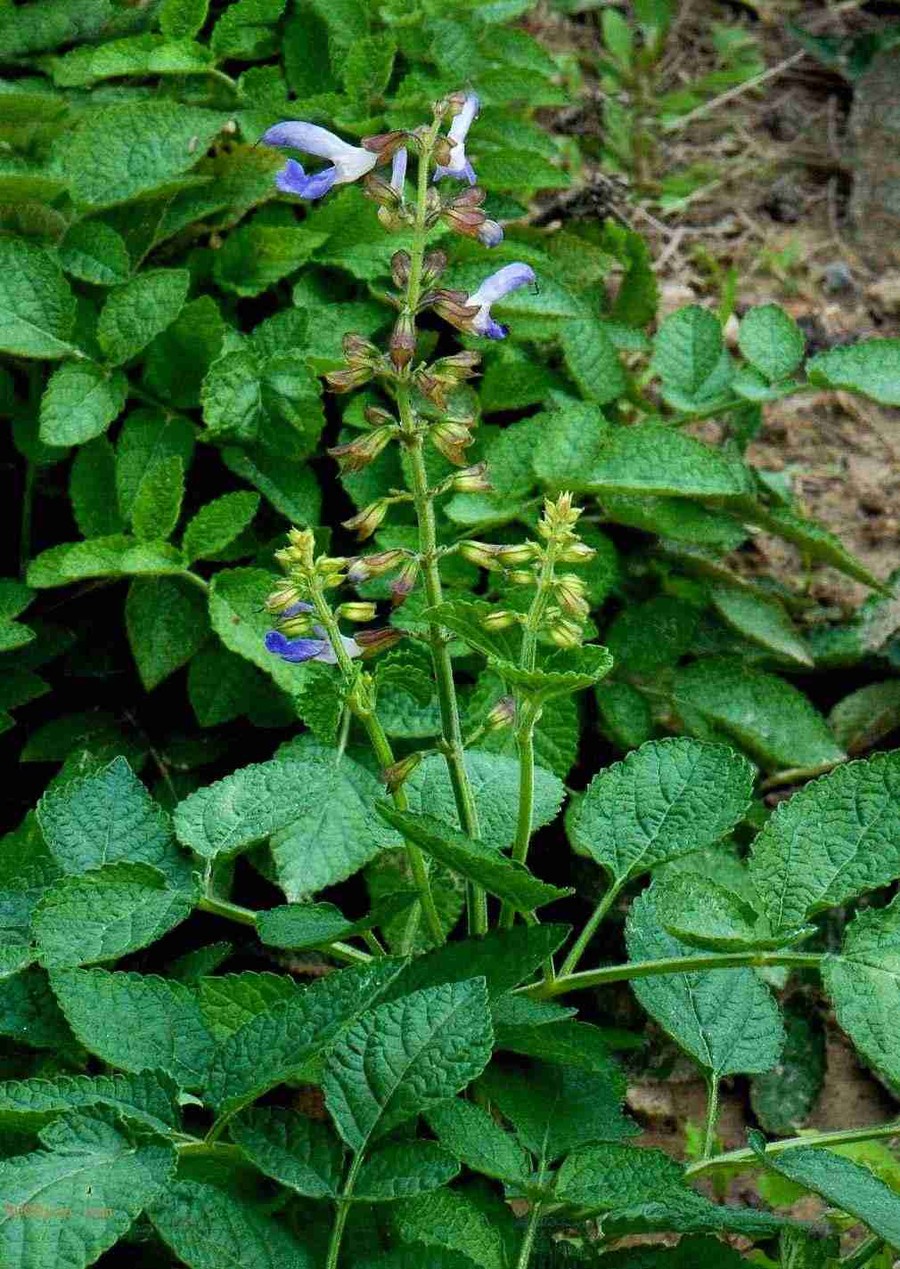
Perennial herb, 30-100 cm tall, densely covered with pale yellow soft hairs and glandular hairs. Stem quadrangular, grooved, branched above. Leaves opposite, odd-pinnate; leaflets usually 5, rarely 3 or 7, the terminal leaflet largest, lateral leaflets smaller, ovate to broadly ovate, apex acute or acuminate, base oblique-rounded or broadly cuneate, margin with rounded serrations, both surfaces densely covered with white soft hairs. Verticillaster inflorescences forming terminal or axillary racemes, each whorl with 3-10 flowers, lower ones spaced apart, upper ones dense; bracts lanceolate, glabrous above, slightly hairy below; calyx nearly campanulate, purple; corolla bilabiate, blue-purple, upper lip erect, falcate, apex slightly cleft, lower lip shorter than upper lip, apex 3-lobed, central lobe longer and larger than lateral lobes; fertile stamens 2, inserted at the middle of the lower lip, exserted beyond corolla; sterile stamens 2, linear, inserted on both sides of the upper lip throat, anthers degenerated into petal-like structures; disc slightly swollen anteriorly; ovary superior, 4-lobed, style slender, stigma 2-lobed, lobes unequal. Nutlets oblong, brown or black when mature, enclosed in persistent calyx. Flowering May to September, fruiting August to October.
Habitat and Distribution
It grows on hillsides, forest understory grasslands, or ditch edges at elevations of 120-1300 m. It is distributed in Liaoning, Hebei, Shanxi, Shaanxi, Ningxia, Gansu, Shandong, Jiangsu, Anhui, Zhejiang, Fujian, Jiangxi, Henan, Hubei, Hunan, Sichuan, Guizhou, and other regions.
Harvesting and Processing
Harvested in spring and autumn, remove sediment and sand, then dry.
Medicinal Properties
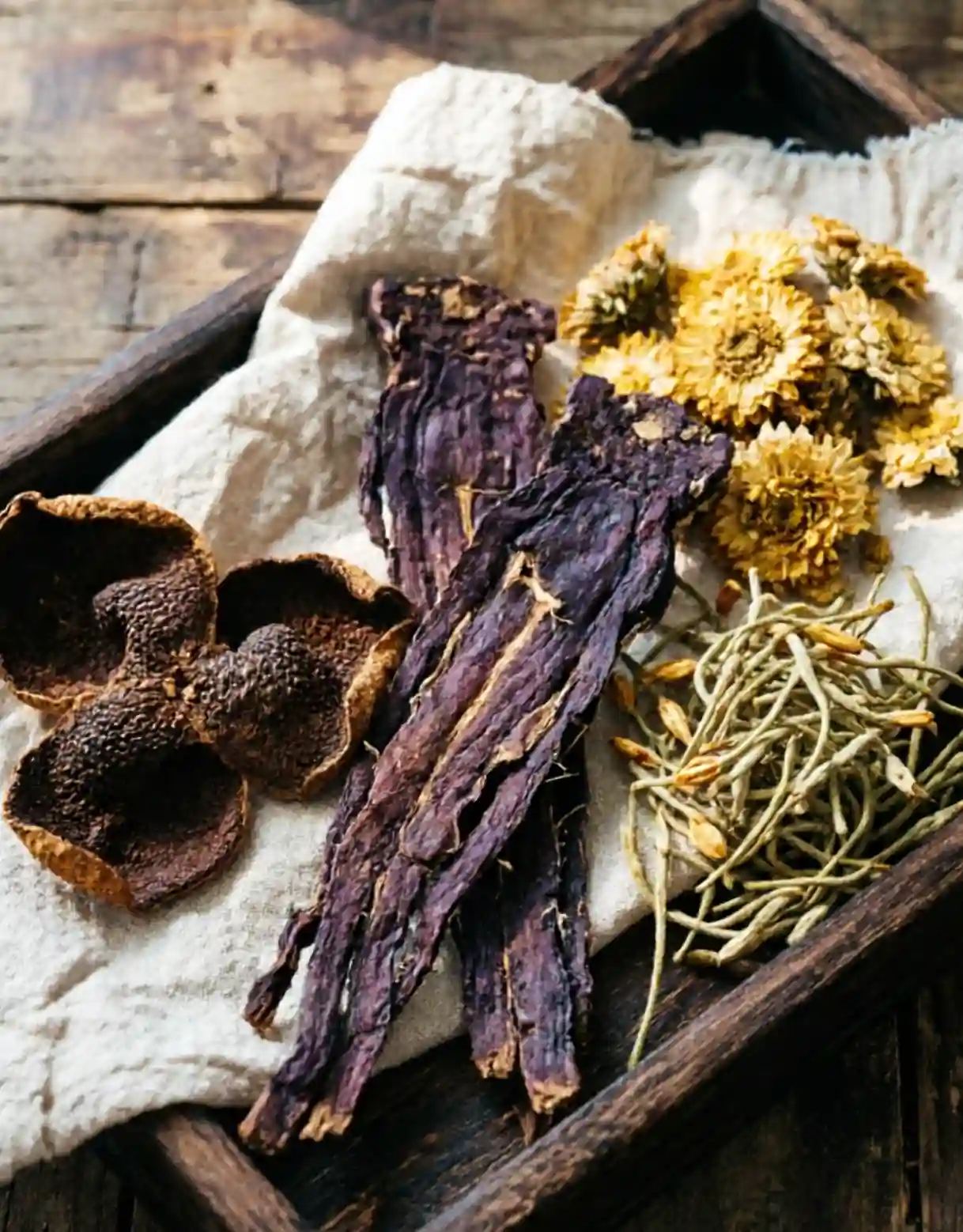
The rhizome is short and thick, occasionally with remnant stem bases at the apex. There are several roots, long and cylindrical, slightly curved, some branched with fibrous rootlets, 10-20 cm long, 0.3-1 cm in diameter. The surface is brownish-red or dark brownish-red, rough, with longitudinal wrinkles. The bark of older roots is loose, mostly purplish-brown, often exfoliating in scale-like flakes. The texture is hard and brittle, the fracture is loose, with fissures or slightly even and dense; the bark is brownish-red, the wood is grayish-yellow or purplish-brown, and the vascular bundles are yellowish-white, arranged radially. Odor: faint; Taste: slightly bitter and astringent.
Chemical Constituents
This product contains tanshinone, cryptotanshinone, lithospermic acid B, salvianolic lactone, dihydrotanshinone, salvianolic acid B, dihydroisotanshinone I, salvianol, salvianolactone, tigogenin,β-β-sitosterol, stigmasterol, cryptomeridol, etc.
Pharmacology
Protects the heart and brain system; lowers blood lipids; anti-atherosclerotic; invigorates Blood and resolves stasis; enhances hypoxia tolerance; strengthens immune function; anti-inflammatory and anti-allergic; protects the liver; anti-gastric ulcer; anti-tumor; sedative and analgesic; protective effect on the respiratory system; improves renal function; antioxidant; antibacterial; promotes healing of skin wounds and fractures; exhibits sex hormone-like effects.
Properties and Channel Entry
Bitter, slightly cold. Enters the Heart and Liver channels.
Functions and Indications
Activates Blood and dispels stasis, unblocks the channels and alleviates pain, clears the Heart and relieves restlessness, cools the Blood and dissipates abscesses. Used for chest impediment and heart pain, epigastric and hypochondriac pain, abdominal masses, painful hot Bi disorder, restlessness and insomnia, irregular menstruation, dysmenorrhea and amenorrhea, and painful sores and swellings.
Dosage and Administration
Oral: decoction, 5-15 g, up to 30 g for large doses.
Precautions and Contraindications
Women with excessive menstruation and those without blood stasis are contraindicated; use with caution during pregnancy; incompatible with Lilium brownii (Lilu).
Prescriptions
1. For scanty menstruation, postpartum abdominal pain due to blood stasis, and abdominal pain due to amenorrhea: Danshen 9 g, Yimucao 9 g, Xiangfu 9 g, decoct in water and take orally. (Selected Chinese Herbal Medicines from Shaanxi, Gansu, Ningxia, and Qinghai) 2. For postpartum vaginal bleeding: Danshen 360 g. Boil with five sheng of wine to obtain three sheng, take one sheng warm, three times daily. (Important Prescriptions Worth a Thousand Gold) 3. For epigastric and abdominal pain of mixed deficiency and excess type: Danshen 30 g, Tanxiang 4.5 g, Sharen 4.5 g, decoct in water and take orally. (Formulas from the Current Era, Danshen Decoction) 4. For acute and chronic hepatitis with bilateral rib pain: Yinchen 15 g, Yujin 9 g, Danshen 9 g, Banlangen 9 g, decoct in water and take orally. (Selected Chinese Herbal Medicines from Shaanxi, Gansu, Ningxia, and Qinghai) 5. For dysmenorrhea: Danshen 15 g, Yujin 6 g, decoct in water, one dose daily, taken in two divided doses. (National Compilation of Chinese Herbal Medicines)