Pinyin: Chuanxiong
Aliases
Shan Ju Qiong, Jing Xiong, Xi Xiong.
Source
Apiaceae plant Ligusticum chuanxiong (Chuanxiong)Ligusticum chuanxiongDried rhizome of *Hort*.
Botanical Description
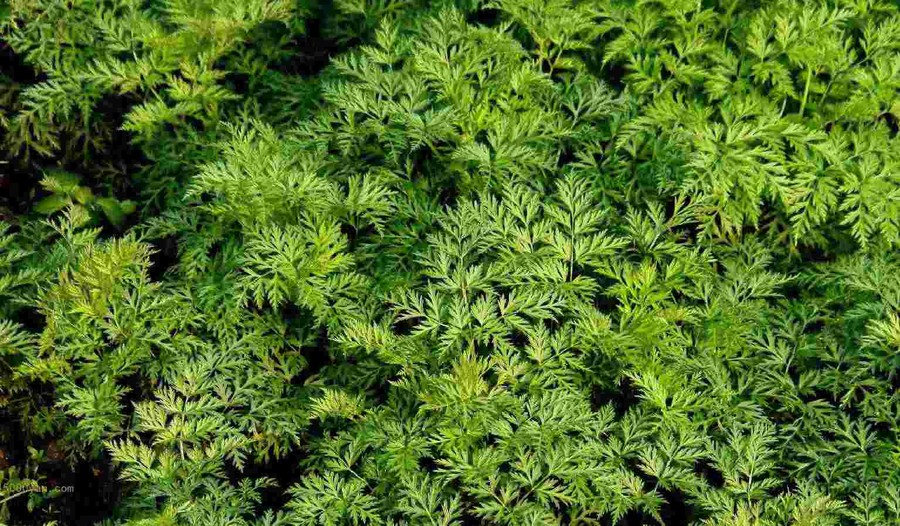
Perennial herb, 40-70 cm tall. The entire plant has a strong aroma. The rhizome is irregularly nodular, forming a fist-shaped mass, with numerous fibrous roots at the lower part. The stem is erect, cylindrical, hollow, with longitudinal grooves on the surface. The nodes at the lower part of the stem are swollen and disc-shaped (commonly known as "Lingzi"), while those above the middle are not swollen. The lower stem leaves have petioles, with the base expanded into a sheath; the leaf blade is ovate-triangular, 3-4 times ternate-pinnatisect, with 4-5 pairs of pinnae, ovate-lanceolate, the ultimate segments linear-lanceolate to long-ovate, with small apical points, sparsely pubescent only on the veins; the upper stem leaves gradually simplify. Compound umbels terminal or lateral, with 3-6 linear involucral bracts; rays 7-20, unequal in length; umbellets with 10-24 flowers; involucel bracts 2-7, linear, slightly purple, pubescent; calyx teeth undeveloped; petals white, obovate to elliptic, with a short mucronate apex, incurved; stamens 5, anthers light green; styles 2, recurved downward. Young fruit laterally compressed; dorsal vittae 1-5, lateral vittae 2-3, commissural vittae 6-8. Flowering period July to August, young fruit period September to October.
Habitat and Distribution
It is a well-known cultivated Chinese medicinal material, with no wild populations found. It has been introduced and cultivated in Sichuan, Yunnan, Guizhou, Guangxi, Hubei, Hunan, Jiangxi, Zhejiang, Jiangsu, Shaanxi, Gansu, and other regions.
Harvesting and Processing
Harvest in summer when the stem nodes are prominently protruding and slightly purplish, dig up the roots, remove sediment, sun-dry then oven-dry, and finally remove the fibrous roots.
Medicinal Properties
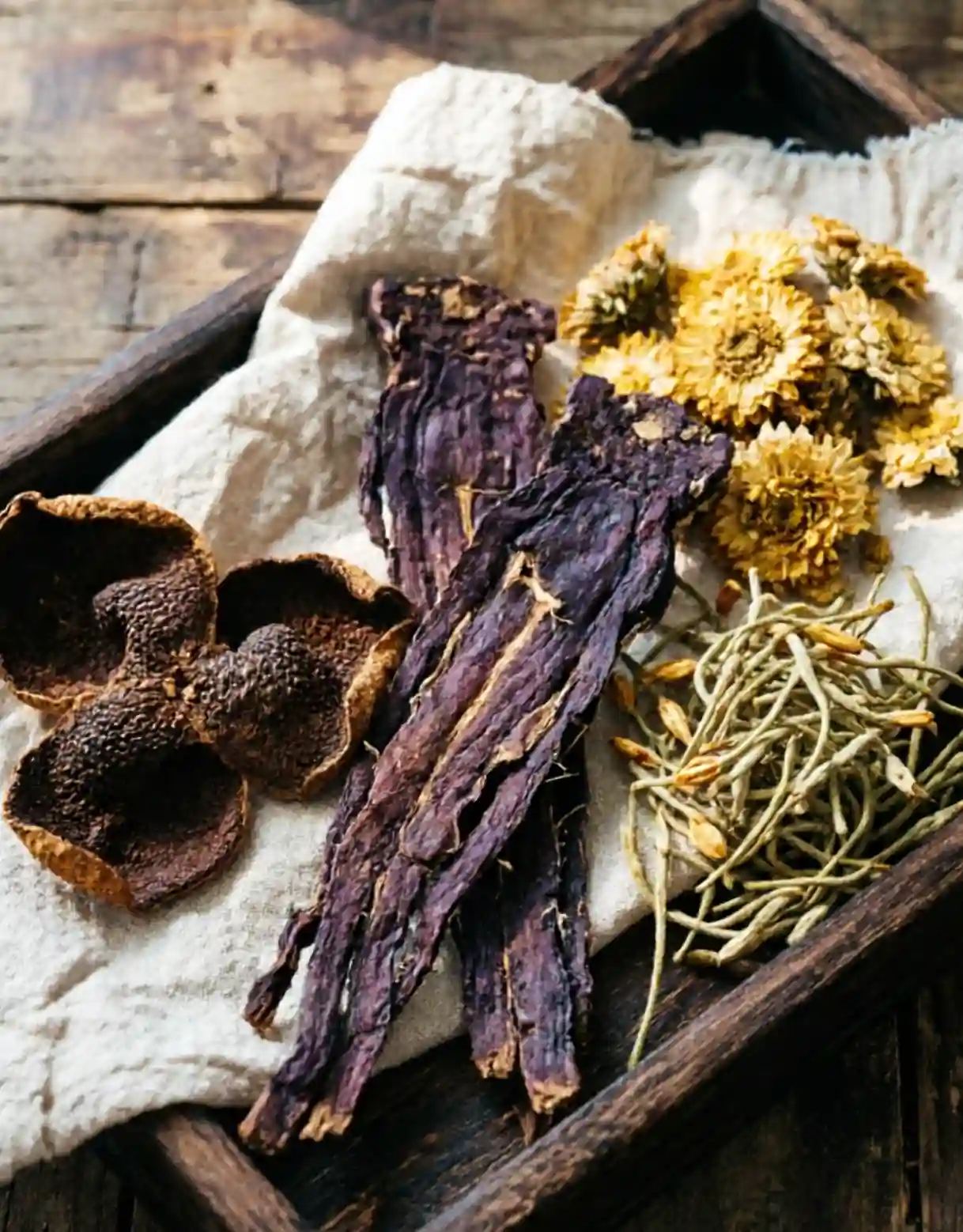
This product is an irregular, nodular, fist‑sized mass, 2‑7 cm in diameter. The surface is yellowish‑brown, rough and wrinkled, with numerous parallel raised annular nodes; the apex shows a depressed, roundish stem scar, while the lower side and the annular nodes bear many small, tumor‑like root scars. The texture is hard, difficult to break; the fracture is yellowish‑white or grayish‑yellow, scattered with yellowish‑brown oil cavities, and the cambium ring appears wavy. The odor is strong and aromatic; the taste is bitter and acrid, with a slight numbing sensation on the tongue and a mild aftertaste of sweetness.
Chemical Constituents
This product contains ferulic acid, ligustilide, 3-butylidenephthalide, myrcene, ligustrazine, palmitic acid, daucosterol,β- Contains components such as sitosterol.
Pharmacology
Effects on the cardiovascular and cerebrovascular system: inhibits cardiac function; dilates blood vessels and lowers blood pressure; increases coronary blood flow; protects against myocardial and reperfusion injury; improves microcirculation; enhances cerebral circulation and alleviates cerebral ischemia. Improves the hematologic system, promotes diuresis, and enhances immune function; inhibits tracheal constriction induced by leukotrienes, histamine, and prostaglandin E2; prevents and protects against epinephrine-induced experimental pulmonary edema in rats; exhibits antitumor and anti-radiation effects.
Properties and Channel Entry
Acrid, warm. Enters the Liver, Gallbladder, and Pericardium channels.
Functions and Indications
Promotes blood circulation and moves Qi, expels Wind and alleviates pain. Used for chest obstruction and heart pain, stabbing pain in the chest and hypochondrium, traumatic swelling and pain, irregular menstruation, amenorrhea and dysmenorrhea, abdominal masses and pain, headache, and Wind-Damp Bi pain.
Dosage and Administration
Oral: decoct in water, 3-10 g; grind into powder, 1-1.5 g per dose; or made into pills or powder. External use: appropriate amount, grind into powder and sprinkle; or decoct and use as a mouth rinse.
Precautions and Contraindications
Use with caution in cases of Yin deficiency with effulgent Fire, excessive menstruation, and hemorrhagic diseases.
Prescriptions
1. For postpartum blood stasis with abdominal pain due to clotted blood: Danggui (Angelica sinensis) 24 g, Chuanxiong (Ligusticum chuanxiong) 9 g, Taoren (Persica seed) 14 pieces (remove skin and tip, grind), Heijiang (charred ginger) 1.5 g, Zhigancao (honey-fried licorice) 1.5 g. Decoct in equal parts of yellow wine and boys' urine, and take orally. (Shenghua Tang from Fu Qingzhu's Obstetrics and Gynecology). 2. For postpartum hemorrhage with blood syncope and unconsciousness: Chuanxiong 15 g, Danggui 15 g, Jingjiesui (Schizonepeta spike, stir-fried black) 15 g. Prepare as one dose, decoct in water, add wine and boys' urine, and take. (Chuanxiong Tang from Song's Secret Records of Obstetrics). 3. For postpartum Qi and Blood deficiency with wind-cold invasion, headache, chills, and fever: Danggui and Chuanxiong each 6 g, Zisu (Perilla leaf) and Gange (Pueraria root) each 3 g. Chop the ingredients, add three slices of fresh ginger, decoct in water, and take orally. (Jiawei Xiong Gui Tang from Yi Deng Xu Yan). 4. For unilateral headache and wind-type headache: Ganjun (Chrysanthemum flower), Shigao (Gypsum), and Chuanxiong each 9 g, grind into powder. Take 3 g per dose, adjusted with tea infusion. (Chuanxiong San from Chi Shui Xuan Zhu). 5. For nasal congestion with loss of smell: Chuanxiong and Xinyi (Magnolia flower) each 30 g, Xixin (Asarum root, remove stem and leaves) 0.9 g, Mutong (Akebia stem, chopped) 15 g. Grind the four ingredients together into a powder. Use a small amount wrapped in cotton to stuff into the nostril, replace when damp. (Chuanxiong San from Sheng Ji Zong Lu).