Pinyin: Huangyaozi
Aliases
Huangyao, Jinxian Diao Hulu, Tie Cheng Tuo, Tu Yu.
Source
Plant of the Dioscoreaceae family, *Dioscorea bulbifera* L.Dioscorea bulbiferaL. dried tuber.
Botanical Description
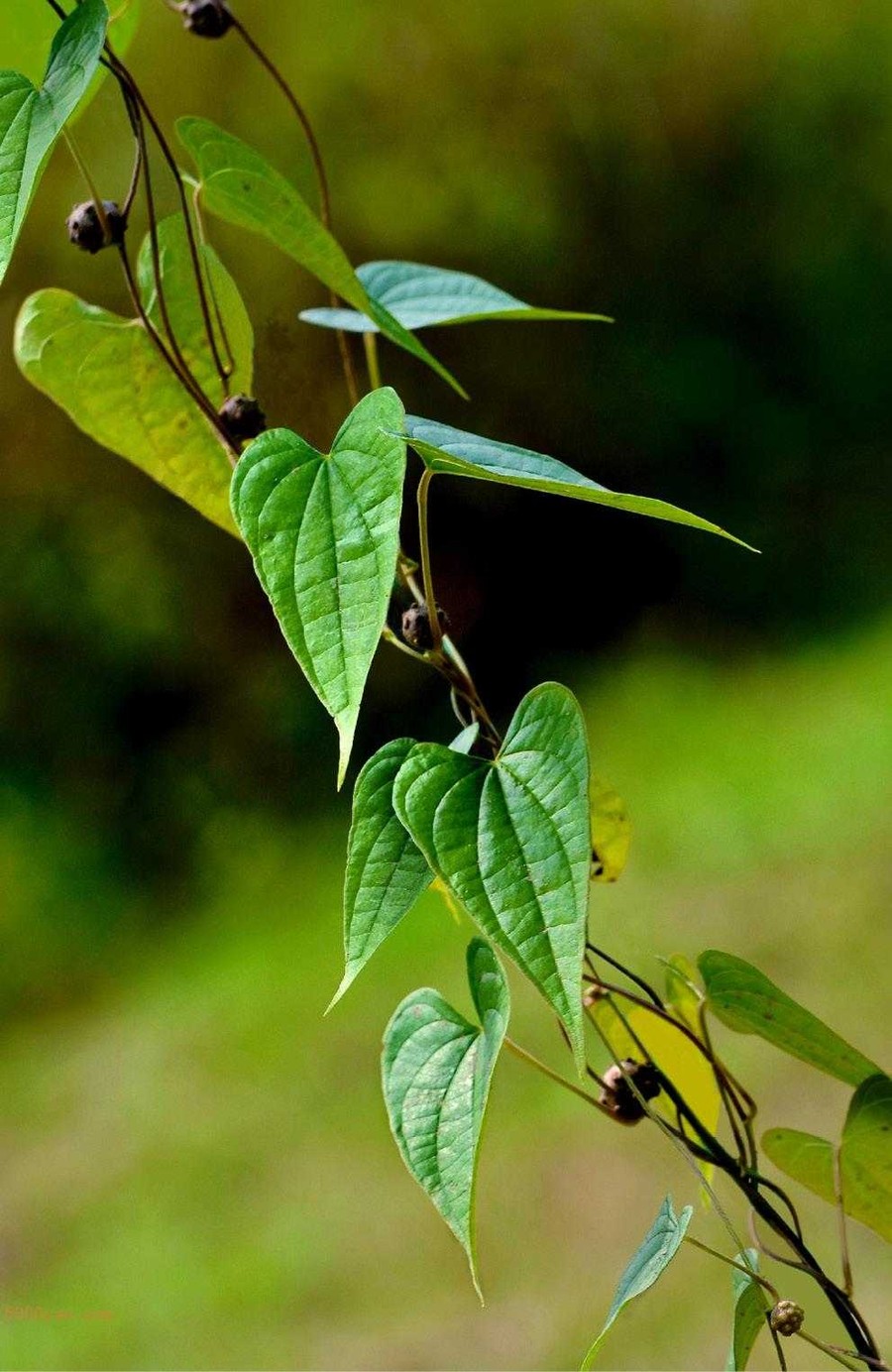
Twining herbaceous vine. Tubers ovoid to oblong, near the soil surface, brownish-brown, densely covered with numerous fine fibrous roots. Stems cylindrical, twining to the left, glabrous. Leaves alternate; petioles slightly shorter than the leaf blades; leaf blades broadly ovate-cordate to ovate-cordate, 5-16(-26) cm long, 2-14(-26) cm wide, apex caudate-acuminate, margins entire or slightly undulate, both surfaces glabrous; axils contain purplish-brown spherical or ovoid bulbils (lingyuzi) of varying sizes, 1-3 cm in diameter, with circular spots on the surface. Flowers unisexual, plants dioecious; male inflorescences spike-like, pendulous, usually clustered in leaf axils, sometimes the basal inflorescence elongates into a panicle; male flowers solitary and dense, with 2 ovate bracts at the base; perianth lobes lanceolate, purple when fresh; stamens 6, inserted at the base of the perianth, filaments nearly as long as anthers; female inflorescences similar to male, often 2 to several clustered in leaf axils, 20-50 cm long, staminodes 6, only 1/4 the length of the perianth lobes. Capsules reflexed and pendulous, trigonous-oblong, 1.5-3 cm long, 0.5-1.5 cm wide, both ends rounded, pale yellow when mature, densely covered with purple spots; seeds dark brown, flat-ovate, usually 2 per locule borne at the apex of the central axis, wings chestnut-brown, extending upward from the seed, oblong in shape. Flowering period July to October, fruiting period August to November.
Habitat and Distribution
Born at riverbanks below 2000 m altitude, in valleys, shady ditches, or at the edges of mixed forests. Distributed in East China, Central South China, Southwest China, and Shaanxi, Taiwan, and other regions.
Harvesting and Processing
After 2-3 years of cultivation, harvest in winter, process tubers with a diameter of 30 cm or more for medicinal use, and continue cultivating the rest for another year. Wash off soil, trim off fibrous roots, then slice horizontally into 1 cm thick pieces, sun-dry or oven-dry, or use fresh.
Medicinal Properties
This product is mostly cross-section thick slices, round or nearly round, 2.5-7 cm in diameter, 0.5-1.5 cm thick. The surface is brown-black, wrinkled, with numerous white, punctate protruding rootlet scars, or with curved residual fine roots, and the cork layer is easily peeled off; the cut surface is yellowish-white to yellowish-brown, flat or uneven. The texture is hard and brittle, easily broken, the fracture surface is granular, with scattered orange-yellow specks. Odor: faint; Taste: bitter.
Chemical Constituents
This product primarily contains diosbulbin A-H, 8-epidiosbulbin E acetate, diosgenin, diosbulbin B, diosbulbin C, saponins, tannins, and starch.
Pharmacology
Has antibacterial, anti-goiter effects, inhibits cardiac function, suppresses intestinal smooth muscle, stimulates uterine smooth muscle, lowers blood sugar, and other actions.
Properties and Channel Entry
Bitter, cold. Slightly toxic. Enters the Lung and Liver channels.
Functions and Indications
Dissipates nodules and reduces goiter, clears Heat and resolves toxicity, cools Blood and stops bleeding. Indications: goiter and thyroid masses, throat obstruction, welling-abscesses, sores, and toxic swellings, poisonous snake bites, tumors, hematemesis, epistaxis, hemoptysis, whooping cough, and cough and dyspnea due to Lung Heat.
Dosage and Administration
Oral: decoct in water 3-9 g; or steep in wine; grind into powder 1-2 g
Precautions and Contraindications
Internal dose should not be too large.
Prescriptions
1. For sprains: Huangyaozi root and Qiyeyizhihua (both fresh) in equal amounts. Pound and roast, then apply externally. (Jiangxi Herbal Medicine) 2. For hemoptysis: Huangyaozi and Hanfangji 30 g each. Grind to powder, take 3 g per dose with one cup of water and 20 wheat grains, decoct together, take warm before meals. (Empirical Prescriptions) 3. For persistent epistaxis: Grind Huangyaozi to powder, take 6 g per dose, administer with decocted Ejiao soup. After a while, mix one spoonful of flour with fresh water and take it. (Brief Prescriptions for Benefiting the Masses) 4. For diarrhea: Grind Huangyaozi to powder, take 3 g per dose, swallow with boiling water. (Guizhou Herbal Medicine) 5. For cough and asthma: Huangyaozi tuber and Hutuizi leaves 9 g each, sugarcane node 2 pieces. Decoct in water and take orally. (Zhejiang Folk Commonly Used Herbal Medicine)