Pinyin: Muxiang
Aliases
Qingmuxiang, Nanmuxiang, Guangmuxiang
Source
Asteraceae family plant Muxiang (Common Aucklandia root).Aucklandia lappaThe dried root of Decne.
Botanical Description
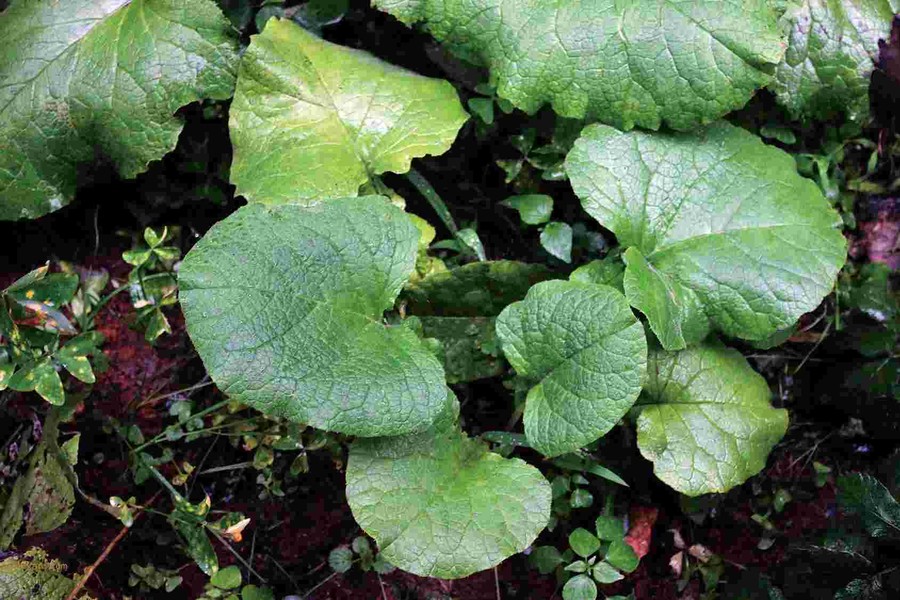
Perennial tall herb, 1.5-2 m high. Taproot stout, cylindrical, surface yellowish-brown, with sparse lateral roots. Stem erect, sparsely covered with short soft hairs. Basal leaves large, with long petioles; leaf blade triangular-ovate or long-triangular, base cordate or broadly cuneate, decurrent to petiole base or irregularly lobed wing-like, margin irregularly shallowly lobed or undulate, sparsely with short spines, upper surface dark green with short hairs, lower surface pale green tinged with brown, with short hairs; stem leaves smaller, leaf base wing-like, decurrent and clasping the stem. Capitula terminal and axillary, usually 2-3 clustered at stem apex, nearly without peduncle, axillary ones solitary with long peduncle; involucral bracts about 10 layers, triangular-lanceolate or long-lanceolate, outer ones shorter, apex long-acute and spine-like, sparsely with minute soft hairs; all florets tubular, dark purple, corolla tube apex 5-lobed; stamens 5, anthers united, upper part slightly separated, with 3 pointed teeth; ovary inferior, style exserted beyond corolla tube, stigma 2-lobed. Achenes linear, apex with 2 layers of yellow erect pappus, often shed at maturity. Flowering period May to August, fruiting period September to October.
Habitat and Distribution
Cultivated in high mountain areas at an altitude of 2500-4000 m, it can also grow in cooler plains and hilly regions. It has been introduced and cultivated in Shaanxi, Gansu, Hubei, Hunan, Guangdong, Guangxi, Sichuan, Yunnan, Tibet and other places in China, with more cultivation and larger yields in northwestern Yunnan. Native to India.
Harvesting and Processing
Harvested in autumn and winter, removed from soil and fibrous roots, cut into segments, large ones split longitudinally into halves, dried and rubbed to remove the rough outer bark.
Medicinal Properties
This product is cylindrical or semi-cylindrical in shape, 5-10 cm long, and 0.5-5 cm in diameter. The surface is yellow-brown to gray-brown, with distinct wrinkles, longitudinal grooves, and lateral root scars. The texture is hard and not easily broken; the fracture surface is gray-brown to dark brown, with a gray-yellow or light brownish-yellow periphery, a brown cambium ring, radial striations, and scattered brown, spot-like oil cavities. The odor is distinctive and aromatic; the taste is slightly bitter.
Chemical Constituents
This product mainly contains costunolide, dehydrocostus lactone, costuslactone, costene, costusic acid, and costol.α-cyclomuscic acid lactone, glycine, palmitic acid,β- β-sitosterol, syringin, etc.
Pharmacology
Promotes gastrointestinal motility; dilates bronchial smooth muscle; antibacterial; lowers blood sugar; antitumor, etc.
Properties and Channel Entry
Acrid, bitter, warm. Enters the Spleen, Stomach, Large Intestine, Sanjiao, and Gallbladder channels.
Functions and Indications
Promotes Qi circulation and alleviates pain, strengthens the Spleen and promotes digestion. Used for distension and pain in the chest, rib-side, and epigastric region, tenesmus (a heavy sensation after diarrhea), undigested food accumulation, and poor appetite. Roasted Muxiang (Saussurea costus) consolidates the intestines and stops diarrhea, used for diarrhea with abdominal pain.
Dosage and Administration
Internal use: decoction, 3-10 g; or made into pills or powder.
Precautions and Contraindications
Forbidden in cases of dryness-heat in the Zang and Fu organs and Yin deficiency with fluid depletion.
Prescriptions
1. For all types of Qi disharmony and wandering pain: Muxiang, grind with warm water to a thick juice, and take with hot wine. (From Jian Dan Shan Fang) 2. For internal burning abdominal pain: Muxiang, Ruxiang, and Moyao 1.5 g each. Decoct in water and take orally. (From Ruan Shi Xiao Er Fang) 3. For Lung insufficiency with incessant cough and wheezing: Muxiang and Fangji 6 g each, Xingren 9 g. Grind into powder, make into honey pills the size of small beans. Take 20 pills each time with a decoction of Sangbaipi. For constipation, add Tingli. (From Wei Sheng Yi Jian Fang) 4. For non-healing sores: Muxiang 6 g, Huangdan and Ku Fan 15 g each, Qing Fen 3 g. Grind each into fine powder separately, mix thoroughly with pig bile, dry in the sun, and grind again into fine powder. Apply to the affected area. (From Yi Xue Tong Zhi, Sheng Ji San) 5. For axillary odor: Soak Muxiang in good vinegar, hold under the armpit. (From Bi Xiao Fang)