Pinyin: Pingbeimu
Aliases
Pingbei, Beimu, Pingbei
Source
Liliaceae plant *Fritillaria ussuriensis*Fritillaria ussurien-sisDried bulb of Maxim.
Botanical Description
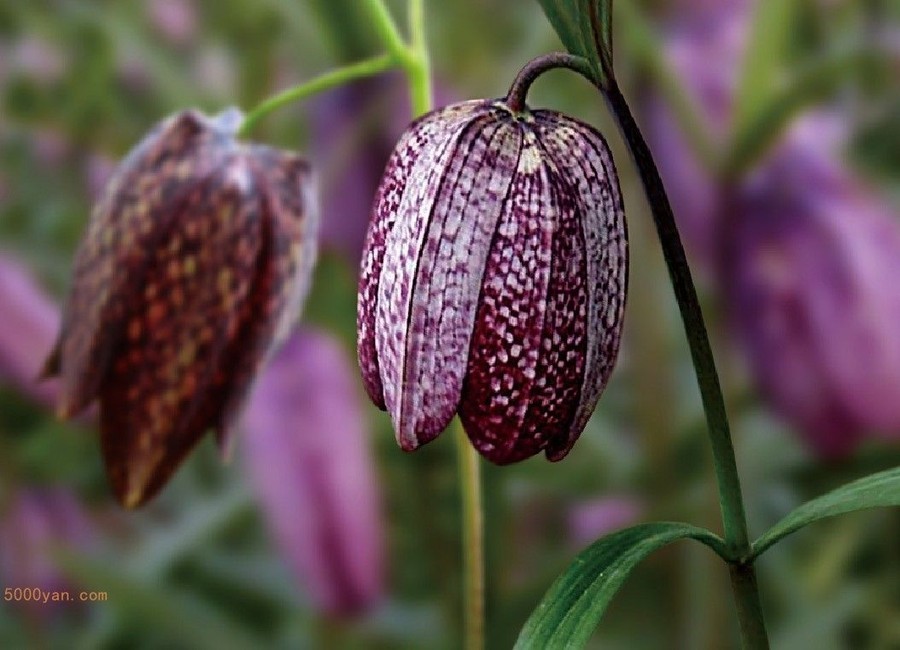
Herbaceous, 40-60 cm tall. Bulb 1-1.4 cm in diameter, composed of 2 thick fleshy scales, with a few small bulblets around. Leaves borne above the stem base, whorled or opposite, with a few scattered above the middle; leaf blade linear, 9-15 cm long, 2-6 mm wide, apex not curled or slightly curled. Flowers 1-3, terminal, pendulous, purple with small yellow squares; terminal flower with 4-6 leaf-like bracts, linear bracts with strongly curled apex; perianth campanulate; perianth segments 6, oblong-obovate, obtuse, with nectaries above the base; stamens 6, about 3/5 the length of the perianth segments; style with papillae; stigma 3-lobed. Capsule broadly obovoid, with rounded ridges. Flowering period: May-June.
Habitat and Distribution
Grows in fertile soil in forests. Distributed in the northeastern region of China.
Harvesting and Processing
Harvested in spring, remove the outer bark, fibrous roots, and soil, then sun-dry or dry at low temperature.
Medicinal Properties
This product is oblate-spherical, 0.5-1 cm high, 0.6-2 cm in diameter. The surface is milky white or pale yellowish-white, with 2 outer scale leaves that are fleshy, similar in size or one slightly larger and clasping the other; the apex is slightly flat or slightly concave, often slightly split open; the central scale leaf is small. The texture is hard and brittle, the broken surface is starchy. Odor: faint; Taste: bitter.
Chemical Constituents
This product mainly contains peimisine, peimisine, sipeimine, peimisine alkaloid, pingbeidinoside, pingbeicyloketone methyl ether,α- Caryophyllene.γ- linalool and other components.
Pharmacology
Has certain inhibitory effects on peptic ulcers and stress ulcers; also has central nervous system depressant, blood pressure lowering, and expectorant effects.
Properties and Channel Entry
Bitter, sweet, and slightly cold. Enters the Lung and Heart channels.
Functions and Indications
Clears Heat, moistens the Lungs, transforms Phlegm, and stops cough. Used for Lung-Heat dry cough, dry cough with scant sputum, Yin-deficiency consumptive cough, and cough with blood-streaked sputum.
Dosage and Administration
Oral administration: decoction, 3-9 g; powder taken with water, 1-2 g per dose.
Precautions and Contraindications
It is not suitable to use in combination with Chuanwu, processed Chuanwu, Caowu, processed Caowu, and Fuzi.
Prescriptions
1. For chronic bronchitis: Pingbeimu, Baihe, Suye, Wuweizi, Jiegeng each 150 g. Decoct twice in water, concentrate to 5,000 g, add 1,000 g of sugar. Take 15-20 ml each time, 3 times daily. (National Compendium of Chinese Herbal Medicine) 2. For tubercular cough with blood-tinged sputum: Pingbeimu 35 g, Baiji 50 g, Baixian 25 g. Grind together into fine powder, take 10 g per dose, 2 times daily. (Changbai Mountain Flora Medica) 3. For yin deficiency fever with dry cough and scant sputum: Pingbeimu 10 g, Zhimu 10 g, Gancao 5 g. Decoct in water and take orally. (Changbai Mountain Flora Medica) 4. For scrofula (lymph node tuberculosis): Pingbeimu 15 g, Xuanshen 20 g, Muli 25 g. Grind into fine powder, make into honey pills weighing 10 g each, take 1 pill each time, 2 times daily. (Changbai Mountain Flora Medica)