Pinyin: Shengdihuang
Aliases
Xian Dihuang, Xian Shengdi, Shanyangen.
Source
Plant of the family Scrophulariaceae, *Rehmannia glutinosa*Rehmannia glutinosaFresh or dried root tubers of Libosch.
Botanical Description
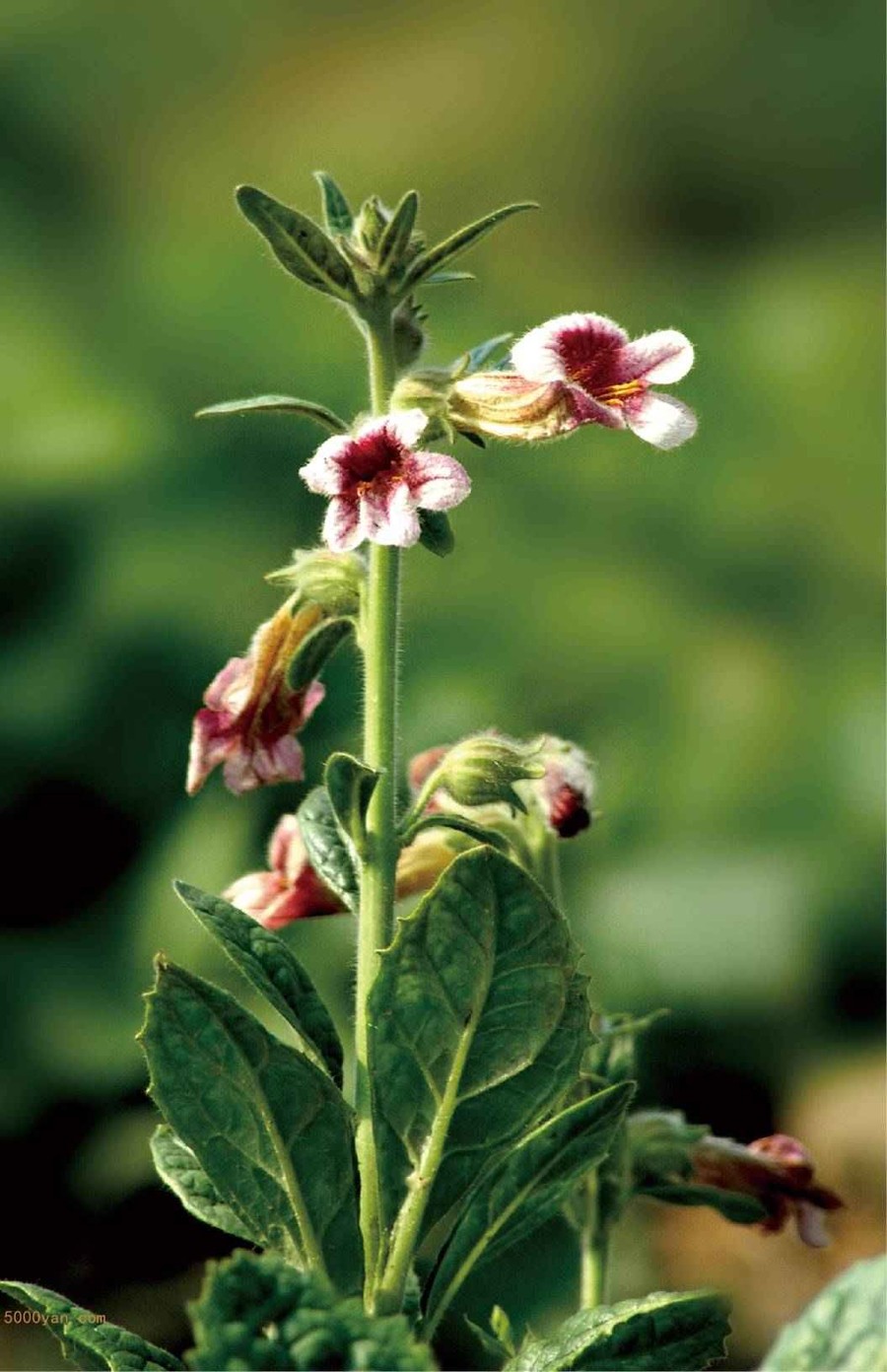
Perennial herb, 10-40 cm tall. Entire plant covered with grayish-white long hairs and glandular hairs. Root thick, fleshy, blocky, cylindrical or fusiform. Stem erect, simple or branched from base. Basal leaves tufted, leaf blade obovate-lanceolate, apex obtuse, base gradually narrowed, decurrent into long petiole, leaf surface wrinkled, margin irregularly serrate; stem leaves smaller. Scape erect, hairy, raceme at upper part of stem; bracts leaf-like, developed or reduced; calyx campanulate, 5-lobed at apex, lobes triangular, covered with long hairs and white long hairs, with 10 veins; corolla broadly tubular, slightly curved, dark purple outside, mixed with yellow inside, with distinct purple lines, 5-lobed at apex, slightly bilabiate; stamens 4, didynamous, anthers divergent at base; ovary superior, ovoid, 2-loculed, becoming 1-loculed after flowering, style 1, stigma enlarged. Capsule ovoid or long-ovoid, apex acute, with persistent style, enclosed by persistent calyx. Seeds numerous. Flowering April to May, fruiting May to June.
Habitat and Distribution
Mainly cultivated, also found growing wild on slopes and wastelands along roadsides at altitudes of 50-1100 m. Distributed in Liaoning, Inner Mongolia, Hebei, Shanxi, Shaanxi, Shandong, Jiangsu, Anhui, Zhejiang, Henan, Hubei, Hunan, Sichuan and other regions.
Harvesting and Processing
Harvested in autumn, remove the reed head, fibrous roots, and sediment; use fresh or slowly bake Rehmanniae Radix until about 80% dry. The former is commonly called "Fresh Rehmanniae Radix," and the latter is called "Raw Rehmanniae Radix."
Medicinal Properties
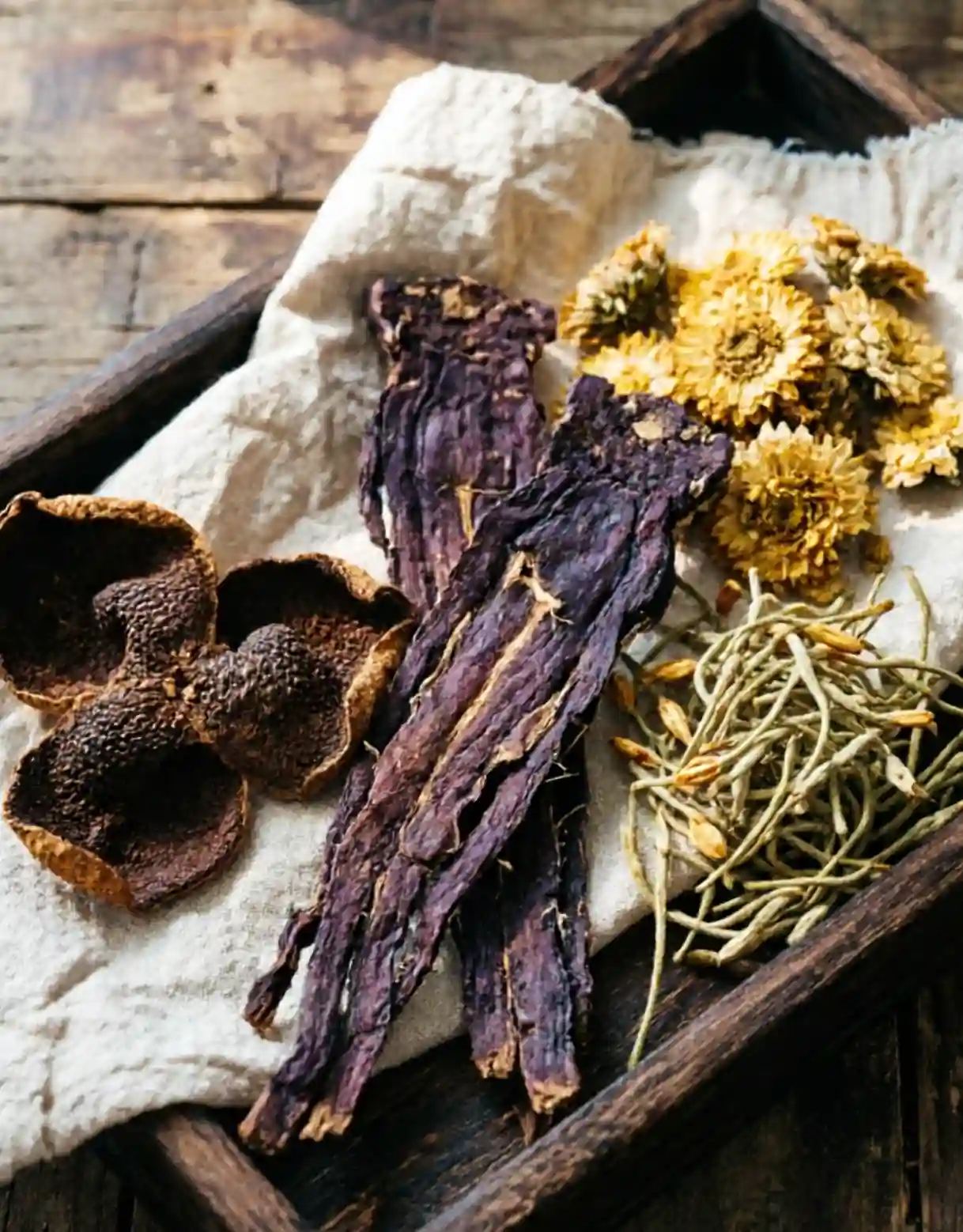
Shengdihuang, mostly irregularly lumpy or oblong, swollen in the middle, slightly tapered at both ends, some slender, elongated, slightly flattened and twisted, 6-12 cm long, 2-6 cm in diameter. Surface brownish-black or brownish-gray, extremely wrinkled, with irregular transverse curved lines. Heavy in weight, relatively soft and tough, difficult to break, cross-section brownish-black or jet-black, lustrous, and sticky. Odor: faint; Taste: slightly sweet.
Chemical Constituents
This product contains catalpol, acteoside, rehmannioside, 5-hydroxymethylfurfural, and tyrosol.
Pharmacology
Enhances immune function; possesses anti-tumor, anti-inflammatory, anti-allergic, hypoglycemic, cardiovascular protective, and antifungal effects.
Properties and Channel Entry
1
Functions and Indications
1. Sheng Dihuang: Clears Heat and cools Blood, nourishes Yin and generates body fluids; used for Heat entering the Nutritive and Blood levels, Warm-toxin maculation, hemoptysis and epistaxis, febrile disease damaging Yin, deep-red tongue with thirst, fluid-damage constipation, Yin-deficiency fever, bone-steaming and tidal fever, internal Heat with wasting-thirst. 2. Xian Dihuang: Clears Heat and generates body fluids, cools Blood, and stops bleeding; used for febrile disease damaging Yin, deep-red tongue with thirst, Warm-toxin maculation, hemoptysis, epistaxis, and sore swollen throat.
Dosage and Administration
Oral: decocted in water, 10-30 g; or crushed to extract juice or made into paste. External use: appropriate amount, crushed for topical application; or extracted juice for external application.
Precautions and Contraindications
For those with Stomach deficiency, reduced appetite, or Spleen deficiency with Dampness, use with caution.
Prescriptions
1. For Yangming Warm Disease without Upper Jiao symptoms, with no bowel movement for several days requiring purgation, but in patients with pre-existing Yin deficiency where Chengqi decoction is contraindicated: Xuanshen 30 g, Maidong (with core) 24 g, and fresh Shengdihuang 24 g. Boil in eight cups of water down to three cups; if thirsty, drink the entire amount. If still no bowel movement, repeat the dose. (Zengye Tang, from *Wen Bing Tiao Bian*) 2. For hematuria due to Blood Heat: Shengdihuang 6 g, Huangqin (stir-fried) 15 g, Ejiao (stir-fried) and Cebaive (stir-fried) each 3 g. Decoct the above in water and take before meals. (Shengdihuang San, from *Chi Shui Xuan Zhu*) 3. For stroke with limb contracture and stiffness: Dried Shengdihuang, Gancao (honey-fried), and Mahuang (without nodes) each 30 g. Grind the ingredients, add three measures of wine and seven measures of water, decoct down to four measures, strain, and divide into eight doses. Take two doses daily regardless of mealtime. (Dihuang Tang, from *Zheng Zhi Zhun Sheng*) 4. For epistaxis and excessive Heat above the diaphragm: Dried Shengdihuang, Longnao, and Bohe, in equal parts, ground into powder. Take with cold water. (Sun Zhao Fang) 5. For threatened abortion with vaginal bleeding during pregnancy: Ganjiang (parched) 30 g and dried Shengdihuang (sliced, dried) 180 g. Grind the two ingredients into powder, take one *fangcunbi* (approximately 1-2 g) with wine, three times daily. (Ganjiang Dihuang San, from *Zhang Shi Yi Tong*)