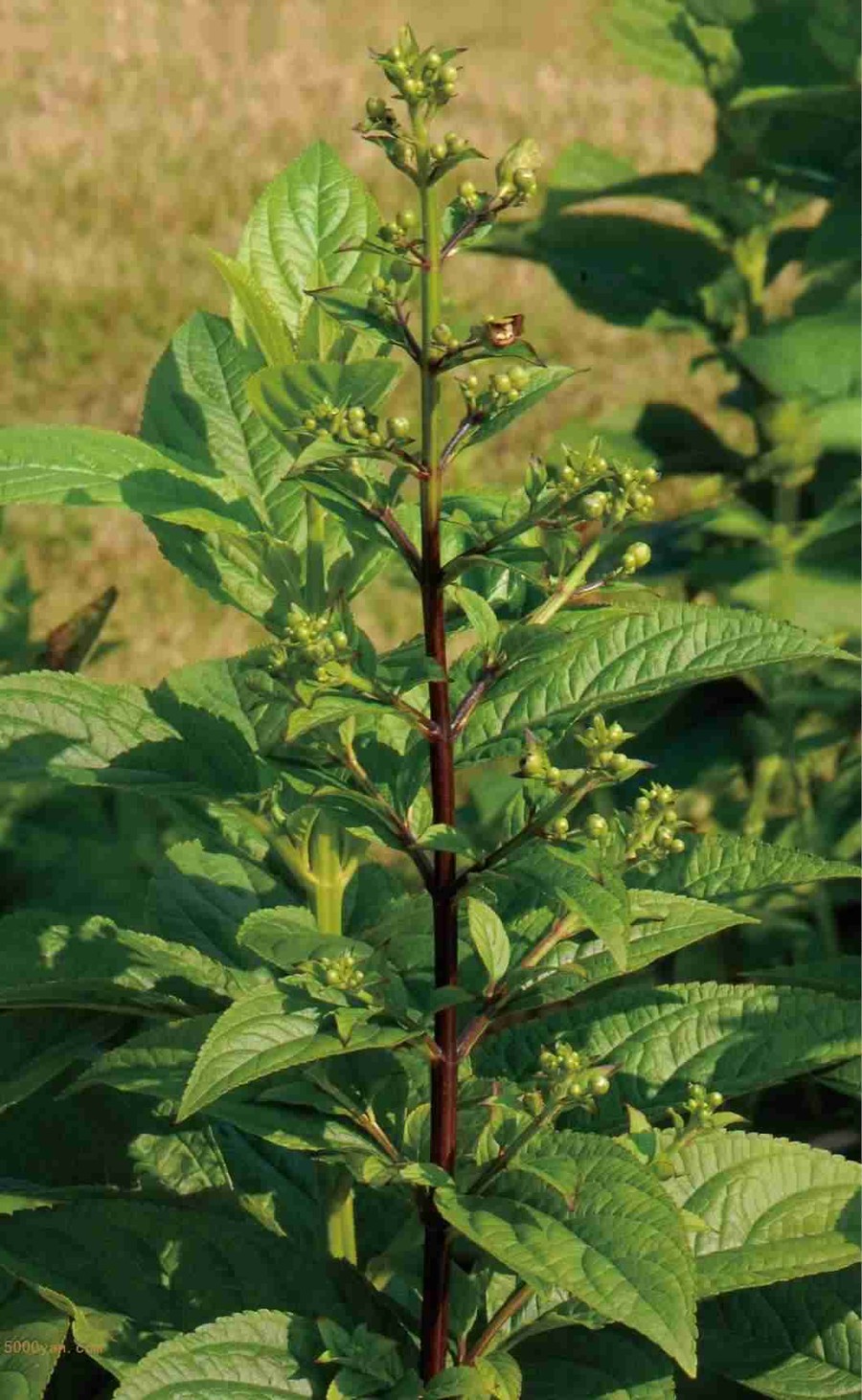
Pinyin: Xuanshen
Aliases
Xuantai, Yuanshen, Shan Danggui.
Source
Scrophulariaceae plant *Scrophularia ningpoensis*Scrophularia ningpoensisDried root of Hemsl.
Botanical Description
Perennial herb, 60-120 cm tall. Root thick, nearly cylindrical, lower part often branched, bark grayish-yellow or grayish-brown. Stem erect, quadrangular, grooved, glabrous or with glandular hairs. Lower leaves opposite, upper leaves sometimes alternate, all petiolate; leaf blades ovate or ovate-elliptic, 7-20 cm long, 3.5-12 cm wide, apex acuminate, base rounded or nearly truncate, margin finely serrate, glabrous or hairy on veins beneath. Cymes loosely spreading, forming a panicle; pedicels 1-3 cm long, rachis and pedicels glandular-hairy; calyx 5-lobed, lobes ovate, apex obtuse, margin membranous; corolla dark purple, tube obliquely urceolate, about 8 mm long, apex 5-lobed, unequal; stamens 4, didynamous, with one staminode scale-like, adnate to corolla; ovary superior, 2-locular, style slender, stigma shortly lobed. Capsule ovoid, apex shortly pointed, about 8 mm long, dark green or dark green, calyx persistent. Flowering July to August, fruiting August to September.
Habitat and Distribution
It grows on hillsides and under forests. It is distributed in Hebei, Shanxi, Shaanxi, Jiangsu, Anhui, Zhejiang, Jiangxi, Fujian, Henan, Hubei, Hunan, Guangdong, Sichuan, and Guizhou. It is cultivated throughout southern China.
Harvesting and Processing
Harvested in winter when the stems and leaves wither, remove the rhizome, buds, fibrous roots, and soil, sun-dry or bake until semi-dry, pile up for 3-6 days, repeat several times until dry.
Medicinal Properties
Root cylindrical, slightly thicker in the middle or thicker at the top and thinner at the bottom, some slightly curved like a ram's horn, 6-20 cm long, diameter 1-3 cm. Externally grayish-yellow or brownish, with distinct longitudinal grooves or transverse lenticels, occasionally with short fine roots or root scars. Texture hard, difficult to break, fracture surface slightly flat, blackish, slightly lustrous. Odor: caramel-like; Taste: sweet, slightly bitter.
Chemical Constituents
This product contains harpagoside, harpagide, sibirioside A, sibirioside B, aucubin, sibirigenin, geniposide, sibirioside F, decaffeoylverbascoside, and verbascoside.
Pharmacology
Has antipyretic, antibacterial, protects against myocardial ischemia, antispasmodic, lowers blood pressure, lowers blood glucose, and other effects.
Properties and Channel Entry
Sweet, bitter, and salty, slightly cold. Enters the Lung, Stomach, and Kidney channels.
Functions and Indications
Clears Heat and cools the Blood, nourishes Yin and descends Fire, resolves toxicity and dissipates masses. Used for Heat entering the Nutritive and Blood levels, Heat diseases damaging Yin, deep-red tongue with thirst, Warm toxin causing macules, bone-steaming with fatigue and cough, fluid damage with constipation, red eyes, sore throat, scrofula, and carbuncles, swelling, sores, and toxicity.
Dosage and Administration
Oral: decoct in water, 9-15 g; or made into pills or powder. External: apply an appropriate amount, mash for topical application or grind into powder for mixing and application.
Precautions and Contraindications
Forbidden for those with Spleen deficiency and loose stools or with Dampness.
Prescriptions
1. For oral ulcers that do not heal for a long time: Xuanshen (Scrophulariae Radix), Tiandong (Asparagi Radix, core removed and dry-fried), and Maidong (Ophiopogonis Radix, core removed and dry-fried) 30 g each. Grind into powder, mix with refined honey to make pills the size of a bullet. Each time, wrap one pill in cotton, hold in the mouth and swallow the saliva. (From *Sheng Ji Zong Lu*, Xuanshen Pill) 2. For nasal sores: Use Xuanshen, soften it by soaking in water, and insert into the nostril; or grind into powder and dab on the affected area. (From *Wei Sheng Yi Jian Fang*) 3. For thirst and dry throat at night: Place two slices of Xuanshen in the mouth to generate body fluids. (From *Ji Ren Ji Yan Fang*) 4. For Qi deficiency with blood stasis, manifested as reddish, turbid urine that resembles blood or urine, with pain in the urethra: Xuanshen and Cheqianzi (Plantaginis Semen) 30 g each, decoct in water and take orally. (From *Bian Zheng Lu*, Xuanchen Dan) 5. For imbalance of Yin and Yang, with excess Fire and insufficient Water, causing restlessness when encountering matters or speaking much, and a constant feeling of disturbance and noise in the chest: Xuanshen and Maidong (Ophiopogonis Radix) 60 g each, decoct in water and take orally. (From *Bian Zheng Lu*, Xuandong Tang)