Pinyin: Baishouwu
Aliases
Geshangxiao, Baiheshouwu, Geshanqiao, Baimuxiang.
Source
Asclepiadaceae plant *Cynanchum auriculatum* Royle ex WightCynanchum auriculatumDried root tuber of Royle ex Wight.
Botanical Description
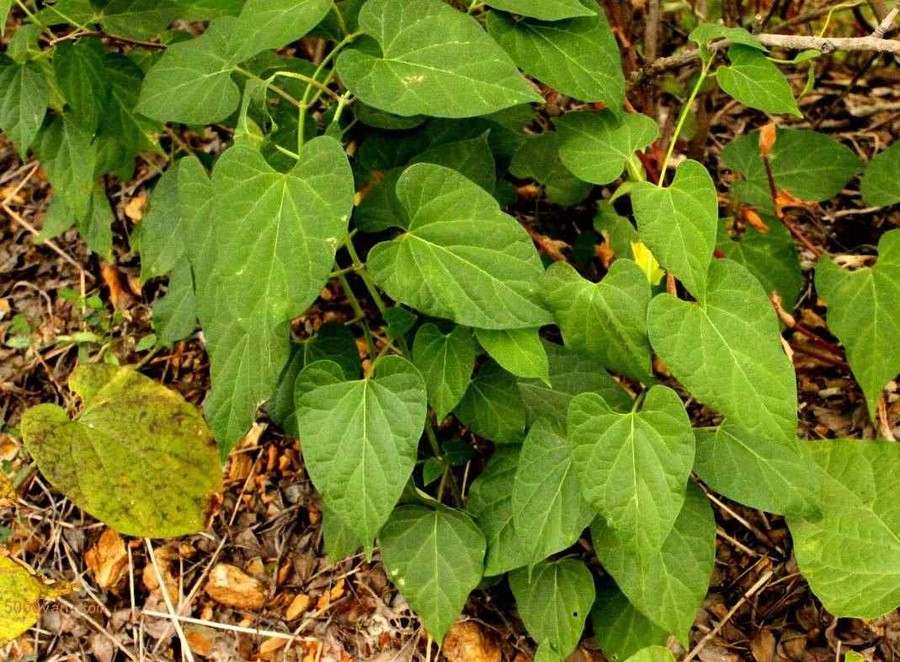
Twining semi-shrub. Contains milky sap. Roots fleshy, thick, subcylindrical, outer surface dark brown, cross-section white. Stems sparsely pubescent. Leaves opposite; petiole 3-9 cm long; leaf blade cordate to ovate-cordate, 4-12 cm long, 3-10 cm wide, apex shortly acuminate, base deeply cordate with auriculate inward-curving sides, margin entire, upper surface dark green, lower surface gray-green, sparsely hairy. Inflorescence corymbose cyme, axillary; peduncle cylindrical, 10-15 cm long, with approximately 30 flowers; calyx nearly 5-parted, lobes ovate-oblong, reflexed; corolla rotate, 5-parted, lobes reflexed, white, sparsely hairy inside; corona shallowly cup-shaped, lobes elliptic, longer than the gynostegium, with a triangular ligulate scale at the middle of the inner surface of each lobe; stamens 5, inserted at base of corolla, filaments fused into a tube, anthers 2-celled, attached around the stigma, each cell with one yellow pollinium, oblong, pendulous; pistil composed of 2 separate carpels, stigma conical, apex 2-cleft. Follicles paired, base narrow, middle cylindrical, apex gradually acuminate, about 8 cm long, about 1 cm in diameter. Seeds ovate-elliptic to obcuneate, margin with narrow wing, apex with a tuft of white long trichomes. Flowering period June to September, fruiting period July to November.
Habitat and Distribution
It grows in moist areas such as rock crevices on slopes below 3500 m altitude, shrublands, roadsides, walls, and riverbanks or ditches. It is distributed in East China, Central South China, and Hebei, Shaanxi, Gansu, Taiwan, Sichuan, Guizhou, Yunnan, and other regions. It is cultivated in Shandong and Jiangsu.
Harvesting and Processing
Harvest the root tubers in early spring or autumn, wash off the soil, remove the residual stems and fibrous roots, and dry in the sun, or slice fresh and dry in the sun. Fresh products are used as soon as they are harvested.
Medicinal Properties
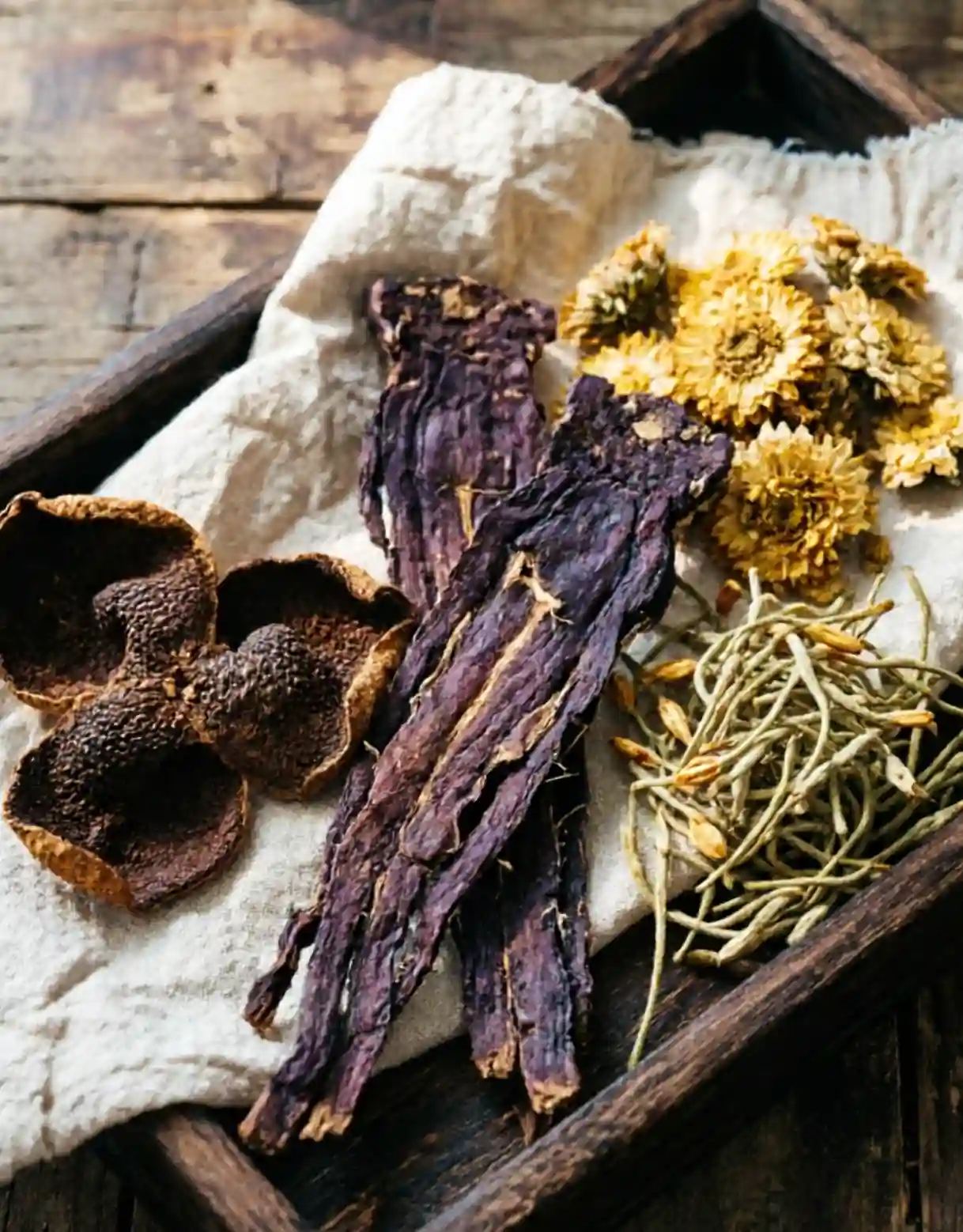
Root long cylindrical, long fusiform, or nodular-cylindrical, slightly curved, 7-15 cm long, diameter 1-4 cm. Surface light brown, with distinct longitudinal wrinkles and transverse lenticels, cork bark exfoliated areas showing earthy yellow or light yellowish-brown, with reticulate texture. Texture hard, fracture off-white, powdery, with bright yellow radiating lines. Odor: faint; Taste: slightly sweet followed by bitter.
Chemical Constituents
This product contains gaoshanxiaoside C.3N, and gasshouside C.1N, and gasshouside C.1GOjibway glycoside K1N, 12-O-cinnamoyl-20-deoxysarcostin, 12-O-benzoyl-20-deoxysarcostin, cynatratoside A, cynatratoside B, cynatratoside C, gagaminine, cynanchol, sarcostin, 12-O- Cinnamoyl deacylglaucogenin, cyanatratoside A, baishouwubenzophenone, various amino acids, vitamins, and inorganic elements.
Pharmacology
Has antioxidant and anti-tumor effects, regulates immune function, affects cardiac function, and lowers blood lipids; improves hemolytic anemia and promotes hair growth, among other actions.
Properties and Channel Entry
Sweet, slightly bitter, neutral. Enters the Liver, Kidney, Spleen, and Stomach channels.
Functions and Indications
Tonifies the Liver and Kidney, strengthens the sinews and bones, benefits the essence and blood, strengthens the Spleen and promotes digestion, and resolves toxicity and treats sores. Mainly indicated for soreness and pain in the lower back and knees, impotence and nocturnal emission, dizziness and tinnitus, palpitations and insomnia, poor appetite, infantile malnutrition (gan accumulation), insufficient lactation postpartum, painful sores and carbuncles, and poisonous snake bites.
Dosage and Administration
Oral: decoct in water, 6-15 g (doubled for fresh herb); grind into powder, 1-3 g per dose; or steep in wine. External: apply appropriate amount of fresh herb, mashed.
Precautions and Contraindications
Internal use should not be excessive.
Prescriptions
1. For lumbar and leg pain with joint stiffness: Bai Shou Wu 15 g, Niu Xi 6 g, Tu Si Zi 9 g, Bu Gu Zhi 6 g, Gou Qi Zi 9 g. Decoct in water for oral administration. (From Shanxi Zhong Cao Yao) 2. For impotence: Bai Shou Wu, Yin Yang Huo, Shan Yao, Dang Shen each 9-12 g. Decoct in water for oral administration. (From Shan Gan Ning Qing Zhong Cao Yao Xuan) 3. For neurasthenia, impotence, and nocturnal emission: Bai Shou Wu 15 g, Suan Zao Ren 9 g, Tai Zi Shen 9 g, Gou Qi Zi 12 g. Decoct in water for oral administration. (From Shanxi Zhong Cao Yao) 4. For stomach pain and dysenteric abdominal pain: Bai Shou Wu and Pu Gong Ying each 9 g. Decoct in water for oral administration. (From Anhui Zhong Cao Yao) 5. For beriberi with edema: Bai Shou Wu and Che Qian Zi each 6 g. Decoct in water, strain, and take in 2 divided doses daily. (From Shi Wu Zhong Yao Yu Bian Fang) 6. For pediatric spleen and stomach weakness, indigestion, food accumulation, and diarrhea: Bai Shou Wu, Nuo Mi Cao, and Ji Shi Teng in equal parts, grind into powder for later use. Take 9 g each time, add 18 g rice flour, steam until cooked, and consume. (From Sichuan Zhong Yao Zhi, 1982 edition) 7. For insufficient lactation: Niu Pi Xiao root (peeled) 30 g, 1 hen (eviscerated). Place the herb inside the chicken's cavity, stew until cooked, remove the herb residue, and consume both the soup and meat without adding salt. (From Hubei Zhong Cao Yao Zhi)