Pinyin: Chishao
Aliases
Mu Shaoyao, Chi Shaoyao, Hong Shaoyao.
Source
Plant of the Ranunculaceae family, Paeonia lactiflora.Paeonia lactifloraDried root of Pal.
Botanical Description
See the entry under "Baishao" (White Peony Root).
Harvesting and Processing
Harvested in spring and autumn, remove the rhizome, fibrous roots, and soil, then dry in the sun.
Medicinal Properties
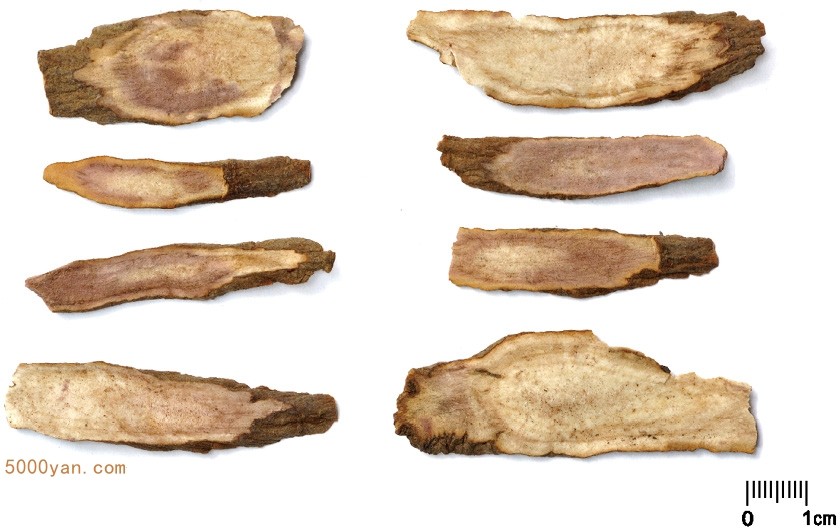
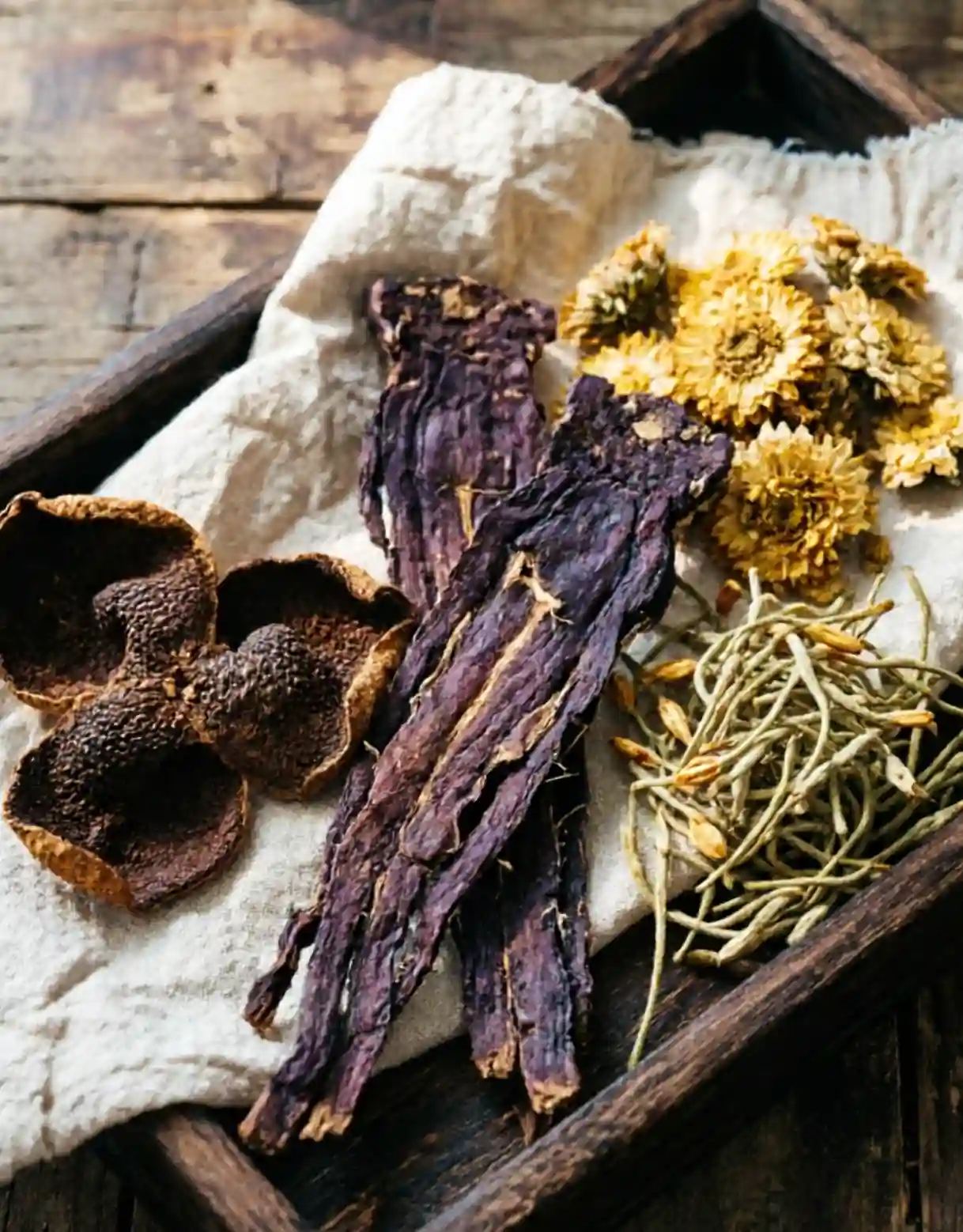
This product is cylindrical in shape, slightly curved, 5-40 cm long and 0.5-3 cm in diameter. The surface is brown or blackish-brown, rough, with coarse, slightly twisted longitudinal wrinkles and transversely protruding lenticels; the outer bark is easily detached. The texture is hard and brittle, easily broken, with a flat fracture surface, powdery white or yellowish-white, narrow bark portion with a darker color, distinct radial striations in the xylem, and sometimes with fissures. The odor is faintly aromatic, and the taste is slightly bitter, sour, and astringent.
Chemical Constituents
This product contains paeoniflorin, dihydroapigenin, paeonolide, paeoniflorin, paeoniflorin A, paeoniflorin B,β- β-sitosterol, camphor hydrocarbon, vanillic acid, vanillic acid, etc.
Pharmacology
Antithrombotic; antiplatelet aggregation; lowers blood lipids and resists atherosclerosis; in small doses mildly inhibits the heart, in large doses significantly inhibits the heart, with conduction block effects, increases coronary artery flow and reduces peripheral resistance; treats and prevents decreased cardiac function. Antitumor; has hepatoprotective, oxygen free radical scavenging, intestinal spasmolytic, and antibacterial effects. Has a sodium-excreting effect.
Properties and Channel Entry
Bitter in taste, slightly cold in nature. Enters the Liver and Spleen channels.
Functions and Indications
Clears Heat and cools Blood, disperses stasis and alleviates pain. Used for Heat entering the Nutritive and Blood levels, Warm Toxin causing skin eruptions, hematemesis and epistaxis, red and swollen eyes, Liver depression with hypochondriac pain, amenorrhea and dysmenorrhea, abdominal masses and pain, traumatic injuries, and carbuncles, swellings, and sores.
Dosage and Administration
Oral: decocted in water, 4-10 g; or made into pills or powder.
Precautions and Contraindications
Patients with blood deficiency without stasis and those with already ulcerated carbuncles should use with caution.
Prescriptions
1. For treating epistaxis (nosebleed) that does not stop: grind Chishao (Red Peony Root) into powder, take 6 g with water. (Shi Lin Guang Ji) 2. For treating hematochezia (bloody stool) due to intestinal wind: take 30 g of Chishao, burn it on a tile until it retains its properties, grind into powder, take 6 g with warm wine. (Fu Ren Liang Fang) 3. For treating all types of carbuncles, deep-rooted boils, and malignant sores: grind equal parts of Chishao, Danggui (Chinese Angelica), and Gancao (Licorice Root) into powder, take 6 g per dose with warm wine, regardless of mealtime. (Wei Sheng Yi Jian Fang) 4. For treating acute mastitis: take 30-60 g of Chishao and 6 g of raw Gancao. Decoct in water for oral administration. If fever is present, add Huangqin (Baikal Skullcap Root); additionally, mash a small amount of Bailiangen (Ampelopsis Root) and salt and apply externally to the affected area. (Dan Fang Yan Fang Diao Cha Zi Liao Xuan Bian) 5. For treating dysentery with abdominal pain: take 30 g each of Chishao, Huangbai (Amur Cork Tree, remove rough bark and dry-fry), and Diyu (Burnet Root). Coarsely grind and sieve the three ingredients, take 15 g per dose. Add one cup of fermented water, decoct until 70% remains, remove the residue, and take warm regardless of mealtime. (Sheng Ji Zong Lu, Shaoyao Tang)