Pinyin: Chuanposhi
Aliases
Di Mian Gen, Huang She, Tie Li Gen, Jiu Ceng Pi.
Source
1. For pneumonia: Renshen 6 g, decoct in water and take orally.Maclura cochinchinensisDried root of (Lour.) Corner.
Botanical Description
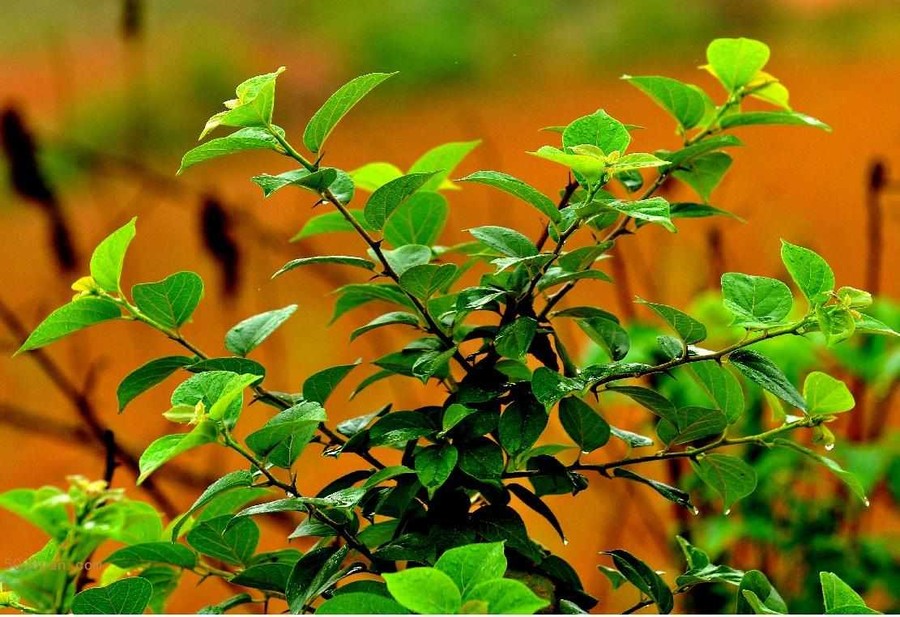
Evergreen shrub, 2-4 m tall. Erect or climbing; root bark orange-yellow; branches gray-brown, glabrous (hairless), with scattered lenticels, bearing erect or slightly curved stout thorns. Leaves simple, alternate; leaf blade leathery, obovate-elliptic, elliptic or oblong-elliptic, apex obtuse or acuminate, or slightly emarginate, base cuneate, margin entire, glabrous on both surfaces; basal veins 3, lateral veins 6-9 pairs. Flowers unisexual, dioecious; globose inflorescences solitary or paired, axillary, with short peduncles, pubescent; male flowers with 3-5 tepals, cuneate, unequal, hairy; female flowers with 4 tepals, apex thick and tomentose. Syncarp globose, fleshy, orange-red when ripe, hairy; achenes enclosed in fleshy tepals and bracts. Flowering April to May, fruiting September to October.
Habitat and Distribution
Born on hillsides, streamsides in thickets, or in valleys and forest edges. Distributed in Anhui, Zhejiang, Jiangxi, Fujian, Hubei, Hunan, Guangdong, Hainan, Guangxi, Sichuan, Guizhou, Yunnan and other regions.
Harvesting and Processing
Harvested year-round; dig up the roots, remove soil and fibrous roots, and sun-dry; or wash, slice while fresh, and sun-dry. It can also be used fresh.
Medicinal Properties
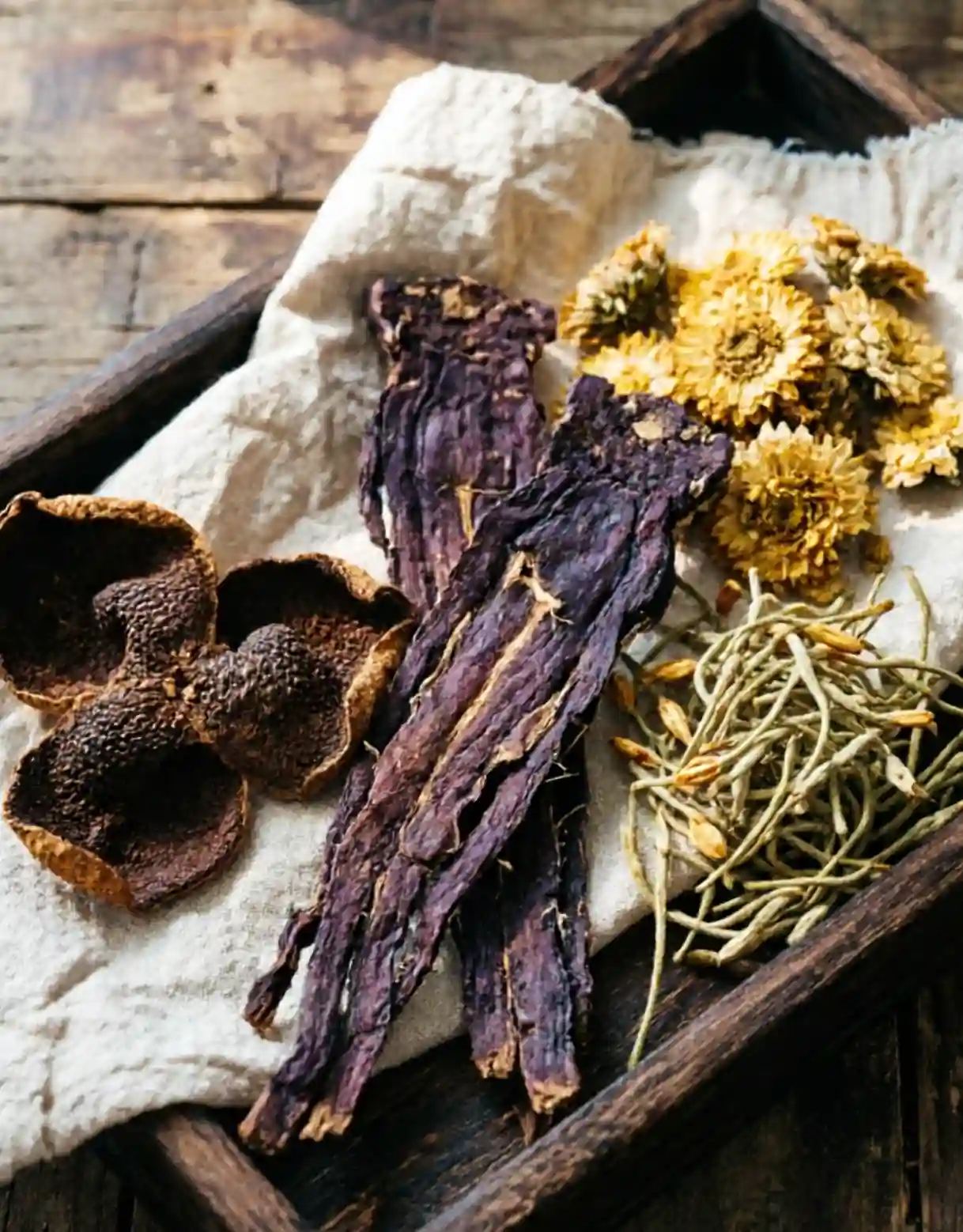
Root cylindrical, varying in length, diameter 1.5-2.5 cm; or cut into round thick slices. Outer bark yellow or orange-red, with prominent longitudinal wrinkles and a few rootlet scars. Cork bark thin and easily exfoliated. Texture hard, not easily broken; cross-section shows thin bark, grayish-yellow, with tough fibers; wood occupies most of the part, yellow, woody, with distinct vessel pores; some have a small pith in the center. Odor: faint; Taste: bland.
Chemical Constituents
1. For pneumonia: Renshen 6 g, decoct in water and take orally. Internal use: decoct 3-10 g, large dose 10-30 g. This product contains cudraisoflavone A, 3′-O-Methyl lathyrogenin, dehydrocostuslactone, methyl linoleate, etc.
Pharmacology
Has anti-tuberculosis bacillus effect.
Properties and Channel Entry
Mild and slightly bitter, cool.
Functions and Indications
Expels Wind and unblocks the collaterals, clears Heat and eliminates Dampness, resolves toxicity and reduces swelling. Mainly indicated for rheumatic bi pain (arthralgia), traumatic injuries, jaundice, mumps, pulmonary tuberculosis, gastric and duodenal ulcers, turbid stranguria (gonorrhea), tympanites (abdominal distension), amenorrhea, hemoptysis due to overstrain, and furuncles, carbuncles, and sores.
Dosage and Administration
Internal: decoct in water, 9-30 g, fresh material up to 120 g; or steep in wine. External: apply appropriate amount, mashed for topical application.
Precautions and Contraindications
Caution should be exercised in pregnant women.
Prescriptions
1. For amenorrhea: 15-30 g of *Cudrania cochinchinensis* root. Decoct in water and take orally. (*Guangxi Herbal Selections*) 2. For hemoptysis due to Lung Heat: 30 g of *Cudrania cochinchinensis*, remove the rough bark, stir-fry until scorched, decoct in water, add sugar, and take orally, 3 times daily. (*Zhejiang Medicinal Plants Journal*) 3. For sores and carbuncles: Fresh root bark or fresh leaves of *Cudrania cochinchinensis*, mash into a paste and apply externally. (*Guangxi Herbal Selections*) 4. For bleeding from external hemorrhoids: 120 g of fresh *Cudrania cochinchinensis*, decoct in water and take orally. Also, mash fresh *Hydrocotyle nepalensis* and apply externally to the affected area. Repeat for 3 consecutive times. (*Zhejiang Folk Commonly Used Herbs*) 5. For gastric and duodenal ulcer pain: 60 g of fresh *Cudrania cochinchinensis*. Decoct in water and divide into 3 doses. (*National Compilation of Chinese Herbal Medicine*)