Pinyin: Tianhuafen
Aliases
Gualou Gen, Tiangua Fen, Gualou Fen.
Source
Cucurbitaceae plant Trichosanthes kirilowii Maxim.Trichosanthes kirilowiiThe dried root of Maxim.
Botanical Description
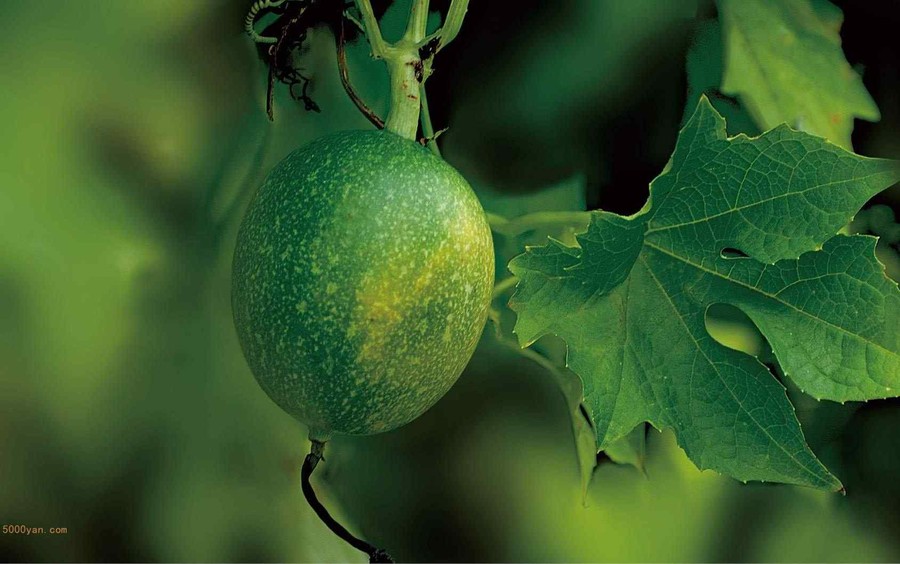
Climbing vine, up to 10 m long. Root tubers cylindrical, thick. Stems relatively thick, much branched, with longitudinal ridges and grooves, covered with white spreading pubescence. Leaves alternate; petioles with longitudinal stripes, covered with long hairs; tendrils 3-7 branched, pubescent; leaf blade papery, outline nearly rounded or subcordate, 5-20 cm in both length and width, often 3-5(-7) shallowly to moderately lobed, rarely deeply lobed or unlobed with only unequal coarse teeth, lobes rhombic-obovate, oblong, apex obtuse or acute, margins often shallowly lobed again, base cordate, sinus 3-4 cm deep, upper surface dark green, rough, lower surface pale green, both surfaces along veins with long hairy bristles, palmate veins 5 at base, fine veins reticulate. Dioecious; male racemes solitary or paired with a single flower, or on upper branches solitary racemes, stout, with longitudinal ridges and grooves, minutely pubescent, with 5-8 flowers at apex, pedicel of solitary flower about 15 cm long, small pedicel about 3 mm long, bracteoles obovate or broadly ovate, with coarse teeth in the upper middle part, base pedicellate, shortly pubescent; calyx tubular, apex expanded, middle and lower part about 5 mm in diameter, shortly pubescent, lobes lanceolate, entire; corolla white, lobes obovate, apex with a green tip at center, both sides with filiform fringes, pubescent; anthers connivent, filaments separate, stout, covered with long hairs; female flowers solitary, pedicel pubescent; calyx tube cylindrical, lobes and corolla same as male flowers; ovary elliptic, green, stigma 3. Fruit elliptic or rounded, yellow-brown or orange-yellow when mature. Seeds ovoid-elliptic, compressed, pale yellow-brown, with a ridge near the margin. Flowering period May to August, fruiting period August to November.
Habitat and Distribution
It grows in mountain slopes, forests, thickets, grasslands, and village margins at altitudes of 200-1800 m, or is widely cultivated within its natural distribution range. It is distributed in North China, Central South China, East China, and Liaoning, Shaanxi, Gansu, Sichuan, Guizhou, and Yunnan.
Harvesting and Processing
Harvest in spring or autumn, with autumn harvest being superior. After digging, wash off soil, scrape off rough bark, cut into 10-20 cm long segments, larger ones can be split lengthwise, and sun-dry.
Medicinal Properties
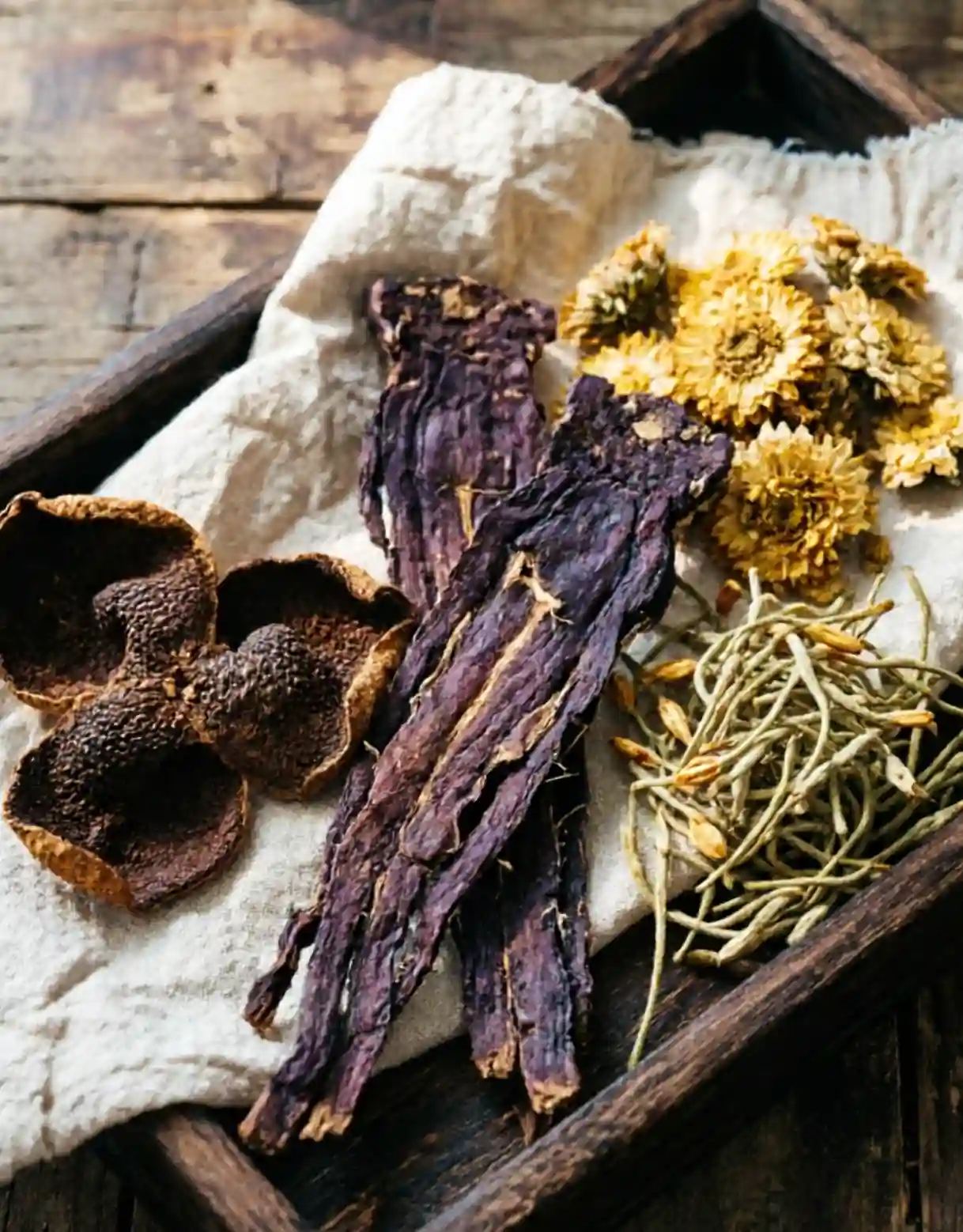
This product is irregularly cylindrical, fusiform, or in lobed blocks, 8-16 cm long, 1.5-5.5 cm in diameter. The surface is yellowish-white or pale brownish-yellow, with longitudinal wrinkles, fine root scars, and slightly sunken transverse lenticels, occasionally with remnants of yellowish-brown outer bark. The texture is firm and solid; the cut surface is white or pale yellow, rich in starchy powder; the transverse section shows yellow xylem arranged in a slightly radial pattern, while the longitudinal section shows yellow striped xylem. Odor: faint; Taste: slightly bitter.
Chemical Constituents
This product contains trichosanthin, bryonolic acid, cucurbitacin, arginine, aspartic acid, fructose, xylose, and other components.
Pharmacology
Induces abortion; anti-early pregnancy; anticancer; immune stimulation and immunosuppression; anti-HIV; hypoglycemic, etc.
Properties and Channel Entry
Sweet, slightly bitter, and slightly cold. Enters the Lung and Stomach channels.
Functions and Indications
Clears Heat, drains Fire, generates body fluids, stops thirst, reduces swelling, and expels pus
Dosage and Administration
Internal: decoct in water, 9-15 g; or prepare as pills or powder. External: appropriate amount, grind into powder for sprinkling or mix for application.
Precautions and Contraindications
Patients with Spleen and Stomach deficiency-cold or loose stools should use with caution; pregnant women should use with caution; should not be used together with Chuanwu (Radix Aconiti), processed Chuanwu, Caowu (Radix Aconiti Kusnezoffii), processed Caowu, or Fuzi (Radix Aconiti Lateralis Preparata).
Prescriptions
1. For febrile diseases with vexation and thirst, and restlessness of various organs: Take fresh *Trichosanthes* root, pound to extract juice, take one *ge* each time, frequently. (From *Sheng Hui Fang*) 2. For internal Heat with profuse phlegm and cough: Tianhuafen 30 g, Xingren, Sangpi, Beimu each 9 g, Jiegeng, Gancao each 3 g. Decoct in water and take orally. (From *Ben Cao Hui Yan*) 3. For deficiency-Heat cough: Tianhuafen 30 g, Renshen 9 g, grind into powder. Take 3 g each time with rice water. (From *Bin Hu Ji Jian Fang*) 4. For lack of breast milk: *Trichosanthes* root (sliced) 1 *sheng*, wine 4 *sheng*. Boil for three bubbles, remove dregs, divide into three doses. (From *Qian Jin Yao Fang*) 5. For Spleen channel exuberant Fire with swollen and painful gums: Tianhuafen 15 g, Baishao Yao, Bohe each 6 g, Gancao 3 g. Decoct in water and take orally. (From *Ben Cao Hui Yan*)