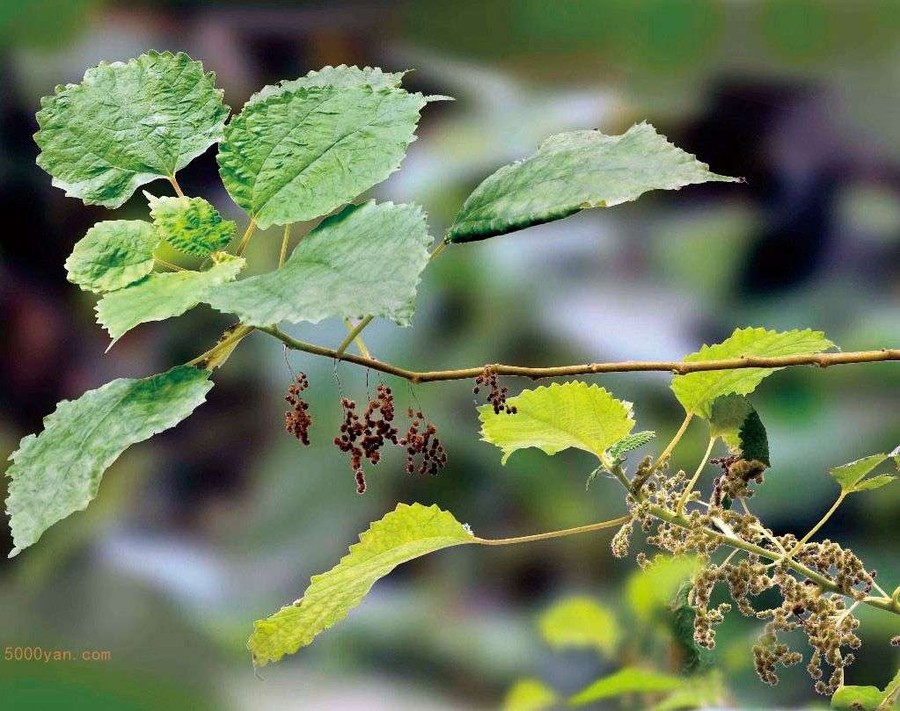
Pinyin: Zhumagen
Aliases
Zhu gen, Ye zhu gen, Zhu ma ru.
Source
1. For pneumonia: Renshen 6 g, decoct in water and take orally.Boehmeria niveaRoot and rhizome of (L.) Gaud.
Botanical Description
Perennial semi-shrub, 1-2 m tall. Stem erect, cylindrical, much branched, greenish-brown, densely covered with coarse long hairs. Leaves alternate; stipules 2, separate, deciduous; leaf blade broadly ovate or ovate, apex acuminate or nearly caudate, base broadly cuneate or truncate, margin densely dentate, upper surface green, rough, sparsely hairy, lower surface densely covered with interwoven white pubescence, with 3 basal veins. Flowers unisexual, monoecious; inflorescence paniculate, axillary; male inflorescence usually below female; male flowers small, sessile, yellowish-white, perianth segments 4, stamens 4, with rudimentary pistil; female flowers pale green, clusters globose, about 2 mm in diameter, perianth tubular, persistent, style 1. Achene small, elliptic, densely short-hairy, enclosed by persistent perianth, containing 1 seed. Flowering in September, fruiting in October.
Habitat and Distribution
It is widely cultivated in regions south of Henan, Shandong, and Shaanxi in China, with wild varieties also present.
Harvesting and Processing
Harvested in winter and spring, dug up, remove the aboveground stems and soil, and dry in the sun
Medicinal Properties
The rhizome is irregularly cylindrical, slightly curved, 4-30 cm long, 0.4-5 cm in diameter; the surface is gray-brown, with longitudinal striae and numerous lenticels, and multiple wart-like protrusions and residual fibrous roots; the texture is hard, not easily broken, and the fracture surface is fibrous. The bark is brown, the wood is pale brown, some have several concentric rings in the center, and the center has a pith or is hollow; the root is slightly fusiform, about 10 cm long, 1-1.3 cm in diameter; the surface is gray-brown, with longitudinal wrinkles and transverse lenticels; the fracture surface is powdery. The odor is faint, the taste is bland, and it has stickiness.
Chemical Constituents
This product primarily contains chlorogenic acid, caffeic acid, oleanolic acid, 19α- Hydroxyursolic acid and other components.
Pharmacology
Has hemostatic effects, etc. Toxic.
Properties and Channel Entry
Sweet, cold. Enters the Liver, Heart, and Bladder channels.
Functions and Indications
Cools Blood and stops bleeding, clears Heat and calms the fetus, promotes urination, and resolves toxicity. Mainly indicated for hemoptysis, hematemesis, epistaxis, hematuria, bloody stools, metrorrhagia, and purpura due to Blood Heat causing reckless movement; fetal irritability, vaginal bleeding during pregnancy; dribbling urination; carbuncles, sores, swelling, and toxicity; and insect and snake bites.
Dosage and Administration
Oral: decoct in water, 5-30 g; or crush to extract juice. External use: appropriate amount, crush fresh herb for topical application; or decoct in water for fumigation and washing.
Precautions and Contraindications
Use with caution in patients without Excess Heat.
Prescriptions
1. For hemoptysis: 30 g of Ramie Root, 30 g of Cogongrass Rhizome. Decoct in water for oral administration. (Sichuan Traditional Chinese Medicine Journal, 1979) 2. For venomous snake bite: Appropriate amount of Ramie Root, mashed with black tung oil. Apply to the affected area. (Hubei Chinese Herbal Medicine Journal) 3. For strangury with hematuria and difficult urination: 9-15 g each of Ramie Root and Field Thistle, 4.5-9 g of raw Pollen Typhae. Decoct in water for oral administration. (Zhejiang Medicinal Flora) 4. For habitual abortion or preterm labor: 30 g of fresh Ramie Root, 30 g of Lotus Seed (core removed), 30 g of Glutinous Rice. Cook in clear water to make congee. Remove Ramie Root and take, 3 times daily until full term. (Hunan Materia Medica) 5. For gout: 250 g of Ramie Root, 15 g of Realgar. Mash together and apply to the affected area. If pain persists, wrap the medicine in lotus leaf, warm over fire, and apply to the affected area. (Guangxi Folk Commonly Used Chinese Herbal Medicine Manual)