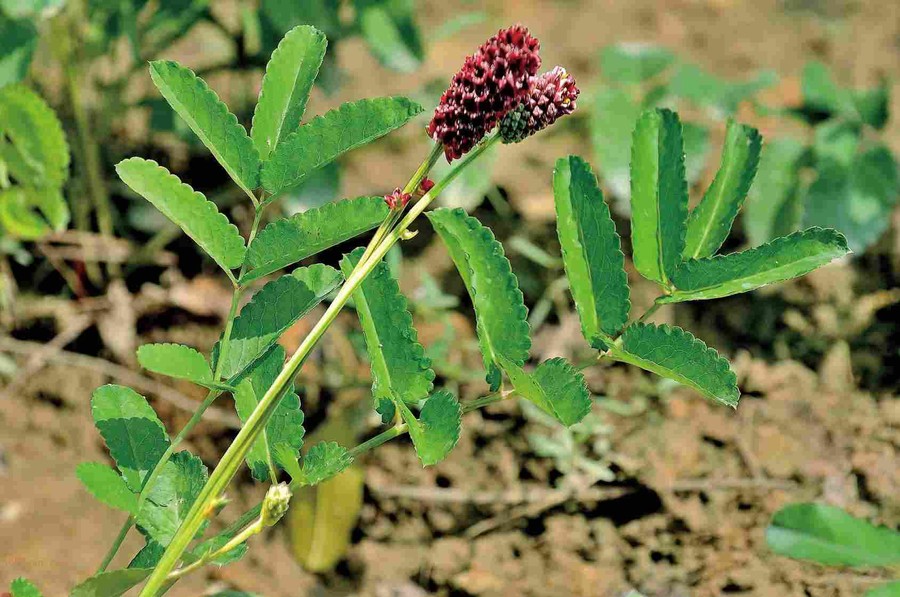
Pinyin: Diyu
Aliases
Bai Diyu, Xi Diyu, Huang Gua Xiang.
Source
Rosaceae plant Sanguisorba officinalisSanguisorba officinalisL.'s dried root.
Botanical Description
Perennial herb. The root is mostly fusiform, with a brownish-brown or purplish-brown surface, longitudinal wrinkles, and transverse fissures. The stem is erect, angular, glabrous (hairless) or with sparse glandular hairs at the base. Basal leaves are pinnately compound with 4-6 pairs of leaflets; leaflets have short petioles; stipules are membranous, brown, glabrous or with sparse glandular hairs on the outside; leaflets are ovate or oblong, apex rounded-obtuse to rarely acute, base cordate to shallowly cordate, margin with numerous large, rounded-obtuse serrations, glabrous on both surfaces. Cauline leaves are fewer, leaflets oblong to oblong-lanceolate, narrower, base slightly cordate to rounded, 1-7 cm long, 0.5-3 cm wide, apex acute; stipules are large, herbaceous, semi-ovate, outer margin with sharp serrations. The spike is ellipsoid, cylindrical, or ovoid, erect, opening from the apex downward; bracts 2, membranous, lanceolate, apex acuminate to abruptly acuminate, shorter than or nearly equal to the sepals, with pubescence on the back and margin; sepals 4, elliptic to broadly ovate, apex often with a short mucro, purplish-red; stamens 4, filaments filiform, nearly as long as the sepals; stigma apex discoid. Achenes are enclosed within the persistent calyx tube, obovoid-oblong or suborbicular, with 4 angles externally. Flowering period July to October, fruiting period September to November.
Habitat and Distribution
It grows in grasslands, meadows, hillside grasslands, thickets, or sparse forests at altitudes of 30-3000 m. It is distributed in Northeast, North, Northwest, East, Southwest China, as well as Henan, Hubei, Hunan, Guangxi, and other regions.
Harvesting and Processing
Harvested when sprouting in spring or after the plant withers in autumn, remove fibrous roots, wash clean, dry, or slice fresh while still moist, then dry.
Medicinal Properties
Root cylindrical, slightly twisted and curved, 5-22 cm long, 0.5-2 cm in diameter. Occasionally lateral rootlets or rootlet scars are visible; the surface is brownish-brown with distinct longitudinal wrinkles. The apex has a cylindrical rhizome or its residue. Texture is hard, slightly brittle; the fracture surface is even and slightly powdery. The transverse section shows an obvious cambium ring, with a pale yellow bark and a brownish-yellow or pinkish-brown wood arranged in a somewhat radial pattern. Odor is faint; taste is slightly bitter and astringent.
Chemical Constituents
This product contains gallic acid, sanguiin, and 1,2,6-tri-O-galloyl-β-D-glucose.βD-glucose, ziyuglycoside, quercetin-3-galactoside-7-glucoside, kaempferol, quercetin, sanguisorbin, sanguiin, and betulinic acid, among others.
Pharmacology
Hemostasis, anti-inflammatory; promotes wound healing; antibacterial, antiemetic; treats acute liver injury; antagonizes hydrogen peroxide-induced hemolysis. Toxic.
Properties and Channel Entry
Bitter, sour, and slightly cold. Enters the Liver and Large Intestine channels.
Functions and Indications
Cools Blood to stop bleeding, resolves toxicity and astringes sores
Dosage and Administration
Internal use: decoct in water, 6-15 g; fresh product 30-120 g; or prepared as pills or powder, or extracted juice for internal use. External use: appropriate amount, decoct in water or crush for juice to apply externally; or grind into powder for external application, or mash for external application.
Precautions and Contraindications
Patients with deficient Cold of the Spleen and Stomach, Sinking of Middle Qi, cold dysentery with diarrhea, uterine bleeding and vaginal discharge, and Blood deficiency with stasis should use with caution.
Prescriptions
1. For burns and scalds: Immediately grind Diyu (Sanguisorba officinalis) into a fine powder, mix with sesame oil and apply externally; the pain will stop immediately. If blisters have already formed, pierce the blisters to release the toxic fluid, then apply the mixture, and additionally sprinkle dry powder on top. This also applies to broken skin. (From "Waike Zhengzhi Quanshu") 2. For gastric ulcer bleeding: Sheng Diyu (Sanguisorba officinalis) 9 g, Wuzeigu (Sepia esculenta) 15 g, Muxiang (Saussurea costus) 6 g. Decoct in water and take orally. (From "Ningxia Zhongcaoyao") 3. For primary thrombocytopenic purpura: Sheng Diyu (Sanguisorba officinalis) and Taizishen (Pseudostellaria heterophylla) 30 g each, or add Huainiuxi (Achyranthes bidentata) 30 g. Decoct in water and take orally, continuously for 2 months. (From "Quanguo Zhongcaoyao Xinliaofa Ziliao Zhanlanhui Xuanbian") 4. For traumatic bleeding: Grind Diyu Tan (charred Sanguisorba officinalis) into a fine powder and apply externally to the affected area. Alternatively, combine with Qiancao (Rubia cordifolia), Baiji (Bletilla striata), and Huangqin (Scutellaria baicalensis), grind into powder for external use. (From "Shan Gan Ning Qing Zhongcaoyao Xuan") 5. For red and white vaginal discharge: Diyu (Sanguisorba officinalis) 60 g, rice vinegar 1 liter. Boil for about ten times, strain the residue, and take 1 he (approximately 100 ml) warm before meals. (From "Weisheng Yijian Fang")