Pinyin: Jianghuang
Aliases
Baodingxiang, Huangjiang.
Source
Zingiberaceae plant Curcuma longaCurcuma longaL. dried rhizome.
Botanical Description
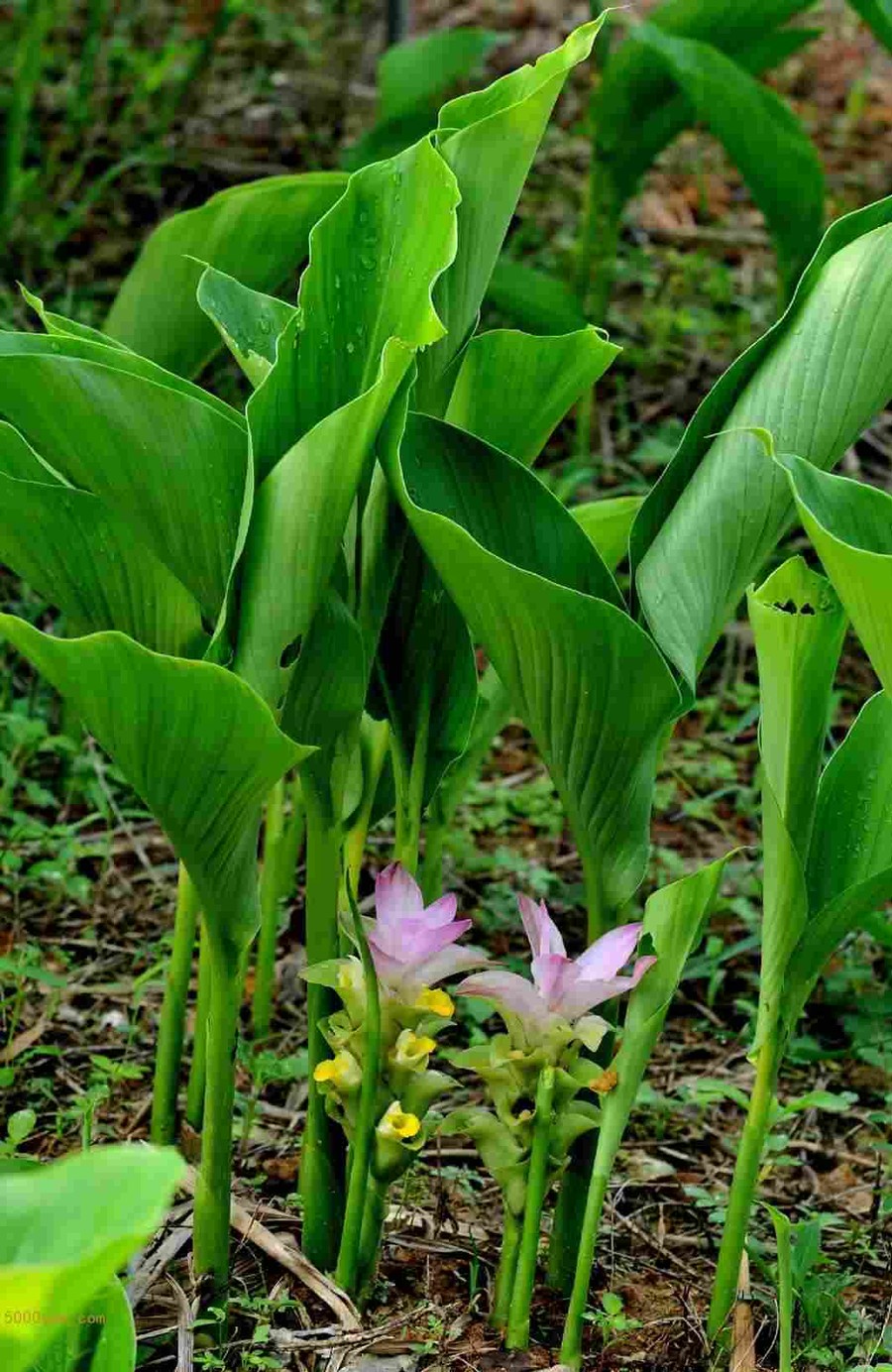
Perennial herb, 1-1.5 m tall. Rhizome well-developed, clustered, branched, elliptical or cylindrical, orange-yellow, very fragrant; roots robust, with enlarged tuberous root tips. Leaves basal, 5-7, distichous; petiole 20-45 cm long; leaf blade oblong or narrowly elliptical, apex acuminate, base cuneate, decurrent to petiole, upper surface yellow-green, lower surface pale green, glabrous. Scape emerging from leaf sheaths; peduncle 12-20 cm long; spike cylindrical; upper sterile bracts pink or light reddish-purple, long-elliptical; middle and lower fertile bracts tender green or greenish-white, ovate to suborbicular; calyx tube greenish-white, 3-toothed; corolla tube funnelform, pale yellow, throat densely pubescent, 3-lobed; fertile stamen 1, filament short and flat, anther oblong, base spurred; ovary inferior, externally pubescent, style slender, base with 2 clavate glands, stigma slightly enlarged, somewhat bilabiate. Flowering in August.
Habitat and Distribution
Mostly cultivated, planted in sunny gardens with fertile, loose soil; occasionally found in the wild. Distributed in Jiangxi, Fujian, Taiwan, Guangdong, Guangxi, Sichuan, Yunnan, and other regions.
Harvesting and Processing
Harvested in winter when the stems and leaves wither, washed clean, boiled or steamed thoroughly until the center is cooked, dried in the sun, and rootlets removed.
Medicinal Properties
The rhizome is irregularly ovoid, cylindrical, or fusiform in shape, often curved, with a deep yellow surface that is rough, wrinkled, and marked with distinct nodes, as well as circular branch scars and fibrous root scars. The texture is firm and hard, not easily broken; the cut surface is brownish-yellow to golden-yellow, horny in appearance with a waxy luster. The endodermis ring lines are distinct, and the vascular bundles are scattered as dots. The odor is characteristically aromatic. The taste is bitter and acrid.
Chemical Constituents
This product primarily contains curcumin, bisdemethoxycurcumin, demethoxycurcumin, curcumenone,β- β-sitosterol.β-β-sitosterol-3-O- Carrot glycosides, turmeric polysaccharides, etc.
Pharmacology
It has anti-inflammatory, cholagogic, and hepatoprotective effects; it has protective effects on the digestive system; it increases coronary blood flow; it has anticoagulant effects and inhibits platelet aggregation; it has lipid-lowering, antioxidant, anti-fertility, uterine-stimulating, anti-tumor, anti-pathogenic microorganism, anti-protozoal, wound healing-promoting, and anti-mutagenic effects.
Properties and Channel Entry
Bitter, acrid, and warm. Enters the Spleen and Liver channels.
Functions and Indications
Breaks Blood and moves Qi, unblocks the Channels and alleviates pain. Primarily treats various patterns of Blood stasis and Qi stagnation, including chest and abdominal flank pain, dysmenorrhea, amenorrhea, postpartum stasis-induced abdominal pain, Wind-Damp impediment pain, traumatic injury, and carbuncle swelling.
Dosage and Administration
Oral: decoct in water, 3-10 g; or made into pills or powder. External use: appropriate amount, grind into powder and apply with a liquid medium.
Precautions and Contraindications
Patients with Blood deficiency without Qi stagnation and Blood stasis should use with caution; pregnant women should use with caution.
Prescriptions
1. For right rib pain with fullness and loss of appetite: Jianghuang (washed), Zhiqiao (seedless, bran-fried), Guixin (rough bark removed, not fire-dried) each 15 g, Gancao (honey-fried) 6 g. Grind into fine powder, take 6 g per dose, mixed with ginger decoction or hot wine, regardless of timing. (From "Jisheng Xu Fang" Tui Qi San). 2. For heart pain: Jianghuang 30 g, Gui (rough bark removed) 90 g. Grind the two ingredients into fine powder, take 6 g per dose, mixed with vinegar decoction. (From "Sheng Ji Zong Lu" Jiang Gui San). 3. For arm and back pain, not due to Wind or Phlegm: Jianghuang, Gancao, Qianghuo each 30 g, Baizhu 60 g. Take 30 g per dose, decoct in water. For pain below the waist, add Haitongpi, Danggui, and Shaoyao. (From "Chi Shui Xuan Zhu" Jianghuang San). 4. For unbearable toothache: Jianghuang, Baizhi, Xixin in equal parts. Grind into coarse powder. Apply to the affected area, wait for saliva to be expelled, then rinse with salt water. For facial redness and swelling, remove Jianghuang and add Chuanxiong, and the swelling will subside immediately. (From "Jing Yue Quan Shu" Jianghuang San). 5. For various sores and ringworm at initial onset with pain and itching: Apply Jianghuang topically. (From "Qian Jin Yao Fang").