Pinyin: Renshen
Aliases
Huang Shen, Yu Jing, Bang Chui, Xue Shen, Di Jing, Tu Jing
Source
Plant of the Araliaceae family, *Panax ginseng*.Panax ginsengDried root and rhizome of C.A. Mey.
Botanical Description
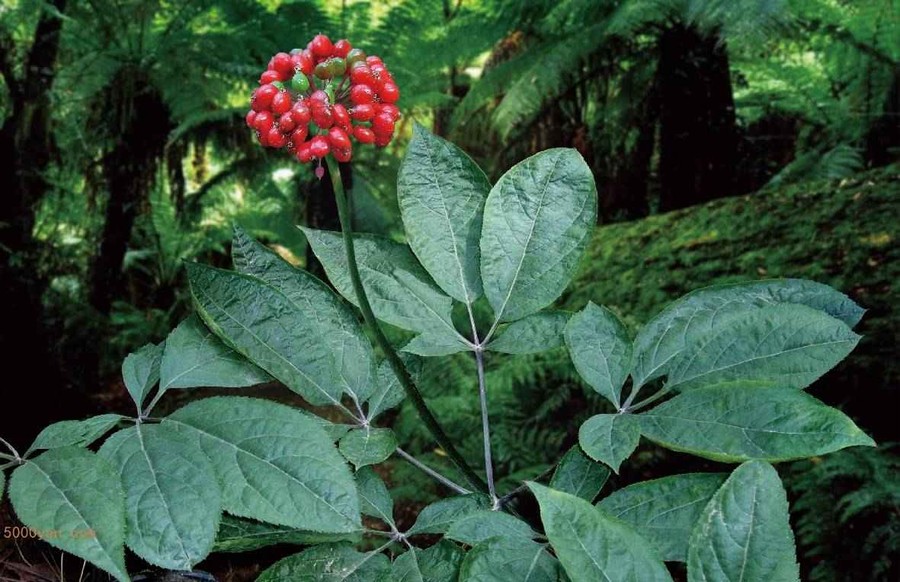
Perennial herb, 30-70 cm tall. Root fleshy, spindle-shaped, with many branches at the end, outer bark pale yellow. Leaves palmately compound, with long petioles; the number of leaflets in the whorl varies with age: generally, first-year plants have one three-foliolate leaf, second-year plants have one five-foliolate leaf, third-year plants have two five-foliolate leaves, and thereafter one leaflet is added each year, up to a maximum of six five-foliolate leaves; leaflets lanceolate, the lower two leaflets smaller, margins finely serrated. Umbel solitary, terminal, each inflorescence with 10-80 or more flowers, forming a spherical cluster; flowers small, calyx green; petals pale yellow-green; ovary inferior. Fruit a drupe-like berry, oblate-spherical. Flowering period May to June, fruiting period June to September.
Habitat and Distribution
It grows under broad-leaved forests or mixed coniferous and broad-leaved forests at altitudes of several hundred meters. It is wild in Heilongjiang, Jilin, Liaoning, and Hebei, and is also introduced and cultivated.
Harvesting and Processing
Mostly harvested in autumn, washed clean, and sun-dried or oven-dried.
Medicinal Properties
The main root is fusiform in shape, 3-15 cm long, 1-2 cm in diameter, with a grayish-yellow surface, bearing coarse transverse striations and longitudinal wrinkles on the upper part or entire body, and 2-3 branch roots at the lower part, with numerous fine fibrous roots attached, often with inconspicuous small wart-like protrusions. The rhizome (Lutou) is 1-4 cm long, 0.3-1.5 cm in diameter, mostly twisted and curved, with adventitious roots and sparse, pit-shaped stem scars (Luwan). The texture is relatively hard, the cross-section is pale yellowish-white and powdery, with yellowish-brown punctate resin canals and radial fissures in the bark. The aroma is distinctive, and the taste is slightly bitter and sweet.
Chemical Constituents
Mainly contains triterpenoid saponins, including ginsenosides, quinquenosides, malonyl-ginsenosides, etc., among which the main ones are ginsenoside Rb.1ginsenoside Re, ginsenoside Rf, and ginsenoside Rg1etc.
Pharmacology
Regulates the physiological functions of the central nervous system; enhances the body's immune function; strengthens the heart and resists shock; protects and stimulates the hematopoietic function of the bone marrow; increases adrenal cortex hormone secretion; regulates blood glucose levels; significantly inhibits cholesterol absorption; anti-tumor, delays aging, and enhances the body's adaptability.
Properties and Channel Entry
Sweet, slightly bitter, slightly warm. Enters the Lung, Spleen, Heart, and Kidney channels.
Functions and Indications
Greatly tonifies the primordial Qi, restores pulse and prevents collapse, tonifies the Spleen and benefits the Lungs, generates body fluids and nourishes Blood, calms the Spirit and enhances intelligence. Used for deficiency with impending collapse, cold extremities and faint pulse, Spleen deficiency with poor appetite, Lung deficiency with wheezing and cough, fluid damage with thirst, internal Heat with wasting-thirst disorder, Qi and Blood deficiency, chronic illness with emaciation and weakness, palpitations and insomnia, impotence and uterine coldness.
Dosage and Administration
Oral administration: decoct 3-10 g, large dose 10-30 g (should be decocted separately and mixed with the decoction of other herbs); or grind into powder, 1-2 g; or make into paste; or soak in wine; or make into pills or powder.
Precautions and Contraindications
Contraindicated in cases of excess patterns, heat patterns, and exuberant internal damp-heat with unweakened healthy Qi. Not suitable for concurrent consumption with tea. Not suitable for concurrent use with Lilu (Veratrum nigrum) or Wulingzhi (Trogopterus dung).
Prescriptions
1. For greatly tonifying Qi and Blood, treating all types of vexation due to deficiency: equal parts of ginseng powder and human milk powder. Make into honey pills, can be dissolved or swallowed. (Fengshi Jin Nang, Shen Ru Wan) 2. For treating Spleen, Stomach, and Kidney Qi deficiency with vomiting and inability to eat: equal parts of ginseng and clove. Grind and sift into powder, take 6 g per dose, taken on an empty stomach with hot rice water. (Pu Ji Fang, Shen Xiang San) 3. For treating deficiency of Nutritive Qi, Defensive Qi, Qi, and Blood: ginseng 9-30 g, Astragalus (honey-wine roasted) 9-18 g, honey-fried licorice 3 g. Decoct in water, take on an empty stomach. (Zhang Shi Yi Tong, Bao Yuan Tang) 4. For treating spontaneous sweating due to consumptive disease: ginseng 45 g, Atractylodes macrocephala 60 g, cinnamon heartwood 21 g. Take 15 g per dose, decoct in water. For severe Yang deficiency, add Aconite. (Chi Shui Xuan Zhu, Shen Zhu San) 5. For treating infantile fright-heat and night sweats: ginseng 3 g, Astragalus 6 g, Chinese angelica 4.5 g. Add one slice of pig heart. Decoct in water. (Ying Tong Lei Cui, Tuan Shen Yin Zi)