Pinyin: Danggui
Aliases
Gangui, Mawei Danggui, Qingui.
Source
Apiaceae plant Angelica sinensisAngelica sinensisDried root of (Oliv.) Diels.
Botanical Description
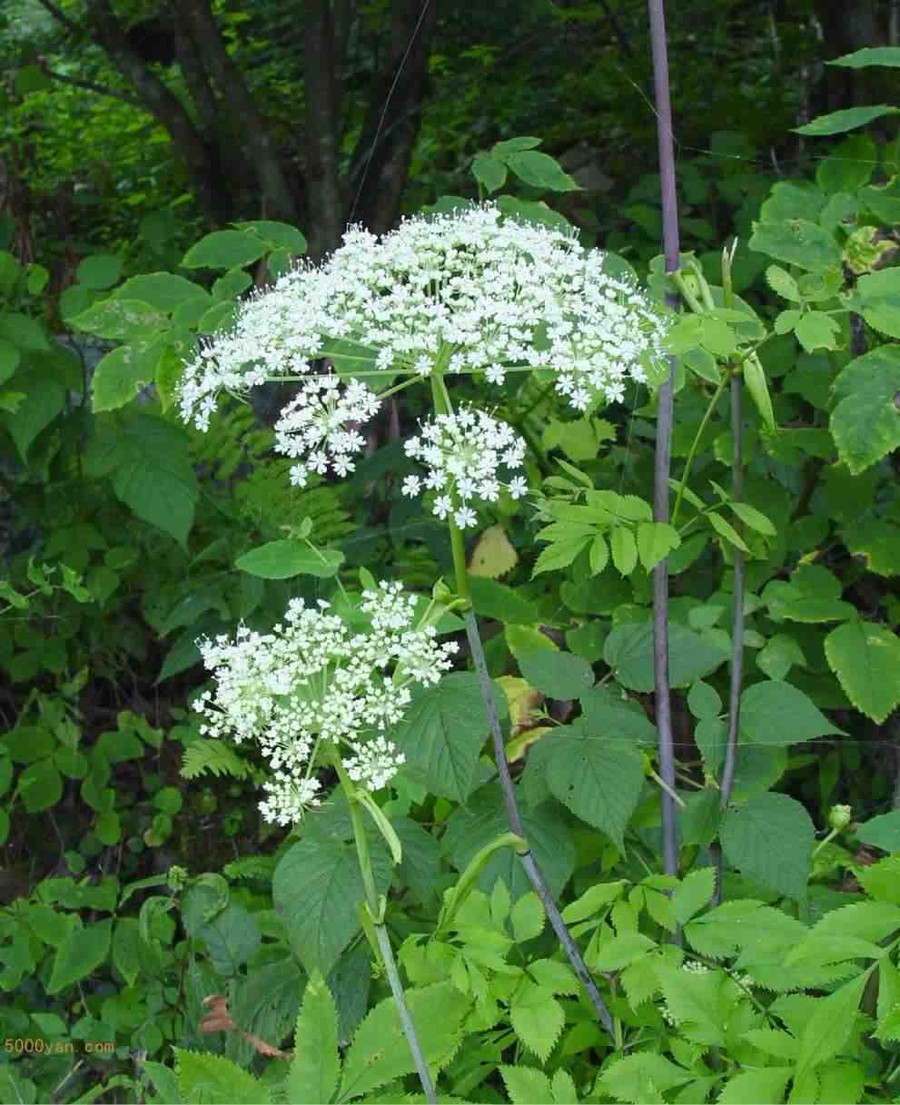
A perennial herb, 0.4-1 m tall. Root cylindrical, branched, with numerous fleshy fibrous roots, yellow-brown, with a rich aroma. Stem erect, green or purple-tinged, with deep longitudinal grooves, glabrous (hairless). Leaves 2-3 times ternate-pinnate; petiole 3-11 cm long, base enlarged into a tubular, membranous sheath; basal and lower cauline leaves ovate in outline, 8-18 cm long, 15-20 cm wide, with 3 pairs of leaflets, the lower pair with petiolules 0.5-1.5 cm long, the upper pair sessile, ultimate segments ovate or ovate-lanceolate, 1-2 cm long, 5-15 mm wide, 2-3 shallowly lobed, margin with incised serrations, teeth with pointed tips, lower surface and margin sparsely covered with white papillose hairs; upper cauline leaves reduced to saccate sheaths and pinnately divided blades. Compound umbels terminal, peduncle densely pubescent; rays 9-30; involucre of 2 linear bracteoles, or absent; umbellets with 13-36 flowers; involucel of 2-4 linear bracteoles; calyx teeth 5, ovate; petals oblong-ovate, apex narrow and acute, inflexed; styles short, stylopodium conical. Fruit ellipsoid to ovoid, 4-6 mm long, 3-4 mm wide, dorsal ribs linear, prominent, lateral ribs forming broad, thin wings as wide as or slightly wider than the fruit body, wing margins pale purple, vittae 1 in each furrow, 2 on the commissure. Flowering June-July, fruiting July-September.
Habitat and Distribution
Cultivated in Shaanxi, Gansu, Hubei, Sichuan, Yunnan, Guizhou, and other regions.
Harvesting and Processing
Harvested in late autumn, remove fibrous roots and sediment, allow some moisture to evaporate, then tie into small bundles, place on racks, and slowly smoke-dry over a low fire.
Medicinal Properties
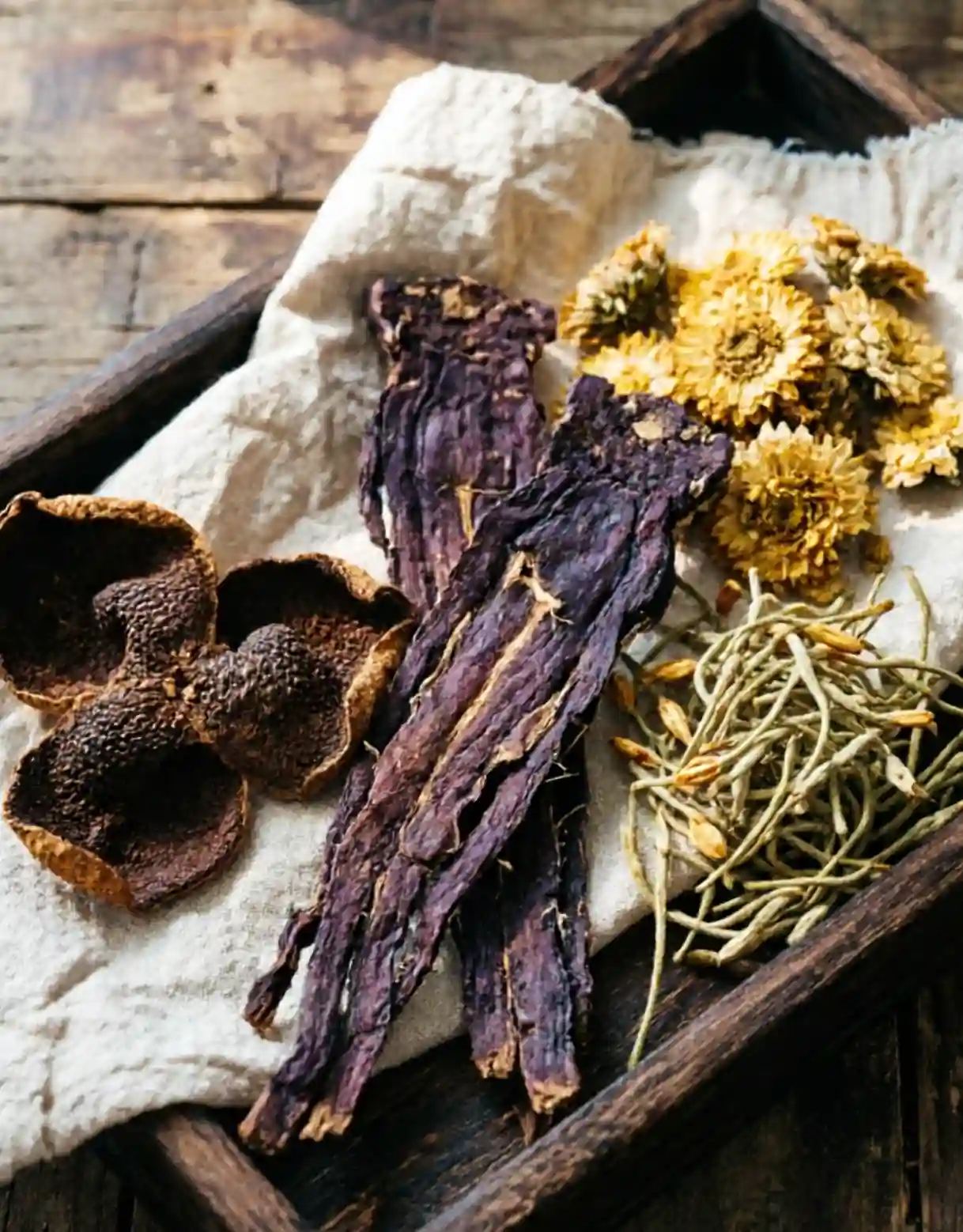
The main root head and primary root are thick and short, roughly cylindrical in shape, 1.5-3.5 cm long, 1.5-3 cm in diameter, with 3-5 or more branched roots below, mostly curved, varying in length, 0.4-1 cm in diameter. The surface is yellowish-brown or brownish-brown, with irregular longitudinal wrinkles and elliptical lenticels; the root head has transverse wrinkles, and the apex retains multiple layers of scaly leaf bases. The texture is hard, easily absorbs moisture and becomes soft; the cut surface is yellowish-white or pale yellowish-brown, with a yellowish-brown cambium ring, numerous brown oil spots and fissures in the bark, and fine and dense medullary rays in the wood. It has a strong aromatic odor, and a taste that is sweet, pungent, and slightly bitter.
Chemical Constituents
This product primarily contains ferulic acid, acetophenone, acorenone, carvacrol, guaiacol, anisic acid, angelica lactone, and ligustilide dimers.
Pharmacology
Reduces platelet aggregation and exhibits antithrombotic effects; promotes hematopoietic system function; lowers blood lipids and resists atherosclerosis; provides antioxidant effects and scavenges free radicals; enhances immune system function; inhibits type I, II, III, and IV allergic reactions; exerts bidirectional effects on the uterus (both excitatory and inhibitory); inhibits prostatic hyperplasia; exhibits anti-gonadotropic effects; protects against radiation damage; demonstrates antitumor activity; provides anti-inflammatory, analgesic, and anti-injury effects; protects the liver, promotes bile secretion, aids digestion, and inhibits gastrointestinal motility; suppresses the nervous system, relaxes tracheal smooth muscle, and exhibits diuretic and antibacterial effects.
Properties and Channel Entry
Sweet, pungent, and bitter in taste, warm in nature. Enters the Liver, Heart, and Spleen channels.
Functions and Indications
Tonifies Blood and activates Blood circulation, regulates menstruation and alleviates pain, moistens the Intestines and unblocks the bowels. Mainly indicated for Blood deficiency with sallow complexion, irregular menstruation, amenorrhea and dysmenorrhea, dizziness and palpitations, deficiency-cold abdominal pain, Wind-Damp Bi pain, dry Intestines with difficult defecation, carbuncles, furuncles, sores, and traumatic injuries.
Dosage and Administration
Oral: decoct in water, 6-12 g; or made into pills or powder; or steeped in wine; or prepared as an ointment. For tonifying blood, use Danggui body; for breaking blood stasis, use Danggui tail; for harmonizing blood, use whole Danggui; for stopping bleeding, use Danggui charcoal; prepared with wine enhances the blood-activating function.
Precautions and Contraindications
Patients with excessive Heat and bleeding should avoid taking this herb, while those with predominant Dampness, abdominal distension, and loose stools should use it with caution.
Prescriptions
1. For menstrual congestion with umbilical and abdominal pain: Danggui and Yanhusuo, equal parts. Coarsely grind into powder. Take 9 g per dose, add three slices of fresh ginger, decoct in water, and take slightly warm. (Xuan Gui San from Ji Yin Gang Mu) 2. For uterine bleeding (beng lou): Danggui, Baishao, Ganjiang, and Zonglu, each charred to preserve its properties, mix with vinegar water, and take before meals. (Bai Yi Xuan Fang) 3. For constipation: Danggui and Baizhi, equal parts, grind into powder. Take 6 g per dose with rice soup. (Sheng Ji Zong Lu) 4. For postpartum spontaneous sweating and night sweats: Danggui 30 g, Huangqi 30 g, Mahuanggen 15 g. Grind into powder. Take 9 g per dose, decoct in water, and take orally. (Danggui Er Huang Tang from Ji Yin Gang Mu) 5. For gangrene of the toe (tuo gu ju): Xuanshen 90 g, Jinyinhua 90 g, Danggui 60 g, Gancao 30 g. Decoct in water and take orally. Take consecutively for 10 doses. (Si Miao Yong An Tang from Yan Fang Xin Bian)