Pinyin: Baiyaozi
Aliases
Baiyao, Baiyaogen, Shanwugui.
Source
Menispermaceae plant *Stephania cepharantha* Hayata.Stephania cep-huranthaDried root tuber of Hayata.
Botanical Description
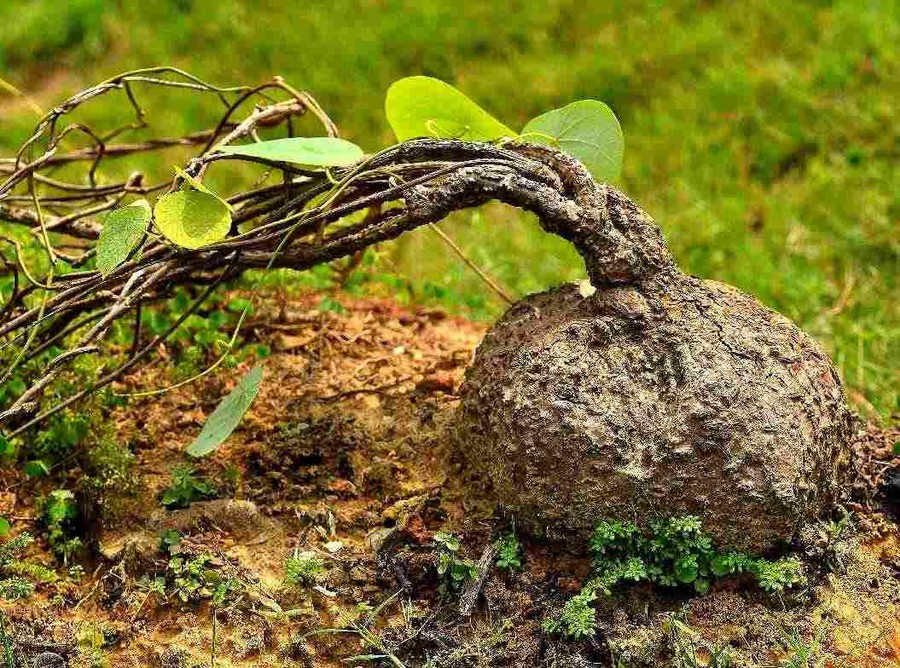
A perennial deciduous vine. The root tuber is thick, elliptical or irregularly blocky, 3-10 cm long and 2-9 cm in diameter. The base of the old stem is slightly woody, with fine grooves, and slightly purple in color; leaves are alternate; petioles are peltate; leaf blades are round-triangular or orbicular-reniform, 5-9 cm long, with width nearly equal to or greater than length; apex obtuse-rounded, often with a small mucronate tip, base slightly concave or truncate, margin entire or slightly undulate, upper surface green, lower surface white-powdery, both surfaces glabrous, with 5-9 palmate veins, papery texture. Flowers are small, unisexual, and dioecious; male plants have compound capitate cymes, axillary, with total peduncle 1-2 cm long, the tip of the peduncle bearing a disc-shaped receptacle, with about 20 flowers; male flowers: sepals 6 (-8), arranged in 2 whorls; petals 3, light green, with 2 large glands on the inner surface; stamens 6, filaments fused into a column, anthers arranged in a ring forming a disc; female plants have simple capitate cymes, axillary, with shorter total peduncle, the tip bearing a disc-shaped receptacle; female flowers: perianth zygomorphic; sepals 1 (-2), borne on one side of the flower; petals 2 (-3); ovary spherical. The drupe is purplish-red, spherical, with a short, fleshy fruit stalk; the endocarp is 4-5 mm in diameter, with 4 rows of small transverse rib-like patterns on the dorsal side. Flowering period is June to July, fruiting period is August to September.
Habitat and Distribution
Growing in fertile and moist grassy areas, shaded places on mountain slopes and roadsides, or in shrub forests, also found on limestone mountains. Distributed in Jiangsu, Anhui, Zhejiang, Jiangxi, Fujian, Taiwan, Hunan, Guangdong, Guangxi, Guizhou, and other regions.
Harvesting and Processing
Harvested year-round or in late autumn to early winter, remove the fibrous roots and soil, wash clean, slice, and sun-dry.
Medicinal Properties
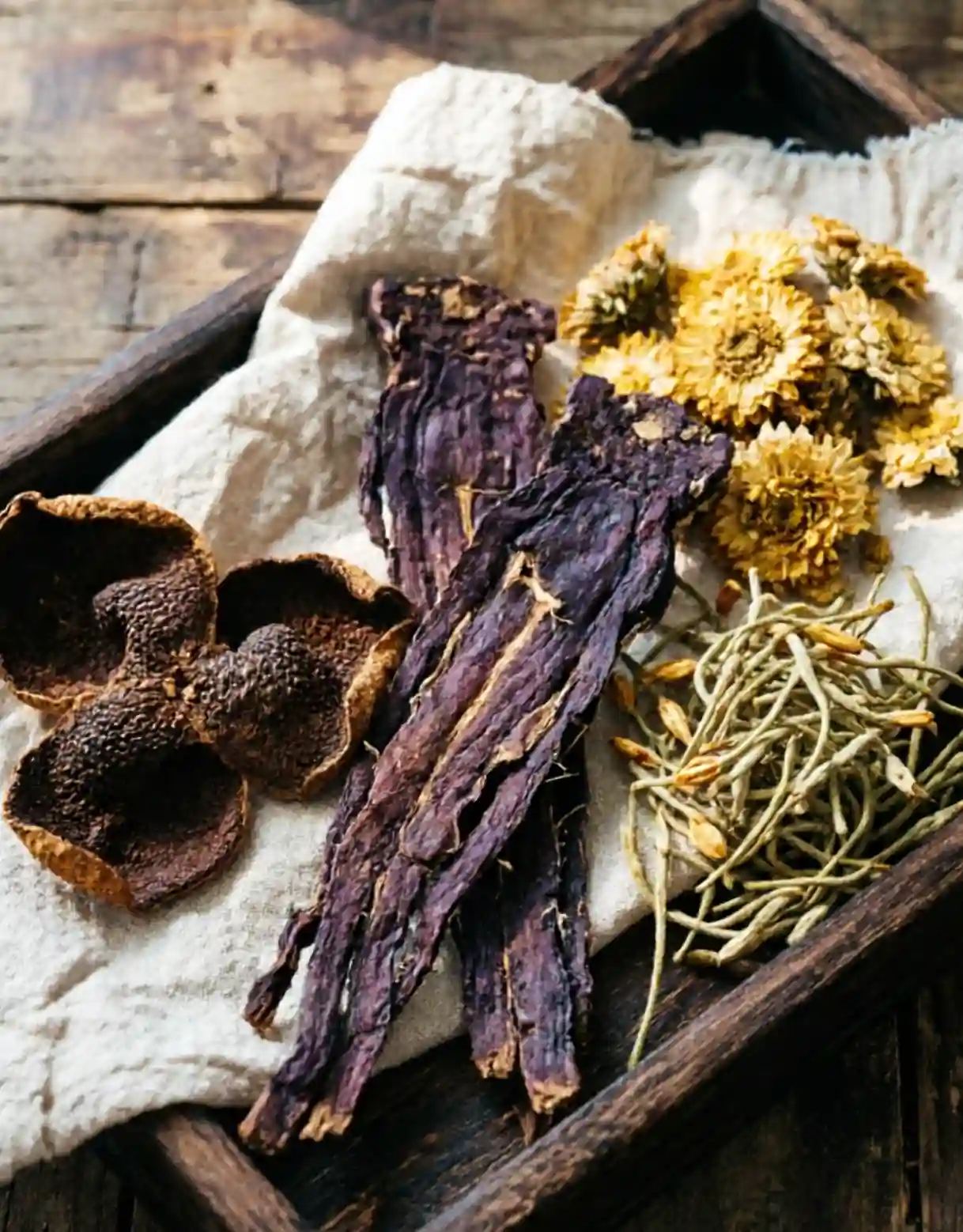
The root tuber is irregularly lumpy or short cylindrical, 2-9 cm in diameter, often with several slightly short cylindrical roots connected below, slightly curved, with constricted transverse grooves, the distal end of the root is sometimes slender, then expands into an elliptical shape, often with several connected in a rosary-like pattern; the top of the root has remnants of the rhizome. Commercially available products are mostly irregular transverse or longitudinal slices, 2-7 cm in diameter, 0.2-1.5 cm thick, with a brown or dark brown surface, wrinkles and rootlet scars, a powdery texture on the cut surface, off-white or grayish-white, with visible vascular bundles arranged in dots or stripes. The texture is hard and brittle, easily broken, with a powdery fracture. Odor: faint; Taste: bitter.
Chemical Constituents
This product contains L-isocorydine, isotetrandrine, cyclanoline, cepharanthine, berbamine and other constituents.
Pharmacology
Has the effects of resolving snake venom, anti-tuberculosis, anti-leprosy, anti-allergic reactions, and promoting bone marrow tissue proliferation.
Properties and Channel Entry
Bitter, acrid, cool, with mild toxicity. Enters the Lung and Stomach channels.
Functions and Indications
Clears Heat, resolves toxicity, expels Wind, alleviates pain, cools Blood, and stops bleeding
Dosage and Administration
Internal: decoct in water, 9-15 g; or prepared as pills or powder. External: appropriate amount, mashed for topical application or ground into powder for application.
Precautions and Contraindications
Contraindicated for those with Spleen deficiency and diarrhea.
Prescriptions
1. For gastric and duodenal ulcers: Baijiaozi 1000 g, Gancao 500 g. Grind into powder, take 3 g three times daily with boiling water. (Hunan Materia Medica) 2. For sprains and contusions: Baijiaozi 30 g, Lianqiancao 30 g, Sanqicao 15 g. Mash and apply to the affected area. (Hunan Materia Medica) 3. For cirrhotic ascites: Baijiaozi (stir-fried with old rice husk) 9 g, Cheqian 15 g, Guoluhuang, Baihuasheshecao, Guazijin, and Danshen each 30 g. Decoct in water and take orally. (Jiangxi Herbal Medicine) 4. For rheumatic arthritis: Baijiaozi 30 g, Wugonglan and Huoxuedan each 15 g. Soak in 500 g of yellow rice wine for 3 days, take 1 tablespoon twice daily after meals. (Zhejiang Folk Commonly Used Herbal Medicine) 5. For insufficient lactation: Baijiaozi ground into powder, take 3 g per dose, mix with pig trotter decoction and take. (Weisheng Yijian Fang)