Pinyin: Jinqiaomai
Aliases
Chidili, Chixueli, Jinsuoyinkai, Zeigutou.
Source
Polygonaceae plant *Fagopyrum cymosum* (golden buckwheat).Fagopyrum dibotrys(D.Don) Hara dried rhizome.
Botanical Description
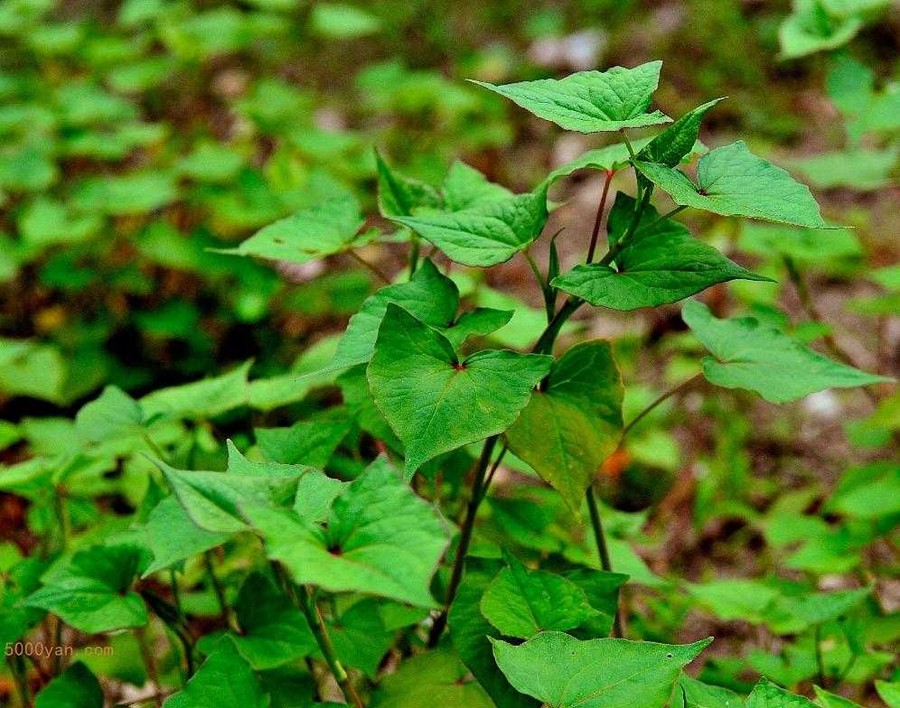
A perennial herbaceous plant with a 0.5-1.5 m tall stem. The main root is thick and large, nodular, creeping, and reddish-brown in color. The stem is erect, much branched, with angular grooves, light green with a slight reddish tint, and the entire plant is sparsely covered with white pubescence. Leaves are alternate, petiolate, with short white pubescence on the petiole; the leaf blade is hastate-triangular, approximately equal in length and width, but the upper leaves are longer than wide, with a long acuminate to caudate apex, a cordate-hastate base, the uppermost leaves are narrow, sessile and clasping the stem, entire or slightly undulate, with fine white pubescence on the veins beneath; the stipular sheath clasps the stem. Small white flowers appear in autumn, arranged in terminal or axillary, slightly branched cymes; perianth segments 5. Stamens 8, in 2 whorls; pistil 1, style 3. The achene is ovoid-trigonous, reddish-brown. Flowering period is July to August, fruiting period is October.
Habitat and Distribution
Born on roadsides and in the shade beside ditches. Distributed in East China, Central-South China, Southwest China, and Shaanxi, Gansu, and other regions.
Harvesting and Processing
Harvested in winter, remove the stem and fibrous roots, wash clean, and sun-dry.
Medicinal Properties
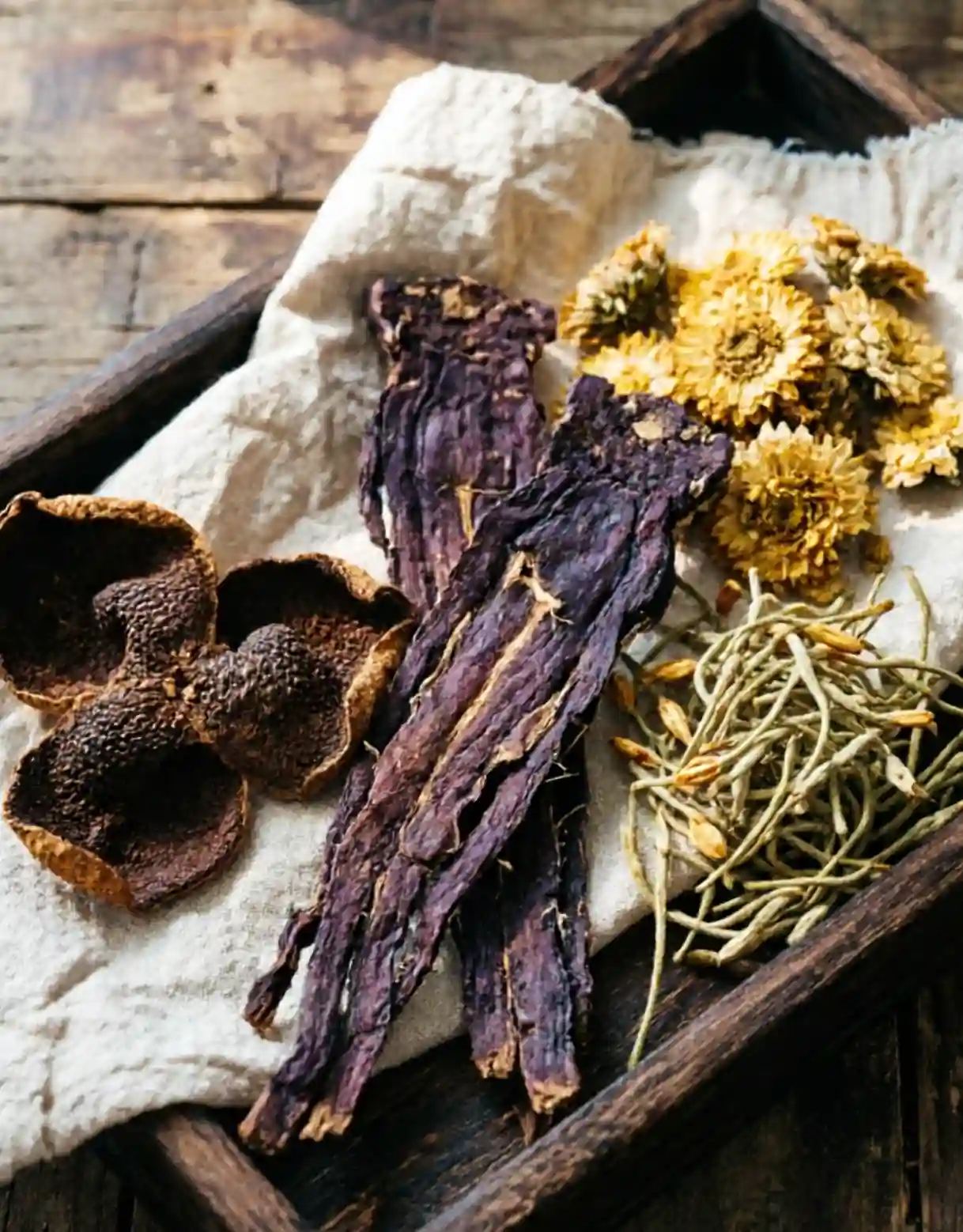
Rhizome irregularly lump-shaped, often with nodular branches, varying in length and size, diameter 1-4 cm. Surface brownish-gray to gray-brown, with dense nodes and irregular longitudinal wrinkles, along with numerous fibrous roots or root scars; apex with stem remnants. Texture hard, not easily broken; cut surface pale yellowish-white to yellowish-brown, with radial striations and a central pith. Odor: faint; Taste: slightly astringent.
Chemical Constituents
This product contains L-epicatechin, procyanidin B2, hecogenin, camphor, linalool,β-β-sitosterol, methyl protocatechuate, and (-)-epicatechin, among others.
Pharmacology
Has anti-cancer, antibacterial, antipyretic, and antitussive effects.
Properties and Channel Entry
Slightly pungent, astringent, and cool in nature. Enters the Lung channel.
Functions and Indications
Clears Heat, resolves toxicity, expels pus, and dispels Blood stasis. Indications: pulmonary abscess with purulent sputum, Lung Heat with wheezing and cough, tonsillitis with swelling and pain.
Dosage and Administration
Internal use: decoct in water, 15-30 g; or grind into powder. External use: appropriate amount, expressed juice or ground juice for topical application.
Prescriptions
1. For traumatic injuries: Jinqiaomai (Fagopyrum cymosum) root 60 g, Suanpanzi (Glochidion puberum) root 30 g, Juyesansanqi (Gynura japonica) 15 g. Decoct in equal parts water and wine, take orally. (Hunan Materia Medica) 2. For low back pain: Jinqiaomai 30 g, Lanxiangcao (Caryopteris incana) 15 g. Decoct in water and take orally. (Hunan Materia Medica) 3. For dysmenorrhea: Jinqiaomai 60 g, brown sugar 30 g. Decoct in water, add brown sugar and take orally. (Hunan Materia Medica) 4. For lung abscess with purulent sputum: Jinqiaomai 30 g, Yuxingcao (Houttuynia cordata) 30 g, Gancao (Glycyrrhiza uralensis) 6 g. Decoct in water and take orally. (Sichuan Chinese Materia Medica, 1982) 5. For bacillary dysentery and amoebic dysentery: Jinqiaomai 15 g, scorched Shanzha (Crataegus pinnatifida) 9 g, raw Gancao 6 g. Decoct and take orally. 1 dose daily, divided into 2 doses. (Hubei Chinese Herbal Medicine)