Pinyin: Shandougen
Aliases
Kudougen, Guangdougen, Nandougen.
Source
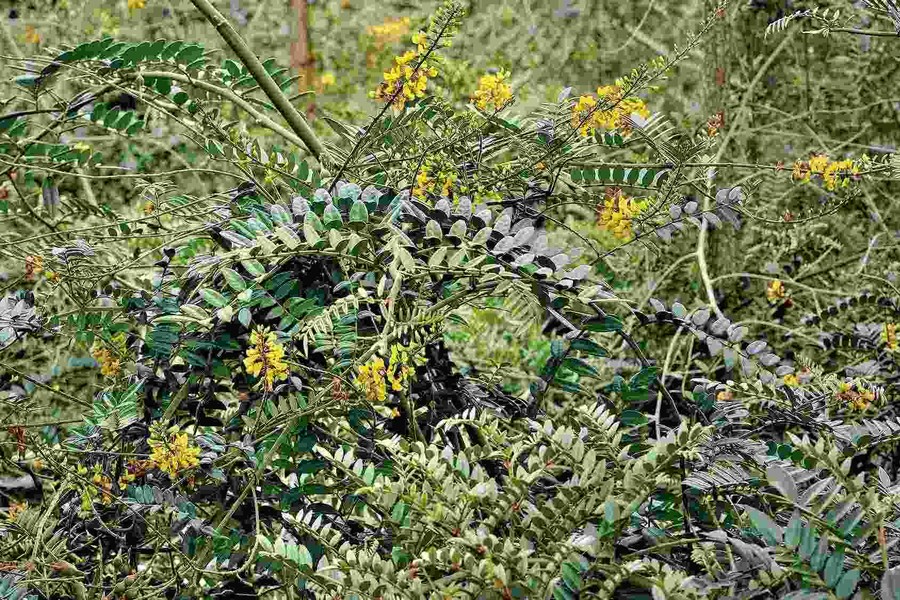
Fabaceae plant Vietnamese SophoraSophora tonkinensisGagnep. dried root and rhizome.
Botanical Description
Small shrub, erect or prostrate, 1-2 m tall. Roots cylindrical, few branches, root bark yellowish-brown. Stems few-branched, densely covered with short soft hairs. Odd-pinnately compound leaves, alternate; leaflets 11-19, elliptical or oblong-ovate, apical leaflet larger, apex acute or short-pointed, base rounded, sparsely covered with short soft hairs above, densely covered with grayish-brown short soft hairs beneath. Racemes terminal, densely covered with short hairs; pedicels about 1 cm long, with fine hairs; calyx broadly campanulate, sparsely hairy outside, apex 5-lobed; corolla yellowish-white, standard ovate, base with short claw, wings longer than standard, base with triangular auricles; stamens 10, free, base slightly broad and flat; ovary stipitate, cylindrical, densely covered with long soft hairs, style curved, stigma round, with long soft hairs. Legumes 2-5 cm long, densely covered with long soft hairs, constricted between seeds, seeds 3-5, black, glossy, elliptical, hilum small. Flowering period May-June, fruiting period July-August.
Habitat and Distribution
Born in mountainous regions and rock crevices at an altitude of 900-1100 m. Distributed in Jiangxi, Guangdong, Guangxi, Guizhou, Yunnan, and other areas.
Harvesting and Processing
Harvested in autumn, remove impurities, wash clean, and dry.
Medicinal Properties
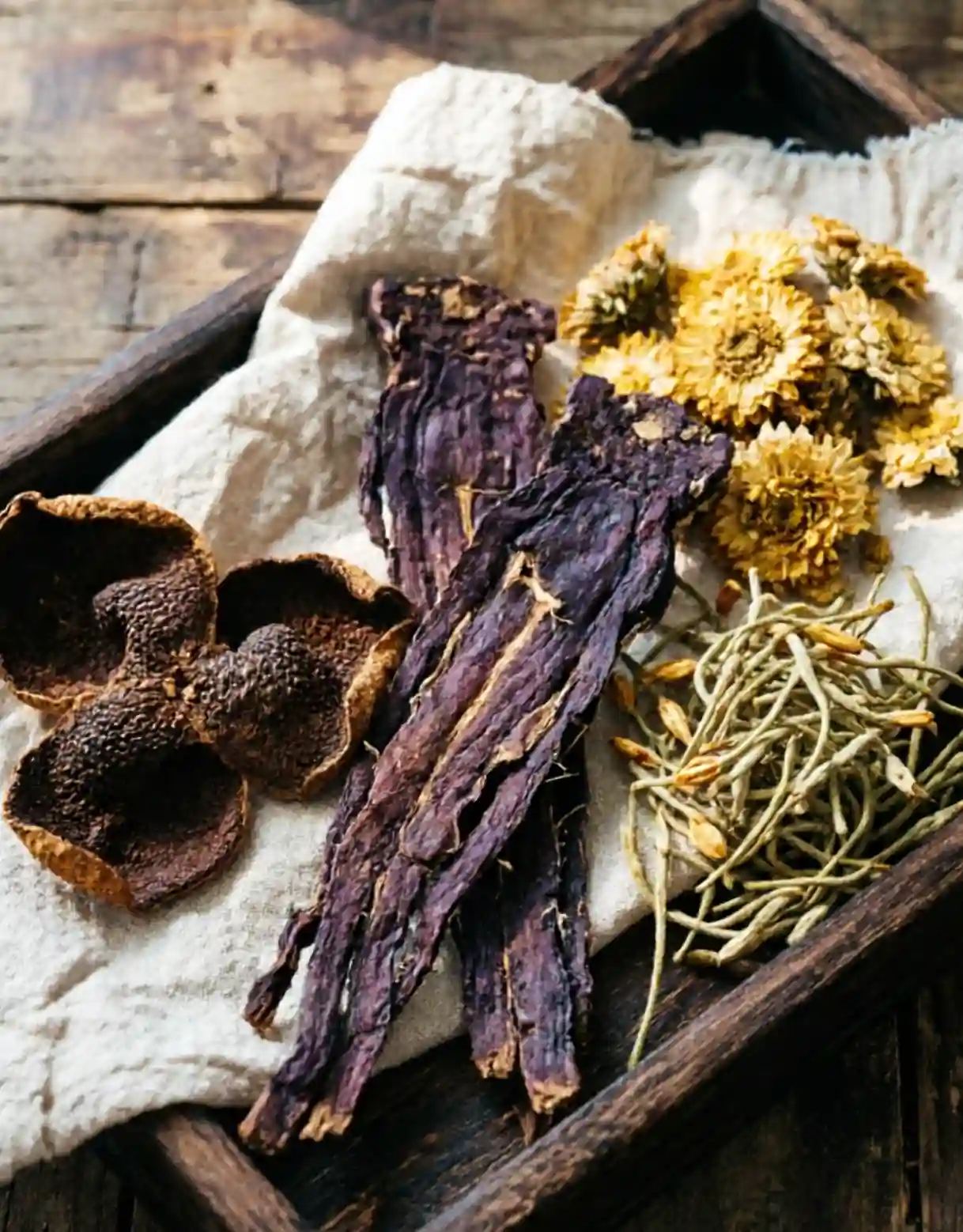
The rhizome is irregularly nodular, often with the remaining stem base at the top and several roots attached below. The roots are long cylindrical, often branched, of varying lengths, with a diameter of 0.7-1.5 cm. The surface is brown to brownish-brown, with irregular longitudinal wrinkles and transversely elongated lenticel-like protrusions. The texture is hard, difficult to break; the fractured surface shows a light brown bark and a pale yellow wood. It has a beany odor and an extremely bitter taste.
Chemical Constituents
This product mainly contains matrine, oxymatrine, racemic sophoridine, anagyrine, methylcytisine, cytisine, lupeol, and other constituents.
Pharmacology
Anti-tumor; enhances immune function; anti-ulcer; inhibits higher central nervous system, stimulates lower central nervous system; has certain toxicity.
Properties and Channel Entry
Bitter, cold; toxic. Enters the Lung and Stomach channels.
Functions and Indications
Clears Heat, resolves toxicity, reduces swelling, and benefits the throat
Dosage and Administration
Internal: decoct 6-12 g; or grind into juice; or grind into powder; or made into pills or powder. External: appropriate amount, hold in mouth for rinsing or mash for application.
Precautions and Contraindications
Those with diarrhea due to deficiency-cold of the Spleen and Stomach should avoid taking this.
Prescriptions
1. For throat obstruction (sore throat): Shandougen (Vietnamese Sophora Root), Shengma (Cimicifuga Rhizome), and Shedan (Belamcanda Rhizome), in equal parts. Take 9 g per dose. Decoct in water, strain, and use as a gargle, swallowing slowly while gargling. (From *Gujin Yitong*, Shandougen Tang) 2. For swollen and painful gums: Shandougen (Vietnamese Sophora Root) 12 g, Baitouweng (Pulsatilla Root) 12 g, and raw Shigao (Gypsum) 15 g. Decoct in water and take orally. (From *Bencao Pianbi*) 3. For toothache: Place one slice of Shandougen (Vietnamese Sophora Root) on the painful area. (From *Beiji Fang*) 4. For cholera: Take Shandougen (Vietnamese Sophora Root) powder, 9 g, with tangerine peel decoction. (From *Beiji Fang*) 5. For laryngeal cancer: Shandougen (Vietnamese Sophora Root) 15 g, Xuanshen (Scrophularia Root) 15 g, Daqingye (Isatis Leaf) 15 g, and Kaijinsuo (Chinese Trumpetcreeper Flower) 30 g. Decoct in water and take orally, one dose daily. (From *Practical Anti-Cancer Handbook*)