Pinyin: Tudahuang
Aliases
Tuxue Cao, Jiuming Wang, Jinbuhuan, Yehao Mai.
Source
Plant of the Polygonaceae family, *Rumex obtusifolius* (Dunye Suanmo).Rumex obtusifolius L. dried root.
Botanical Description
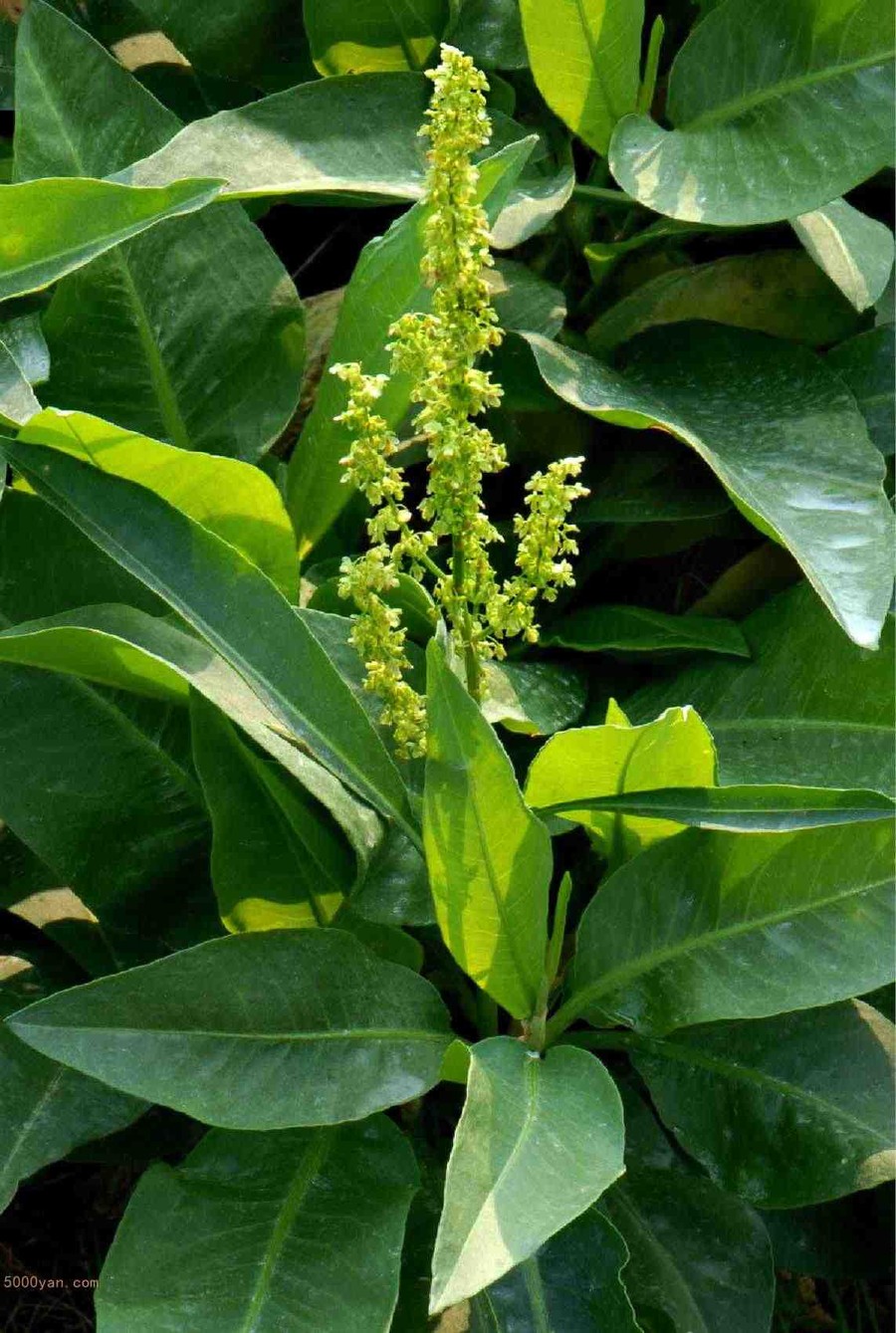
Perennial herb. Root thick and large, yellow in color. Stem stout and erect, about 1 m tall. Basal leaves large, with long petioles; stipules membranous; leaf blades ovate or ovate-oblong; cauline leaves alternate, ovate-lanceolate or ovate-oblong, upper cauline leaves gradually smaller, becoming bracts. Panicle inflorescence, flowers small, purple-green to green, bisexual, verticillate and racemose; perianth segments 6, pale green, in 2 whorls, persistent, outer 3 segments lanceolate, inner 3 segments enlarging with fruit into fruit perianth, margin toothed, midrib with warty protrusions; stamens 6; ovary 1-loculed, angled, styles 3, stigmas hairy. Achene ovoid, 3-angled, tea-brown. Seed 1, flowering and fruiting period May to July.
Habitat and Distribution
Grows on wild slopes and hillsides. Distributed in Jiangsu, Anhui, Zhejiang, Jiangxi, Henan, Hunan, Guangxi, Guangdong, Sichuan, Yunnan, and other regions.
Harvesting and Processing
Harvest the root from September to October, remove soil and impurities, wash clean, slice, and air-dry or use fresh.
Medicinal Properties
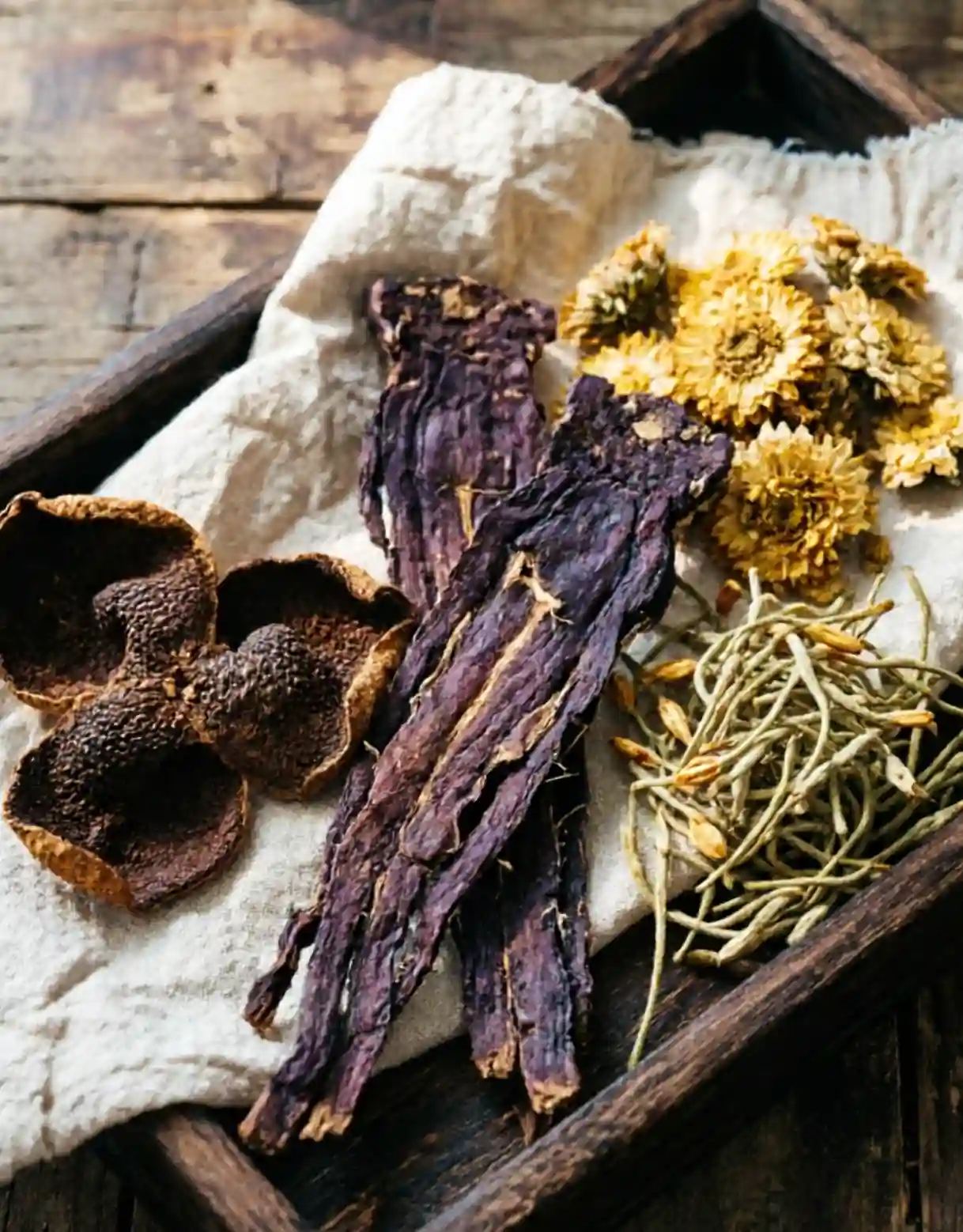
Rhizome short and stout, approximately 3 cm in diameter, with a few branches, apex with remnants of stem bases and leaf bases appearing as brown scales and fibrous hairs, some with lateral buds and fibrous roots, and a few transverse striations. The root head is elongated conical, approximately 17 cm long, up to 1.8 cm in diameter, surface brown to brownish-brown, upper part with transverse striations, lower part with numerous longitudinal wrinkles, scattered with transverse elongated lenticel-like scars and punctate fibrous root scars. Texture hard, fracture yellowish, showing a brown cambium ring and radiate striations. Odor: faint; Taste: slightly bitter.
Chemical Constituents
This product mainly contains emodin, physcion, chrysophanol, rumicin, 6-O- Malonyl-β- Methyl-D-glucopyranoside, ascorbic acid and other components.
Pharmacology
Has antibacterial and hemostatic effects, among others.
Properties and Channel Entry
Bitter, acrid, and cool in nature.
Functions and Indications
Clears Heat, resolves toxicity, cools Blood and stops bleeding, removes stasis and reduces swelling, unblocks the bowels, and kills parasites. Indications: hemoptysis due to pulmonary tuberculosis, lung abscess, hematemesis, abdominal pain due to blood stasis, traumatic injury, constipation, mumps, carbuncles and furuncles, burns, scabies and tinea, and eczema.
Dosage and Administration
Oral: decoct in water, 10-15 g. External: apply appropriate amount, mash and apply or grind and apply the juice.
Prescriptions
1. For lower abdominal stasis pain: 9-15 g of Rumex obtusifolius root. Decoct with equal parts wine and water for oral administration. (Hainan Materia Medica) 2. For burns: 15 g of Rumex obtusifolius and 15 g of Sanguisorba officinalis, ground into fine powder, add 0.3 g of borneol. Mix with vegetable oil for topical application. (Sichuan Chinese Materia Medica, 1982) 3. For thrombocytopenia: 15 g of Rumex obtusifolius. Decoct in water, one dose daily, divided into three portions. (Qingdao Handbook of Chinese Herbal Medicine) 4. For cough with hemoptysis and traumatic bleeding: 15-21 g of Polygonum chinense, finely chopped with lean pork, made into meat patties, steamed in a double boiler, and eaten. (Chinese Medicine Experimental Research) 5. For dermatitis and eczema: Appropriate amount of Rumex obtusifolius. Decoct in water for washing. (Guangzhou Military Unit Common Chinese Herbal Medicine Handbook) 6. For mumps: Appropriate amounts of fresh Rumex obtusifolius root and fresh Semiaquilegia adoxoides root, with a little distiller's grains, mashed and applied externally. (Jiangxi Herbal Medicine) 7. For lung abscess: 30 g of Polygonum chinense root. Extract juice, decoct with wine, and take orally; recovery after three doses. (Bai Cao Jing) 8. For tinea and leprosy: Soak Rumex obtusifolius root in lime water for 2 hours, then apply with vinegar. (Hunan Materia Medica)